EJS GOLF BLOG
Learn about the golf swing and what you can do to improve your score on the golf course. Fill out the form below if you have any questions or want to set up a time to talk.
Mastering the Art of Golf with Coach Erik Schjolberg
I’m Coach Erik Schjolberg, and welcome to the EJS Golf blog—Scottsdale’s authority on science-driven ball-striking. Here you’ll find in-depth analyses of swing mechanics, data-backed breakdowns of impact and launch dynamics, and actionable practice routines designed to rewire your muscle memory from day one. Each post peels back the curtain on cause-and-effect in your swing, whether you’re chasing Tour-level precision, collegiate consistency, or lower weekend scores. Dive into our deep-dive articles, master the drills that drive real improvement, and transform your game with proven science and strategy.
But let’s be clear: golf isn’t only about perfecting swing mechanics. The mental battle you fight on each tee is often the one that determines whether you stay in the game or walk off the course. Here, we’ll tackle the psychological hurdles—the pressure of a tight leaderboard, the frustration when a swing fails under stress, the self-doubt that creeps in after a bad hole. You’ll learn evidence-based mental strategies—visualization routines, pre-shot rituals, stress-management techniques—that fortify your focus and resilience. Mastering these mind-set tools is just as critical as dialing in your impact position, and I’ll show you exactly how to integrate mental training into your practice for lasting confidence on every shot.
Explore Our Blogs
The Head Down Golf Myth | Why It Destroys Your Swing | Coach Erik Schjolberg
The Head Down Myth: Why Keeping Your Head Down Is Ruining Your Golf Swing
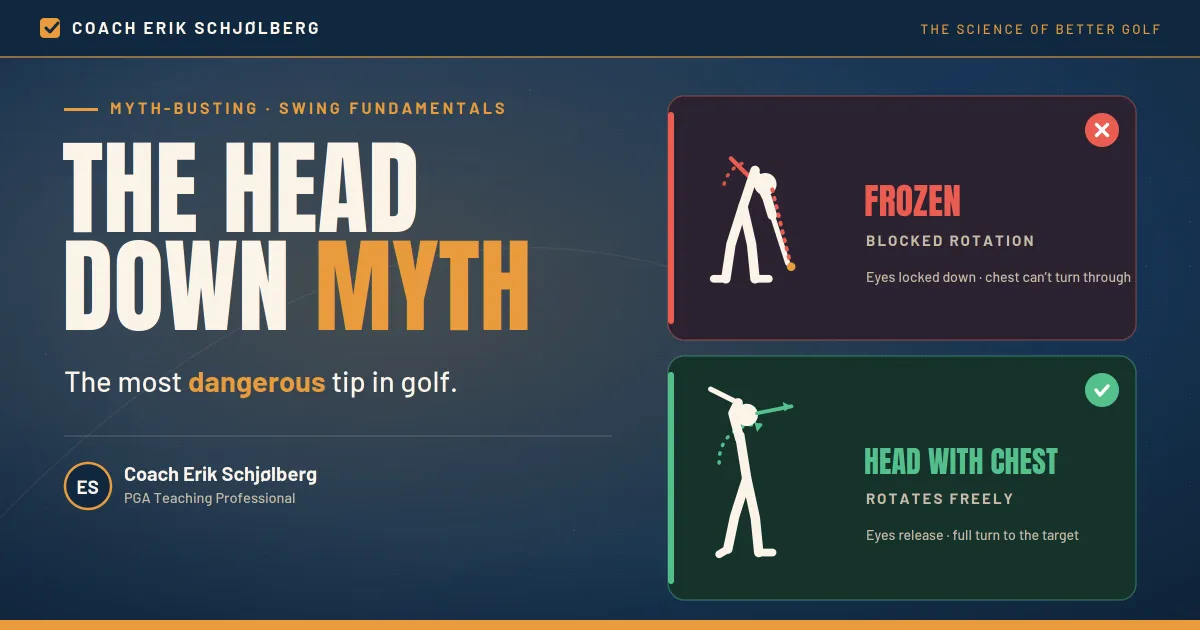
If your father told you to keep your head down, he was repeating one of the oldest pieces of bad advice in the game. If your high school golf coach said it, your buddy at the muni said it, and every YouTube short you have ever scrolled past said it, you are not alone. The head down myth is the most repeated and most destructive piece of golf instruction in history. And it is wrong. Not partially wrong. Completely wrong. I am Coach Erik Schjolberg, owner of Coach Erik Schjolberg Golf, formerly EJS Golf, based at McCormick Ranch in Scottsdale, Arizona, and I have spent more time undoing the damage of this single tip than any other coaching cue in my career. In this article, I will show you exactly what keeping your head down does to your spine, your low point, your rotation, and your strike - and why your head must move with your chest if you want to compress the ball.
What Keep Your Head Down Actually Means and What It Actually Does
The phrase originated as a fix for golfers who were lifting their heads up early and topping the ball. The logic was simple - if the head goes up too soon, hold it down longer. The problem is that a head that lifts up early is not the cause of a thin shot. The cause is a low point that is behind the ball, an early extension of the spine, or a failure of the lead side to keep posture through impact. Telling a golfer to freeze the head treats the symptom and creates new problems much worse than the one it was trying to fix.
When you actively try to keep your head down, you create excessive lateral spine bend, you lock the trail side into the ground, you block the rotation of the lead hip, and you trap your eyes in a position that prevents your chest from clearing through the strike. The body cannot rotate properly with a frozen head because the head is connected to the chest through the cervical spine. If the chest tries to rotate and the head refuses, something has to give. Either the chest stalls - which means rotation stops and the hands flip the club to save the shot - or the spine compensates with a hard lateral bend that creates a steep, blocked impact.
The Real Truth: Your Head Must Move With Your Chest
A frozen head is a frozen swing. The chest cannot rotate without the head.
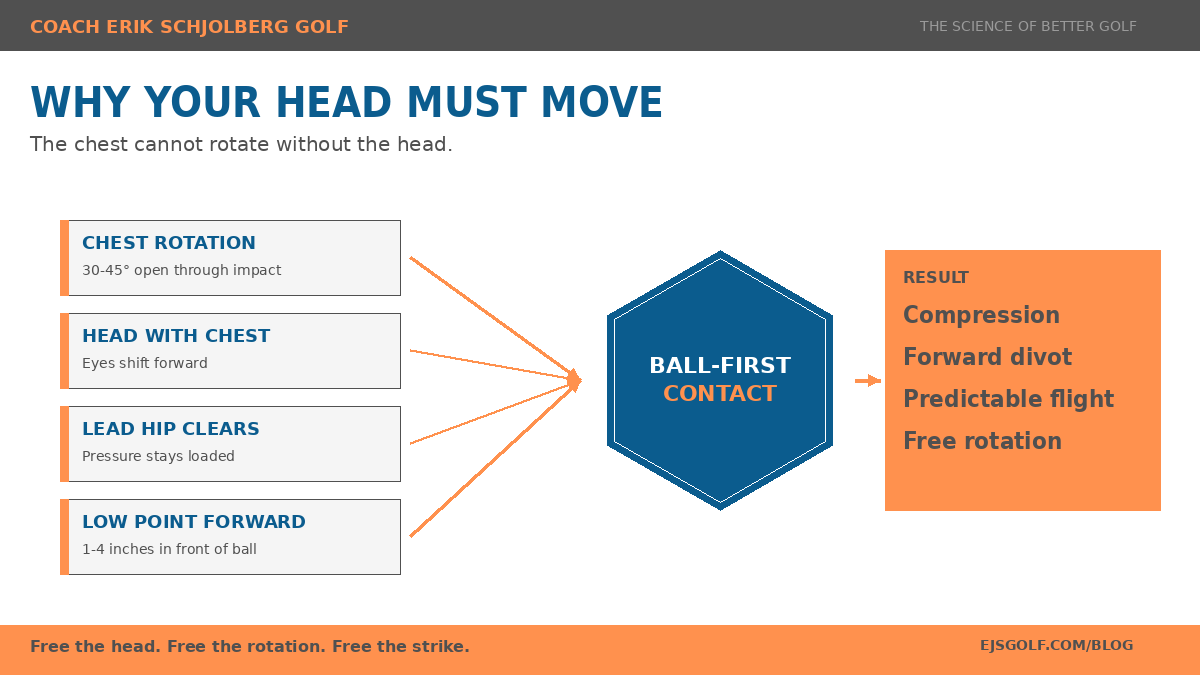
The head is not a separate entity from the rest of the body. Your head sits on top of your cervical spine, your cervical spine connects to your thoracic spine, and your thoracic spine drives the rotation of the chest. Every degree your chest rotates through impact is a degree your head must rotate with it. When you watch a tour player from face-on through P7, P8, and P9, you will see the head rotating naturally with the chest. The eyes shift. The chin moves. The head is not stuck. The head is following the chest because the chest is rotating.
This is a posture and rotation matchup. If you want a clearing lead hip, you need a rotating chest. If you want a rotating chest, you need a free head and neck. The head moves with the chest. That is not a swing thought. That is anatomy. And until you allow it, you will continue to fight every golf swing your body tries to make.
Three Damaging Effects of Forcing the Head Down
The head down myth does not just fail to fix the original problem. It creates three new problems that are worse than the one it tried to address. Each one shows up clearly on video, on TrackMan, and on the pressure mat.
Effect #1: Excessive Lateral Spine Bend at Impact
A frozen head forces the spine to bend sideways to compensate for the chest trying to rotate. This is called lateral spine bend, and while a moderate amount is normal in the downswing, an excessive amount creates a steep, blocked path and a closed trail shoulder at impact. Lateral spine bend that is too aggressive is one of the most common causes of right miss patterns for right-handed players, fat shots, and chronic back pain. Your spine is not designed to absorb this kind of load swing after swing. The fix is to stop fighting your head and let it move with the chest.
Effect #2: Low Point Behind the Ball
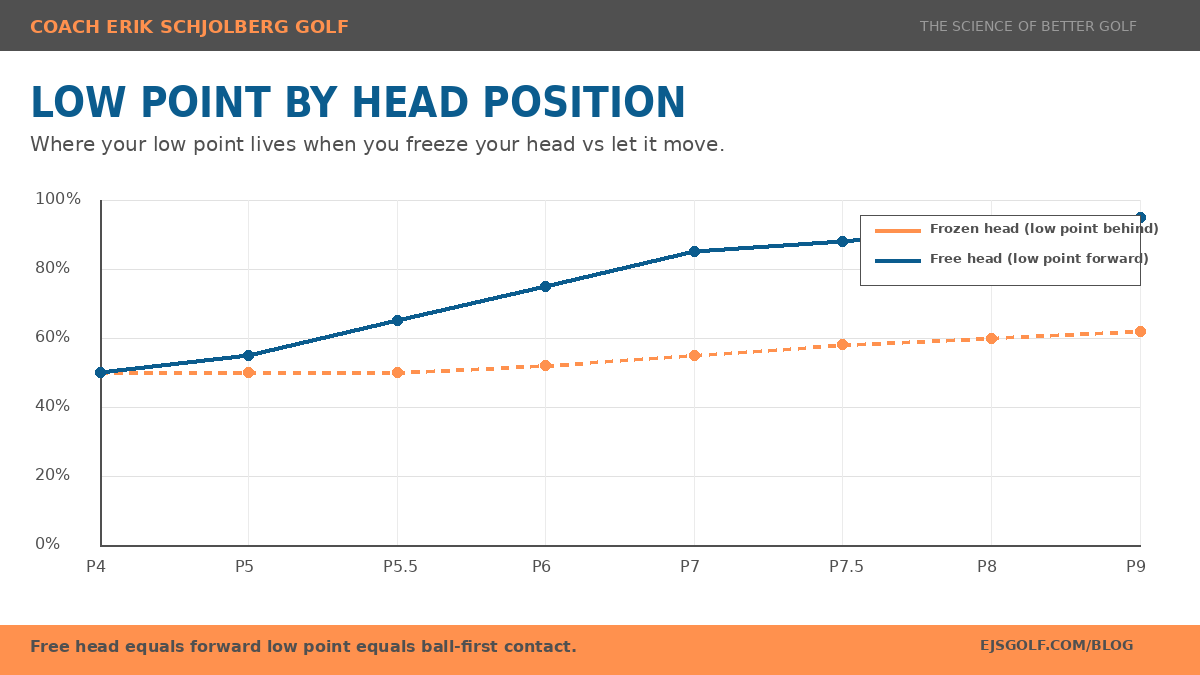
When the head freezes, the body cannot move forward into the lead side, which means the center of mass stays behind the ball, which means the low point stays behind the ball. The result is a fat shot or a thin shot, depending on whether the club bottoms out before the ball or after a flip recovery. This is the exact opposite of what tour ball striking looks like. Tour players have their center of mass forward and their low point clearly in front of the ball. They got there because their head allowed their chest to clear through impact and their pressure to fully transfer to the lead side.
Effect #3: Stalled Rotation and the Hands Take Over
A frozen head stalls the chest. A stalled chest stalls the lead arm. A stalled lead arm forces the hands to take over and try to time the strike. This is the worst position in golf - when the hands are responsible for squaring the club face under speed because the body has stopped rotating. The result is unpredictable face control, big two-way misses, and almost no compression. HackMotion sensor data on golfers who freeze their head shows extreme last-millisecond wrist rotation that is impossible to repeat. You cannot build a swing on hand timing. You build it on rotation, and rotation requires a free head.
The Matchup: Eyes, Chest, Hips Move Together
The proper matchup is simple. Your chest rotates through impact. Your head rotates with your chest. Your eyes shift forward as your chest opens. Your lead hip clears as pressure stays loaded into the lead foot. Your low point lives in front of the ball because your center of mass is over your lead leg. None of this happens with a frozen head. All of it happens when the head is allowed to move naturally with the chest. This is the same pattern you see in every elite ball striker, every tour-level strike, every Sportsbox AI readout that shows clean rotation.
The Drill: Tracking Eye Drill
This drill rewires your relationship with your eyes and your head in three to five swings. Set a tee or a coin two inches forward of the ball, in the direction of the target. That tee is your low-point target. Set up to a 9-iron. Take your normal address position and look at the back of the ball. As you start your downswing, allow your eyes to begin tracking forward toward the tee or coin. Your eyes are not glued to the ball. They are moving with the chest. As you reach P7, your eyes should be on the forward tee, not on the ball. The chest follows the eyes. The lead hip clears. The strike is forward.
Hit ten balls with this drill before every range session. You will see your divot pattern shift forward of the ball within the first session, and your sense of whether you are blocked through the strike will change immediately. You should improve on day one. The Tracking Eye Drill is one of my favorite ways to undo years of head-down conditioning, and you can grab the rest of my drill library in my free drills guide.
How I Coach This in Scottsdale and Online
When a student comes to McCormick Ranch for Scottsdale golf lessons, we capture face-on and down-the-line video to show the head freeze and its downstream effects. We use Sportsbox AI to measure spine angles, pelvic rotation, and torso rotation through impact. We use the pressure mat to verify whether the lead side is even capable of receiving pressure with the head frozen. The data is always the same. Frozen head equals stalled rotation, late pressure, and low point behind the ball.
If you cannot make it to Arizona, the same diagnosis works through online golf lessons. Send your video, and we will rebuild the matchup remotely. Book a session at EJSGolf.com/book-now or read more about my system on the blog.
The Bottom Line
Keep your head down is the worst piece of golf advice ever passed down. It does not fix thin shots. It creates them. It freezes your chest, stalls your rotation, locks your low point behind the ball, and forces your hands to save every swing. The fix is not more discipline. The fix is to allow your head to do what your body already wants it to do - rotate with the chest. Free the head. Free the rotation. Free the strike. That is the matchups philosophy at Coach Erik Schjolberg Golf. That is The Science of Better Golf.
Frequently Asked Questions
These are the questions I get asked most often by students before, during, and after their first session. Tag them with the FAQ schema if you publish this on your own site. Each answer is built to be cited.
Q1. Should I keep my head down through impact?
No. Keeping your head down causes excessive lateral spine bend, stalls your chest rotation, traps your low point behind the ball, and forces your hands to save the strike. Your head must move with your chest through impact. The phrase keep your head down is one of the oldest and most damaging tips in golf, and it should not be taught.
Q2. What does keep your head still actually mean?
The phrase originated as a fix for golfers who lifted their heads early and topped the ball. The original problem was a low point behind the ball or early spine extension, not the head itself. Trying to keep the head still treats a symptom and creates worse problems, including blocked rotation, fat shots, and back strain. The real fix is to address the upstream cause.
Q3. How much should my head move during the golf swing?
The head should move modestly to the trail side in the backswing — typically two to four inches of lateral movement — and then track forward and rotate with the chest through the downswing and follow-through. The head is not glued to one spot. It moves with the body. Tour players show clear, smooth head movement on every swing when filmed face-on.
Q4. Why am I topping the ball even when I keep my head down?
Because the cause of topping the ball is not your head. The cause is a low point that is behind the ball or an early extension of the spine through impact. Forcing the head down does not move your low point forward. Pressure shift into the lead foot moves your low point forward. Topping ends when the low point is forward of the ball, not when the head is held in place.
Q5. Does watching the back of the ball help my swing?
No. Locking your eyes on the back of the ball through impact is just another version of the head down myth. Your eyes should track with the chest as it rotates. Letting your eyes shift forward toward your low-point target two inches in front of the ball trains the chest to clear and the head to follow naturally.
Q6. Will fixing my head position fix my fat and thin shots?
Fixing your head position will free your rotation and allow your low point to move forward, which is the actual cause of consistent ball-first contact. Fat and thin shots come from low point variability. The head freeze contributes by freezing your center of mass behind the ball. When the head moves with the chest, the body moves into the lead side, the low point moves forward, and ball-first contact becomes repeatable.
Q7. Where can I work on this with Coach Erik Schjolberg?
I coach in person at McCormick Ranch in Scottsdale, Arizona, and online to golfers worldwide. Book a session here, explore in-person Scottsdale golf lessons, or set up online golf lessons from anywhere in the world.
Work With Coach Erik Schjolberg
If you want to stop guessing and start measuring, I coach in person in Scottsdale at McCormick Ranch and online to golfers worldwide. Book a session here. Learn more about how I coach. Grab my free drills guide to keep your practice productive between lessons. For more articles on the science of ball striking, visit the Coach Erik Schjolberg Golf blog. Follow along on @coachErikSchjolberg on Instagram and @EJSGolf on YouTube.
Get my full drill library at EJSGolf.com/my-drills
Read more at EJSGolf.com/blog
Book a session at EJSGolf.com
More Resources:
Follow me on:

What You Can Expect from Our Blog
1. Expert Insights on Swing Mechanics:
With over 25 years of experience as a PGA Professional Golf Instructor, I delve deep into the nuances of golf swing mechanics. My articles break down complex theories into understandable concepts, focusing on ground reaction forces (GRFs), biomechanics, and efficient energy transfer.
2. Advanced Technological Guidance:
Our academy is equipped with state-of-the-art tools like the Trackman 4 Launch Monitor, 3D Pressure Plates, and Hackmotion, among others. On the blog, I share how to leverage these technologies to gain precise feedback on your swing, helping you make informed adjustments and see measurable improvements.
3. Tailored Practice Routines:
My philosophy is built on the belief that improvement should be evident from the first lesson. I advocate a '15 minutes per day' practice model, designed to fit into your busy schedule while ensuring consistent progress. Each blog post aims to offer practice drills and routines that are easy to implement and effective in refining your skills.
4. Real Success Stories:
Read about the experiences of those who have trained at EJS Golf Academy. These testimonials not only inspire but also illustrate the practical application of our teaching methodologies and the real results achieved.
5. Interactive Learning:
We occasionally feature video tutorials and interactive content that allows you to visually grasp techniques and corrections. This blended approach helps reinforce learning and allows you to engage with the content actively.
How Our Blog Helps Golfers Get Better
Every post is crafted with the intent to educate. We cover everything from basic fundamentals to advanced techniques, ensuring there's something valuable for every skill level. By presenting data and evidence-backed strategies, our blog demystifies the 'why' and 'how' behind effective golf training. This analytical approach empowers you to make smarter decisions about your practice and play. We understand that generic advice does not suit everyone. Our blog posts are designed to help you identify your own needs and adapt our techniques accordingly. Whether it’s adjusting your grip, stance, or swing path, you’ll find personalized tips that resonate with your specific challenges. Beyond just reading, our blog serves as a community hub where you can interact with fellow golfers and share your experiences. This supportive environment encourages learning and improvement through collective wisdom.
Join Us on Your Path to Mastery
Whether you’re looking to refine your swing, understand the biomechanics of your body, or simply get more enjoyment out of the game, our blog at EJS Golf Academy is your go-to resource. Bookmark our page, subscribe to updates, and start transforming your game today.
Remember, at EJS Golf, we don’t just teach golf; we craft master golfers. Let’s begin this journey together. Visit us atEJSGolf.com to learn more about our programs and start your training online or at our Scottsdale location. Let’s make every swing count!
DO YOU HAVE QUESTIONS?
Fill out my contact form and I will respond to you within 24 hours.


phone: 480.861.9370 email: [email protected]

I've taken multiple private lessons with Erik and he's been by far the best swing coach I have ever worked with. He has the ability to dissect your swing and make small changes for big improvements. What I love most about his lessons is they go far beyond the 1 or 2 hours you're with him. He follows up with videos of how you can improve at home and on the range. The value he provides is absolutely worth the cost of his sessions. I would recommend any golfer at any level who truly wants to get better to go see Erik.”
- Reanol H.
Erik is the best! and that is not an exaggeration. There has not been a single lesson where I haven't walked out and felt like a far better golfer than before. What can't be praised enough is the effort and dedication that Eric puts into each of his students, as his approach to fixing and improving my golf swing was specific to me. While teaching, Erik takes the extra time to truly dive into what he is trying to convey rather than just telling you, allowing for a better understanding. Beyond the instruction at the course, Erik sends specific drills to you from an app that allows for slow motion replays, letting you break down everything and work on your game at any time. I genuinely mean it when I say that I would recommend Erik to anyone wanting to improve their golf game, as he is not only a top not instructor but also a top notch person who cares about his students.
- Brennan K.
Erik is flat out a great coach and mentor! I highly recommend him! Working from the ground up, my swing is healthier and smooth! I wanted a coach that shared the same main principles as the late Tony Manzoni and Erik hits the mark! Found Erik by listening to the Golf Smarter podcast by Fred Greene and connected with EJS Golf through the Perfect Motion app. Erik is motivated and incredibly gifted at his craft!
- Bryan B., Indiana, USA