The Rotation Fallacy in Golf | Why Hip Rotation Won't Fix Your Swing
The Rotation Fallacy: Why Trying to Open Your Hips More Will Never Fix Your Swing and What Vertical Force Actually Does
Almost every amateur golfer I work with at McCormick Ranch tells me the same thing in their first session. They say they need to rotate more. They say their pro told them to open their hips by impact. They say they have been trying to fire their hips through the ball for years, and nothing has changed.
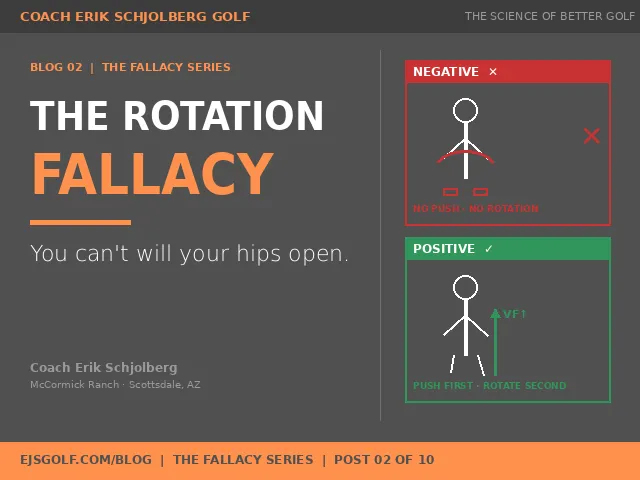
Here is the truth most golfers have never heard. You cannot fix a rotation problem by trying to rotate harder. Trying to open your hips more by impact is going to cause more problems than it will solve. The fallacy lies in the idea that a golfer can simply will their hips to open faster. That never works.
I am Coach Erik Schjolberg. I run Coach Erik Schjolberg Golf, formerly EJS Golf, out of McCormick Ranch in Scottsdale, Arizona, and in this article, I am going to show you why hip rotation is a consequence of the lead leg pushing into the ground - not a willed action - and what you actually need to fix to unlock face stability, compression, and speed.
What Hip Rotation Actually Is and Why You Don't Have It
Pelvic rotation in the golf swing is the angular motion of your pelvis around your spine through the downswing and into impact. On Sportsbox AI body parameter readouts, you can see exactly how many degrees your pelvis rotates from P4 to P7, how it relates to torso rotation, and where the X-factor stretch lives between them. Tour-level pelvic rotation typically opens between forty and fifty-five degrees by impact, depending on the player. The fallacy is in assuming that you can hit those numbers by simply trying harder to spin your hips.
The reality is that the pelvis is not a free-floating object you can spin in space. Your pelvis is anchored to the ground through your legs. The only way the pelvis rotates is when one or both legs apply force to the ground in the right sequence. If your lead leg is not pushing vertically into the ground between P5 and P6, your pelvis has nothing to rotate against. You can stand in front of a mirror and try to fire your hips all day. Without ground force production from the lead leg, the pelvis will stall. And when the pelvis stalls, the entire kinetic chain above it stalls with it.
The Critical Truth: Rotation Is a Consequence of the Lead Leg Push
Rotation is not the cause. Rotation is what happens when your lead leg pushes the ground.
Read that pull quote again. Hip rotation is what happens AFTER the lead leg pushes vertically into the ground. The push comes first. The rotation follows. This is not an opinion. It is biomechanics. Dr. Young-Hoo Kwon's published work on three-dimensional kinematics, the research coming out of force-tracking technology, and the data on Sportsbox AI all support the same truth. The lead leg vertical force production needs to peak between P5 and P6 in the downswing. That early peak in vertical force is what allows the pelvis to begin rotating against a stable lead-side platform. Without that early peak, the pelvis cannot clear in time to give your club face the stability it needs at impact.
This is also why so many golfers feel like they are rotating fast and yet measure as having a stalled pelvis on Sportsbox. Their effort is going in the wrong direction. They are spinning the upper body, throwing the trail shoulder, and chasing rotation as a feel - when the actual mechanical input they need is a vertical jump from the lead leg. When I put a student on the pressure mat for the first time, the pattern is almost always the same. They want to rotate. They have not yet pushed. We fix the push first. Then the rotation shows up automatically, and the face becomes stable through the strike.
The Three Real Reasons Your Hips Won't Open
When the pelvis fails to rotate through impact, the cause is always one of three problems happening earlier in the downswing. None of them is a willed action. All of them are mechanical failures that need to be measured and corrected.
Cause #1: Pressure Stuck on the Trail Foot in Transition
The first reason your hips will not open is that your pressure is still on your trail foot when the downswing begins. If your pressure is fifty-fifty or worse on your trail foot at P5 - the moment your lead arm is parallel to the ground in the downswing - your lead leg has nothing to push against. There is no load. There is no platform. And without that load, the pelvis cannot rotate efficiently because it has no ground reaction force to work against. This is the most common failure I see at McCormick Ranch. Golfers think they have a rotation problem. They have a pressure problem. Fix the pressure, and the rotation appears.
Cause #2: Vertical Force Peaks Late
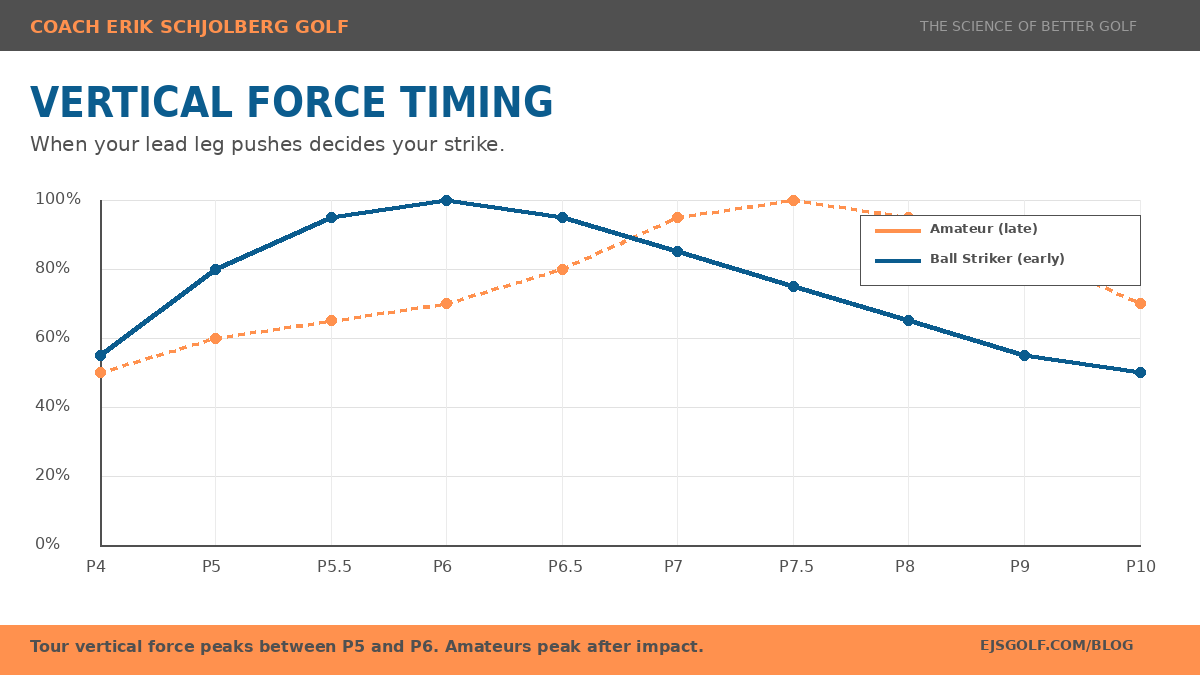
The second reason is that the vertical force production from your lead leg is peaking too late. On a pressure mat, we measure when the lead leg pushes vertically into the ground. Tour players hit peak vertical force between P5 and P6, before impact. Amateur golfers commonly hit peak vertical force at P7 or even P8 - after the ball has already left the face. By the time their lead leg starts pushing, impact is over. The hip clearance happens too late, the hands stall, and the club face inherits whatever path and orientation the upper body manipulation provided. This is why drilling vertical force timing is one of the highest-leverage fixes I teach.
Cause #3: A Broken Kinematic Sequence
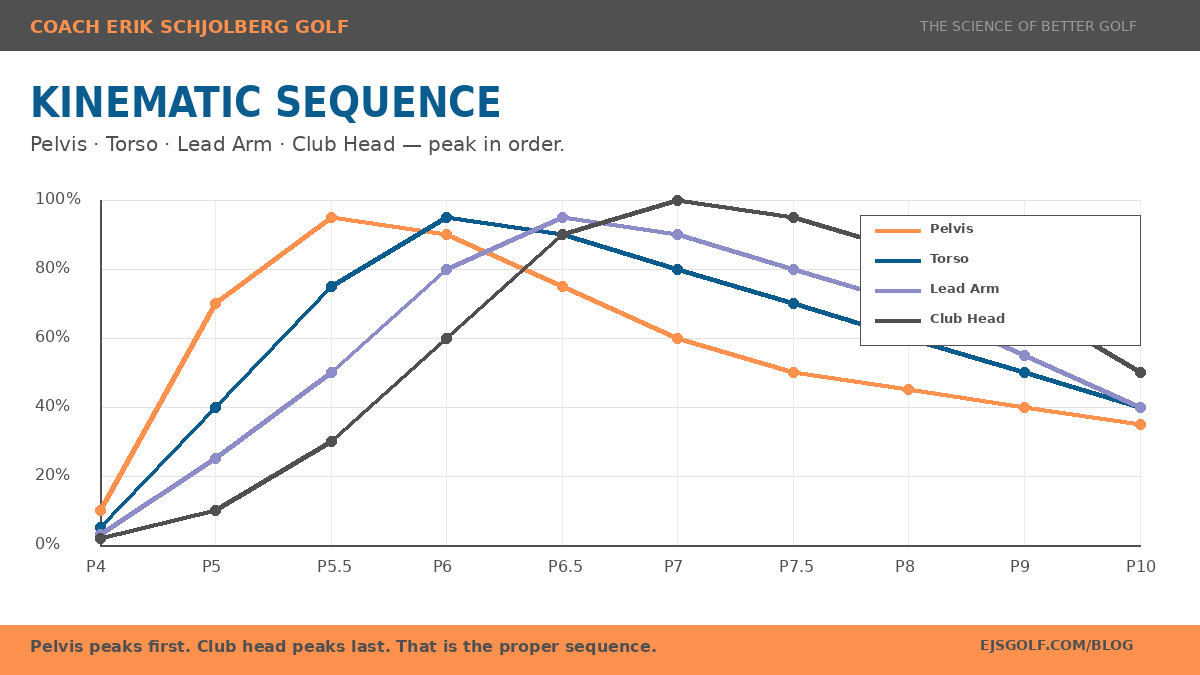
The third reason is that your kinematic sequence is broken. The proper sequence is pelvis first, torso second, lead arm third, club head fourth. Each segment peaks in angular velocity and then decelerates so the next segment can accelerate. This is the energy transfer principle Dr. Sasho MacKenzie has researched extensively. When your pelvis stalls, every segment after it stalls too, or worse, the upper body takes over and starts the sequence backward, leading with the trail shoulder. A reversed sequence is one of the worst patterns in the swing because it sets up an over-the-top path, an open club face, and zero compression. Sequence is everything. The sequence is built on pressure shift and lead leg push.
The Matchups That Produce Real Hip Rotation
Once you fix the upstream causes, hip rotation becomes a byproduct. Four matchups produce the rotation you actually need. First, pressure into the lead foot at sixty to seventy percent by P5, climbing toward eighty-five percent by P7. Second, the vertical force from the lead leg peaks between P5 and P6. Third, lead leg extension that pushes the lead hip up and around, not laterally toward the target. Fourth, a kinematic sequence where the pelvis peaks first in angular velocity, then the torso, then the lead arm, then the club head. None of these are conscious actions you take at impact. They are conditions you create earlier in the downswing that make rotation inevitable.
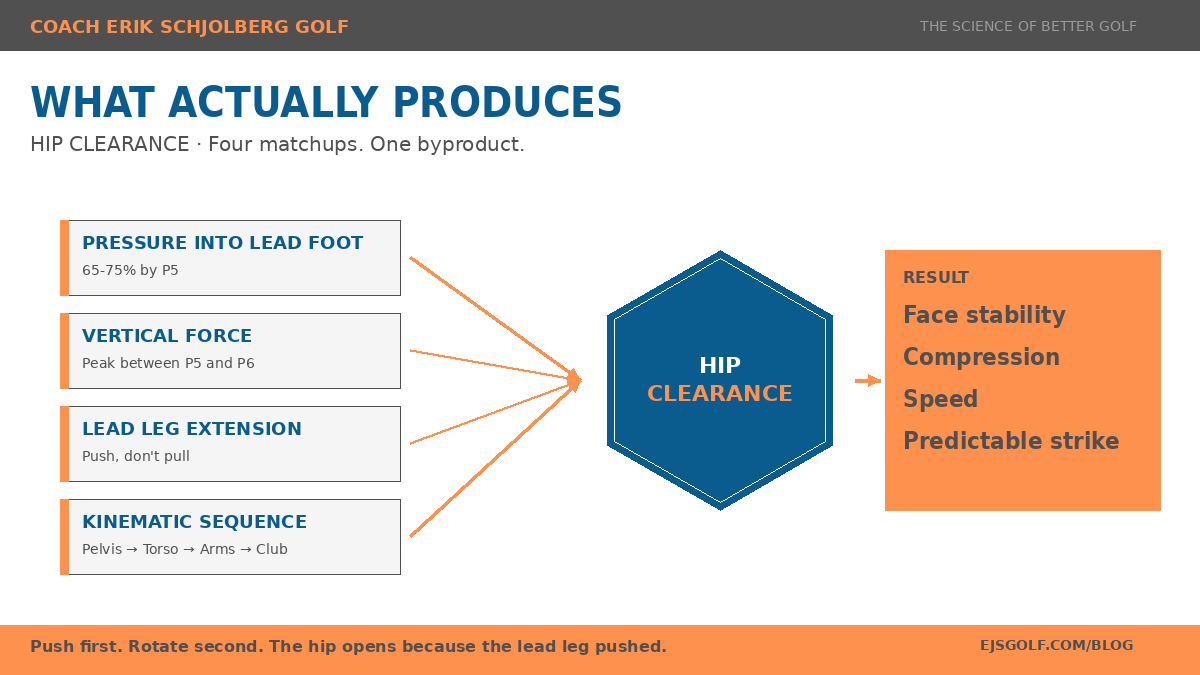
This is the matchups philosophy. Hip rotation does not exist in isolation. It only works when pressure, vertical force, lead leg extension, and kinematic sequence agree. This is why I refuse to teach swing thoughts about hip turn. Read more about how I build cause-and-effect mechanics into my system on the Coach Erik Schjolberg Golf blog or learn more about my approach.
The Drill: Lead Leg Push Drill
If you want to feel real rotation without spinning your hips, this drill produces the change inside one range session. Place an alignment stick or a yoga block under your lead heel. Set up to a 7-iron with a normal stance. Make a three-quarter backswing focused on loading pressure into your trail foot. As you transition into the downswing, feel a vertical jump from your lead leg into the ground — like you are trying to push the alignment stick through the floor. The vertical push should peak as your lead arm reaches parallel to the ground in the downswing, around P5 to P6. Your pelvis will begin to rotate as a byproduct of the push. Do not try to rotate. Just push.
Hit ten balls with this drill before every range session. You will feel your lead hip clearing earlier and your hands arriving at impact with face stability for the first time. You should improve on day one. I do not believe in getting worse before getting better. The Lead Leg Push Drill is in my free drills guide at EJSGolf.com/my-drills, along with the rest of the constraint-led drills I use with my students.
How I Coach This in Scottsdale and Online
When you come to McCormick Ranch for Scottsdale golf lessons, we measure your rotation problem directly. We capture your swing on Sportsbox AI to see your pelvic rotation, torso rotation, and X-factor stretch in three dimensions. We put you on a pressure mat to time your vertical force production. We use TrackMan to verify the result at impact - face-to-path, attack angle, and dynamic loft. With the data in hand, we work backwards from impact to identify which of the three upstream causes is breaking your rotation, then apply constraint-led drills until the new pattern repeats.
If you cannot make it to Arizona, I can deliver the same process through online golf lessons. Send me your face-on and down-the-line video, your launch monitor data if you have it, and we'll build the same input chain remotely. The cause-and-effect is the same whether I am standing next to you at McCormick Ranch or coaching you over video. Book a session at EJSGolf.com/book-now to get started.
The Bottom Line
You do not have rotation because the lead leg is not pushing. Pressure is stuck on your trail foot. Vertical force is peaking too late. Your kinematic sequence is broken. Trying to rotate harder makes every one of those problems worse, because the harder you spin without ground force production, the more your upper body takes over and the more your sequence reverses. Stop trying to open your hips. Start pushing from the lead leg. The rotation takes care of itself, the face becomes stable, and your strike, your speed, and your start line all follow. That is the matchups philosophy. That is The Science of Better Golf. That is what Coach Erik Schjolberg Golf was built to deliver.
Frequently Asked Questions
These are the questions I get asked most often by students before, during, and after their first session.
Q1. What is hip rotation in the golf swing?
Hip rotation, more precisely called pelvic rotation, is the angular motion of your pelvis around your spine during the downswing. It is measured in degrees on Sportsbox AI and other 3D systems. Tour-level pelvic rotation through impact typically reaches forty to fifty-five degrees open relative to the target line, with peak angular velocity occurring before impact.
Q2. Can I just try to rotate my hips faster to gain speed?
No. Trying to rotate the hips harder without producing the upstream conditions - pressure shift, lead leg push, vertical force - will only stall your sequence and force your upper body to take over. The harder you try to spin, the more your kinematic sequence breaks. Speed comes from sequence, not from effort applied at the wrong link in the chain.
Q3. What is vertical force in the golf swing?
Vertical force is the upward push your lead leg applies to the ground during the downswing. It is one of the three components of ground reaction force, alongside horizontal force and rotational torque. The vertical component is what allows the pelvis to rotate efficiently and the lead hip to clear in time. On a pressure mat, vertical force is measured as a percentage of body weight pushing down through the lead foot.
Q4. When should the vertical force peak in the golf swing?
Vertical force should peak between P5 and P6 in the downswing - that is, between the moment your lead arm reaches parallel to the ground and the moment your club shaft reaches parallel to the ground. Tour players load and unload this vertical force early, well before impact. Amateurs commonly peak vertical force at P7 or P8, which is too late to influence the strike.
Q5. Why won't my hips open through impact?
Because something earlier in the downswing is preventing the lead leg from pushing into the ground. Most commonly, your pressure is still on the trail foot at P5, your vertical force timing is late, or your kinematic sequence has reversed, and your upper body is leading. The fix is upstream of the hip itself - pressure shift first, then lead leg push, then rotation as a consequence.
Q6. What is the kinematic sequence in golf?
The kinematic sequence is the order in which body segments peak in angular velocity during the downswing. The proper sequence is pelvis first, torso second, lead arm third, and club head fourth. Each segment decelerates so the next segment can accelerate, transferring energy outward to the club head. A broken or reversed sequence is one of the most common patterns in amateur golf, and it stalls every link below it.
Q7. Where can I get my rotation measured by Coach Erik Schjolberg?
I coach in person at McCormick Ranch in Scottsdale, Arizona, with full Sportsbox AI, TrackMan, HackMotion, and pressure mat integration. I also coach online to golfers worldwide. Book a session. Learn more about my system, in-person Scottsdale golf lessons, or online golf lessons.
Work With Coach Erik Schjolberg
If you want to stop guessing and start measuring, I coach in person in Scottsdale at McCormick Ranch and online to golfers worldwide. Book a session here. Learn more about how I coach. Grab my free drills guide to keep your practice productive between lessons. For more articles on the science of ball striking, visit the Coach Erik Schjolberg Golf blog. Follow along with Coach Erik Schjolberg on Instagram and EJSGolf on YouTube.


