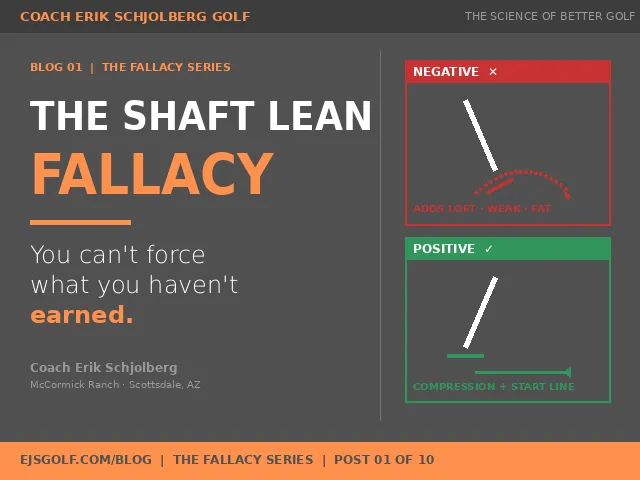
The Shaft Lean Fallacy: Why Forward Lean Can't Be Forced
The Shaft Lean Fallacy: Why You Don't Have Forward Shaft Lean - and Why Forcing the Handle Forward Will Never Give It to You
If you have ever stood over a 7-iron, told yourself to lean the shaft forward at impact, and watched the ball balloon weakly to the right or dive straight into the turf, you have been living inside the shaft lean fallacy. The truth most golfers will never hear from a YouTube tip is this. You do not have forward shaft lean. You are not faking it. You simply do not have it. And the moment you try to manufacture it by pushing the handle forward at impact, you make your strike worse, not better. I am Coach Erik Schjolberg. I run Coach Erik Schjolberg Golf, formerly EJS Golf, out of McCormick Ranch in Scottsdale, Arizona, and I want to spend the next two thousand words explaining why your shaft lean problem is not a shaft lean problem at all. The cause is always upstream.
What Forward Shaft Lean Actually Is - and Why You Don't Have It
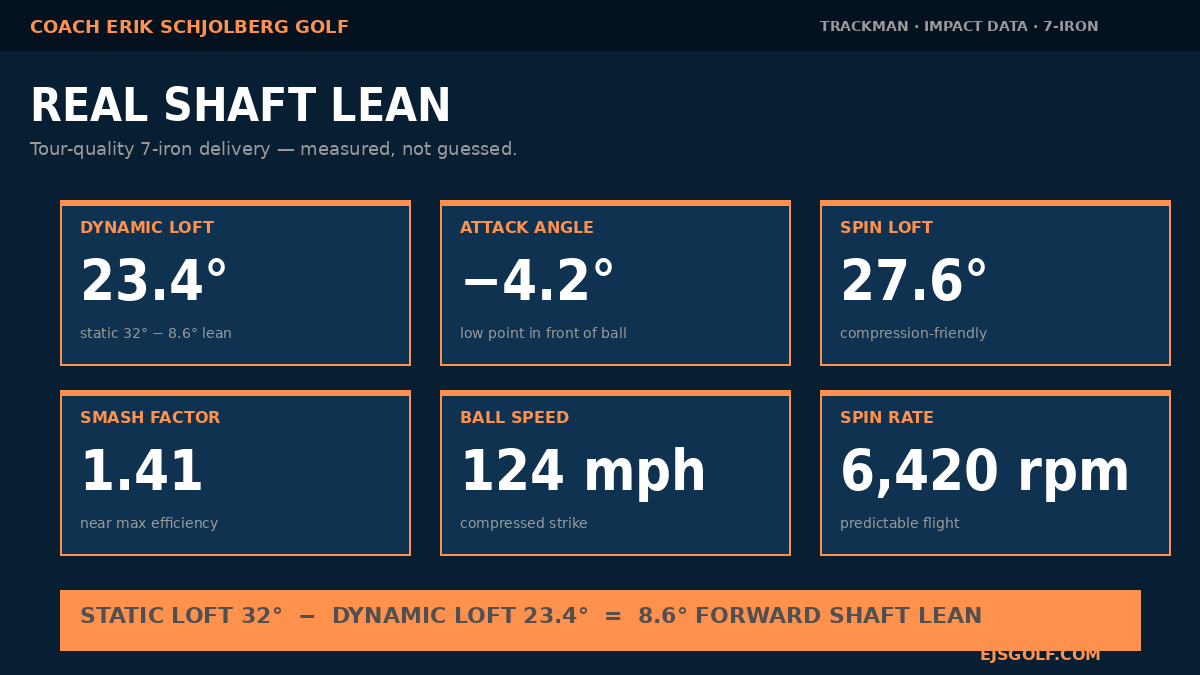
Forward shaft lean is the angle of the shaft at impact, leaning toward the target. On TrackMan it appears as a relationship between dynamic loft and static loft. A 7-iron with thirty-two degrees of static loft delivered at twenty-four degrees of dynamic loft has approximately eight degrees of forward shaft lean. That de-lofting is what produces compression, ball speed, and tour-quality flight. Here is the part nobody tells you. Forward shaft lean is a consequence of correct delivery, not a cause of it. You cannot generate it with your hands. The reason you do not have shaft lean is not that you forgot to push your hands forward. The reason you do not have shaft lean is that something earlier in the swing is preventing it from happening.
In nearly every new student I see at McCormick Ranch in Scottsdale, the missing shaft lean is the result of one of three upstream problems. The first is an open club face arriving at P6, the moment when the club shaft is parallel to the ground in the downswing. The second is poor pressure movement, where the golfer's weight is stuck on the trail foot in transition. The third is a broken kinematic sequence in which the lead leg never pushes vertically, and the lead hip never clears in time. Until those upstream problems are fixed, no amount of hand manipulation will produce real shaft lean - and any handle push you add on top of those problems makes the impact worse, not better. This is exactly why I refuse to teach swing thoughts. I teach causes. Read more about my philosophy at EJSGolf.com/about.
The Critical Truth Nobody Teaches: Shaft Lean Is an Opener
Forward shaft lean opens the club face.
Read that sentence again. Forward shaft lean opens the club face. When you lean the shaft toward the target, you reduce dynamic loft, which on a 7-iron that you naturally deliver face-square may now arrive face-open. That is why golfers who manually shove the handle forward end up hitting blocks, push-fades, and shanks. They have added shaft lean without adding the corresponding face-closing mechanism, and the geometry of the club tilts the face open through impact. This single insight is missing from almost every YouTube video and golf magazine article ever written about shaft lean.
This is also the entire reason I refuse to teach universal fundamentals. There are only matchups. Shaft lean must be matched. If you have a stronger lead-hand grip, you can carry more shaft lean because your grip pre-closes the face. If you have a weaker lead-hand grip, you need either more lead-wrist flexion or more body rotation through the strike to keep the face square as the shaft leans forward. If you do not understand this matchup, every additional degree of shaft lean you create at impact becomes another degree of open face, and the ball flies dead right. This is verifiable on every HackMotion wrist sensor reading I have ever recorded. The data does not lie. Shaft lean and face control are two different conversations, and they must agree.
The Three Real Causes of Missing Shaft Lean
To stop trying to fake forward shaft lean and start actually producing it, you have to look upstream. Here are the three real causes of missing forward shaft lean - and they all live before P6 in the downswing.
Cause #1: An Open Club Face Coming Into Impact
If your club face is open at P6, your brain knows it. Your subconscious will do anything to save the shot, and the most common save is a flip - a last-millisecond release where the club head passes the hands to square the face up at the cost of all your shaft lean. You cannot have a shaft lean and an open face at the same time without hitting the ball forty yards right of the target. So your body chooses survival. It flips. The face squares. The shaft loses its lean. The ball goes straight-ish, but high, weak, and short. The cause is not your hands. The cause is whatever made the face open at P6 - typically a steep, cupped lead wrist, a grip that does not match your release pattern, or a trail-side throw that opens the face as the club approaches the ball.
Cause #2: Weight Stuck on the Trail Foot in Transition
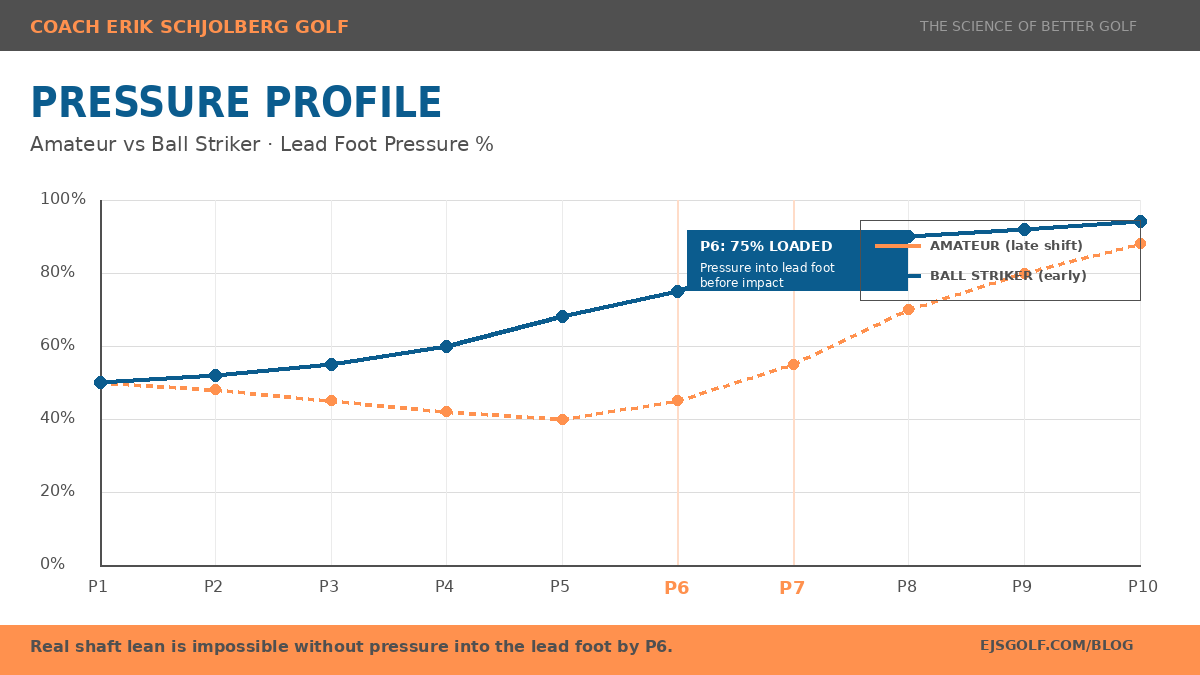
A pressure mat tells the truth in a way no video angle can. If your pressure is still fifty percent or worse on your trail foot at P6, your center of mass is behind the ball. That means your low point is behind the ball. That means your hands cannot lead the club head through impact, because the geometry will not allow it. Your low point dictates where the handle is at impact. Pressure dictates the low point. So if you do not get pressure into your lead foot in transition, you will never have shaft lean. End of discussion. This is the work coming out of force-tracking research from Dr. Young-Hoo Kwon and others, and it is exactly what I measure on every student using my pressure mat and Sportsbox AI body parameters. Pressure first. Always.
Cause #3: A Broken Kinematic Sequence and Missing Vertical Force
Real shaft lean requires the lead hip to clear before impact. The lead hip clears because the lead leg pushes vertically into the ground, and that vertical force is what allows the pelvis to rotate. The pelvis pulls the torso. The torso pulls the lead arm. The lead arm pulls the hands. The hands lead the club head. That is the kinematic sequence in one sentence. If your lead leg never pushes - because pressure is still on your trail foot or your timing is late - the entire chain breaks and the hands stall at impact. When the hands stall, the club head overtakes them. Shaft lean disappears. The most common version of this I see at McCormick Ranch is a golfer whose vertical force production peaks late, after impact, instead of before. Vertical force from the lead leg should max between P5 and P6, not at P7. That early vertical force is what makes shaft lean physically possible at the moment it counts.
The Matchups That Actually Produce Forward Shaft Lean
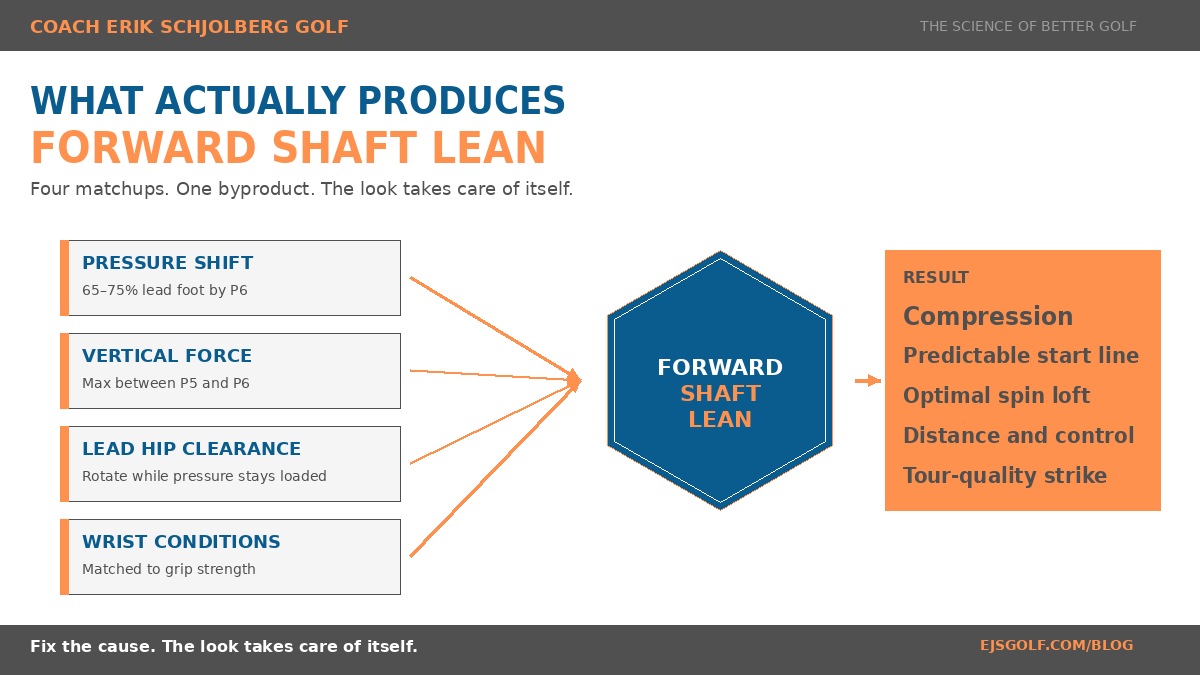
Once you fix the upstream causes, shaft lean becomes a byproduct. There are four matchups you must produce at impact, and they must all agree with each other. First, pressure into the lead foot at sixty-five to seventy-five percent by P6, climbing toward eighty-five percent by P7. Second, vertical force from the lead leg maxing between P5 and P6, not afterward. Third, the lead hip clearing through impact while pressure stays into the lead foot. Fourth, lead-wrist conditions matched to your grip -flexion to a square or closed face if your grip is neutral or weak, neutral-to-slightly-extended if your grip is strong. None of these matchups is about your hands. None of them requires a conscious push of the handle. They are body conditions, and they produce shaft lean as the unavoidable consequence of correct delivery.
This is the matchups philosophy. This is the entire reason I built Coach Erik Schjolberg Golf around cause and effect rather than feel-based instruction. Every other article on the Coach Erik Schjolberg Golf Blog is built around the same principle - fix the cause, and the effect takes care of itself.
The Drill: Lead Foot Loaded Punch
If you want to feel a real forward shaft lean without manipulating your hands, this drill gets you there inside one range session. Set up to a 9-iron. Take a half-width stance. Before you start your backswing, push seventy percent of your pressure into your lead foot and keep it there. Do not shift back. Make a three-quarter backswing while keeping your pressure in your lead foot. Then make a punch swing where your belt buckle keeps rotating left through and past the ball, and your trail heel comes off the ground. The constraint is the lead-foot pressure. With your pressure already in your lead foot, your low point will move automatically in front of the ball. Your hands will lead the club head through impact because there is no other place for them to go.
Do this with ten balls before every range session. You will see the divot pattern shift forward of where the ball was sitting within the first session. You should improve on day one. I do not believe in getting worse before getting better. If a drill cannot produce a measurable improvement in strike location or contact quality in the first range session, it is the wrong drill, and I will not prescribe it. The Lead Foot Loaded Punch is in my free drills guide at EJSGolf.com/my-drills, along with the rest of the drills I use with my Scottsdale and online students.
How I Coach This in Scottsdale and Online
When you walk into McCormick Ranch for Scottsdale golf lessons, the very first thing I do is measure where your problem actually lives. We capture your swing on TrackMan to see your dynamic loft, attack angle, spin loft, and face-to-path. We strap a HackMotion sensor to your lead wrist to see what flexion and extension are doing through impact. We put you on a pressure mat to see exactly when and how your pressure is shifting and when your vertical forces peak. Once we have the data, we work backwards from the impact result to the body conditions producing it. Then we apply constraint-led drills until the new pattern produces the new data, repeatable. That is how a swing becomes a system.
If you cannot make it to Arizona, the same process works through online golf lessons. I review your face-on and down-the-line video, your TrackMan or launch monitor data if you have it, and we build the same input chain remotely. The data does not lie, and the cause-and-effect is the same whether I am standing next to you at McCormick Ranch or coaching you over video. The fastest way to get started is to book a session at EJSGolf.com/book-now.
The Bottom Line
You do not have forward shaft lean because something upstream is preventing it. An open club face at P6, weight stuck on your trail foot in transition, or a broken kinematic sequence with missing vertical force — one of those three is the real culprit. Every time you try to manufacture shaft lean by pushing the handle forward, you compound the problem because shaft lean is an opener, and you have no face-closing mechanism to match it. Stop chasing the look. Fix the cause. The shaft lean takes care of itself, and your strike, your compression, your start-line predictability, and your distance all follow. That is the matchups philosophy. That is The Science of Better Golf. That is what I built Coach Erik Schjolberg Golf to deliver.
Frequently Asked Questions: The Shaft Lean Fallacy
These are the questions I get asked most often by students before, during, and after their first session. Use them as a quick reference, and tag them with the FAQ schema if you are publishing this article on your own site.
Q1. What is forward shaft lean in the golf swing?
Forward shaft lean is the angle of the shaft at impact, measured against vertical, leaning toward the target. It de-lofts the club face, reduces dynamic loft relative to static loft, and is the geometric reason elite ball strikers compress the ball. On TrackMan, it shows up as the difference between your dynamic loft and your static loft. A 7-iron with thirty-two degrees of static loft delivered at twenty-four degrees of dynamic loft has approximately eight degrees of forward shaft lean.
Q2. Why can't I just push my hands forward to create shaft lean?
Because shaft lean is a consequence of body conditions earlier in the downswing, not a hand action. The hands cannot get ahead of the club head if your pressure is still on your trail foot or your lead hip has not cleared. Pushing the handle forward without producing the upstream causes adds shaft lean to an open face and produces blocks, push-fades, and shanks. You cannot manufacture an output by mimicking what it looks like.
Q3. Does the forward shaft lean open or close the club face?
Forward shaft lean opens the club face. This is the most under-taught matchup in golf instruction. When you lean the shaft toward the target, the geometry of the club tilts the face open relative to the path. Real ball strikers compensate with either a stronger grip, a flexed lead wrist, or a body-driven release that closes the face to match the lean. Without that face-closing mechanism, more shaft lean equals more right-side miss.
Q4. How much forward shaft lean should I have with a 7-iron?
Tour-level 7-iron deliveries average six to nine degrees of forward shaft lean. A driver should have slightly negative shaft lean - handle slightly behind vertical - because you want a positive attack angle for distance. A pitching wedge can carry ten to fourteen degrees. The optimal amount is club-specific and matchup-specific, not a universal target. Trying to apply an iron shaft lean to a driver costs you distance and predictability.
Q5. Why am I hitting fat shots even when I try to lean the shaft?
Because your low point is still behind the ball. Manual handle-push does not move your low point. Pressure shift moves your low point. If your pressure is on your trail foot, your center of mass is behind the ball, your low point is behind the ball, and you will hit fat regardless of what your hands try to do. Fix pressure first. The shaft lean follows automatically.
Q6. Can I get shaft lean if my lead leg never pushes vertically?
No. Real shaft lean requires the lead hip to clear before impact, and the lead hip only clears when the lead leg pushes vertically into the ground. That vertical force needs to peak between P5 and P6, not at impact and not after. If your vertical force is late, your hands stall, the club head overtakes them, and the shaft loses its lean. This is measurable on a pressure mat in less than five swings.
Q7. Where can I get a swing assessment with Coach Erik Schjolberg?
I coach in person at McCormick Ranch in Scottsdale, Arizona, and online to golfers worldwide. You can book a session here, learn more about my system at EJSGolf.com/about, explore in-person Scottsdale golf lessons, or set up online golf lessons from anywhere in the world.
Work With Coach Erik Schjolberg
If you want to stop guessing and start measuring, I coach in person in Scottsdale at McCormick Ranch and online to golfers worldwide. Book a session here. Learn more about how I coach. Grab my free drills guide to keep your practice productive between lessons. For more articles on the science of ball striking, visit the Coach Erik Schjolberg Golf blog. Follow along with Coach Erik Schjolberg on Instagram and EJSGolf on YouTube.
Get my full drill library at EJSGolf.com/my-drills
Read more at EJSGolf.com/blog
Book a session at EJSGolf.com


