
EJS GOLF BLOG
Learn about the golf swing and what you can do to improve your score on the golf course. Fill out the form below if you have any questions or want to set up a time to talk.
Mastering the Art of Golf with Coach Erik Schjolberg
I’m Coach Erik Schjolberg, and welcome to the EJS Golf blog—Scottsdale’s authority on science-driven ball-striking. Here you’ll find in-depth analyses of swing mechanics, data-backed breakdowns of impact and launch dynamics, and actionable practice routines designed to rewire your muscle memory from day one. Each post peels back the curtain on cause-and-effect in your swing, whether you’re chasing Tour-level precision, collegiate consistency, or lower weekend scores. Dive into our deep-dive articles, master the drills that drive real improvement, and transform your game with proven science and strategy.
But let’s be clear: golf isn’t only about perfecting swing mechanics. The mental battle you fight on each tee is often the one that determines whether you stay in the game or walk off the course. Here, we’ll tackle the psychological hurdles—the pressure of a tight leaderboard, the frustration when a swing fails under stress, the self-doubt that creeps in after a bad hole. You’ll learn evidence-based mental strategies—visualization routines, pre-shot rituals, stress-management techniques—that fortify your focus and resilience. Mastering these mind-set tools is just as critical as dialing in your impact position, and I’ll show you exactly how to integrate mental training into your practice for lasting confidence on every shot.
Explore Our Blogs

Ground Reaction Forces: Power in Scottsdale Golf Lessons
Ground Reaction Forces: Unlock Power and Precision in Your Golf Swing
By Coach Erik Schjolberg, PGA-level golf coach, Scottsdale, Arizona
When golfers come to me for Scottsdale Golf Lessons, they often share a common frustration: a lack of consistent power, erratic ball striking, or a swing that feels disconnected from the ground up. They’ve tried every tip, every swing thought, and every YouTube “secret,” yet the ball flight remains stubbornly inconsistent. What many don't realize is that the true engine of the golf swing-the source of both power and precision-lies beneath their feet: Ground Reaction Forces (GRF). My approach at EJS Golf, rooted in The Science of Better Golf, doesn't chase cosmetic positions. Instead, I teach from impact backward, using data from force plates to diagnose exactly how a golfer is interacting with the ground. This isn't about brute strength; it's about efficient energy transfer, and understanding it is the fastest way to unlock measurable improvement in your game.
The Short Answer: What Are Ground Reaction Forces in Golf?
Ground Reaction Forces are the forces exerted by the ground on your body in response to the force your body applies to the ground. In golf, these forces-vertical, horizontal, and rotational-are critical for generating club head speed, controlling the club face, and achieving a consistent low point. Efficient use of GRF allows golfers to transfer energy from the ground through their body and into the club, creating a powerful and repeatable swing. My coaching focuses on optimizing these interactions for maximum power and precision.
What Is Really Happening at Impact: The Ground as Your Power Source
Many golfers mistakenly believe that power originates solely from their arms or shoulders. While these play a role, the most significant power generation in the golf swing begins with how you interact with the ground. When I analyze a student's swing on the force plates at McCormick Ranch, I'm looking for specific patterns of pressure and force application that either create or leak power. A common issue I see is an inability to effectively use the ground to generate vertical force. This often manifests as a lack of height in the shot, a weak impact, or a tendency to "flip" the club head at impact. The golf ball does not make mistakes; its flight reveals precisely what the club face and club head were doing at impact, and often, the root cause traces back to an inefficient interaction with the ground.
My force plate data consistently shows that many amateurs fail to effectively load and unload pressure into the lead side during the downswing, particularly in the vertical dimension. This isn't just about losing distance; it directly impacts your ability to control the low point of your swing and deliver the club face squarely to the ball. Without proper vertical force, the body struggles to create the necessary leverage and rotation, leading to compensations like early extension or a stalled rotation. These compensations, in turn, make it nearly impossible to achieve the desired shaft lean and compression at impact, resulting in weak, inconsistent shots. This is why I emphasize that understanding your ground forces is not just about power; it's fundamental to consistent ball striking. If you're struggling with inconsistent contact, it's highly likely your ground interaction is a significant factor. For a deeper dive into how crucial low point control is, I recommend reading my article on Mastering Low Point Control: Scottsdale Golf Lessons for Better Impact.
The Cause Upstream: Inefficiency, Not Weakness
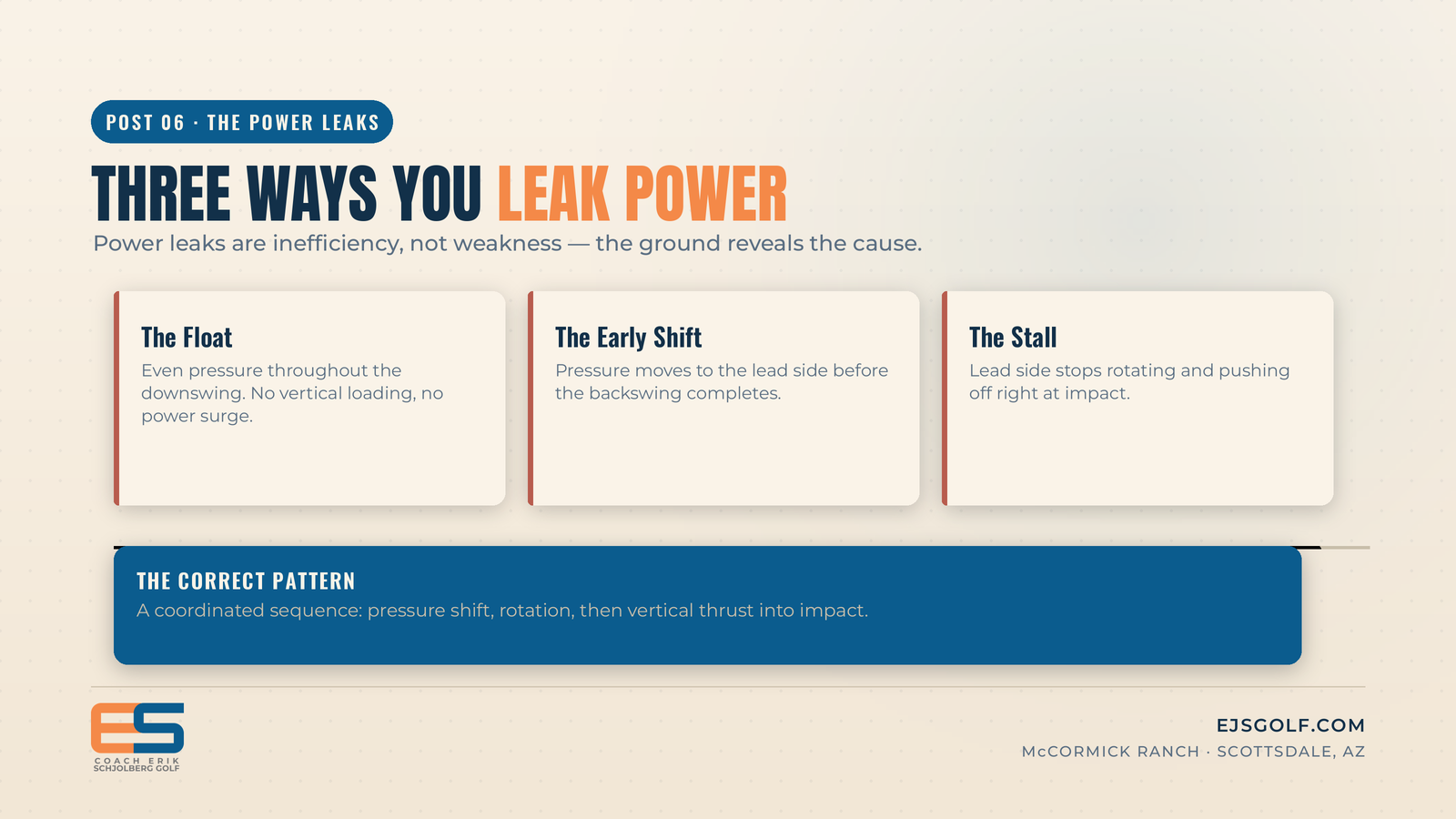
When I observe power leaks in a student's swing, it's rarely due to a lack of physical strength. More often, it's an issue of inefficiency in how they apply and manage ground reaction forces. The golf swing is a kinetic chain, and if the foundation-your interaction with the ground—is faulty, the entire chain suffers. I've identified four common ground force patterns that reveal these inefficiencies:
The Float (No Vertical Loading): This golfer maintains a relatively even pressure distribution throughout the downswing, failing to generate a significant vertical push off the ground. The result is often a lack of club head speed and a feeling of "swinging from the arms."
The Early Shift (Transition Before Top): Here, the golfer shifts pressure to the lead side too early, often before completing the backswing. This disrupts the sequencing and timing, leading to a loss of power and potential issues with low point control.
The Stall (Lead Side Stops at Impact): This pattern involves a failure to continue rotating and pushing off the lead side through impact. The body stalls, and the arms take over, often resulting in a "flip" release and inconsistent contact.
The Correct Pattern: The ideal pattern involves a coordinated sequence of pressure shift, rotation, and vertical thrust, maximizing energy transfer and club head speed while maintaining control over the club face and low point.
The key to correcting these inefficiencies is understanding that the ground tells the cause, while video often only shows the symptom. For example, a golfer might see early extension on video and try to fix it by "staying down." However, the root cause is often a lack of proper vertical force generation, which forces the body to extend early to create space for the club. By addressing the ground interaction, we can often resolve the visible swing faults more effectively. This is why I rely heavily on force plate data in my Scottsdale Golf Lessons; it provides the objective truth about what's happening beneath the surface. To understand more about how different release patterns interact with these forces, check out my breakdown of The Four Release Patterns: Why There Is No Single Correct Way to Release the Golf Club.
What I Change First: Prioritizing Vertical Force
When addressing ground reaction force issues, my primary focus is almost always on vertical force. For most amateur golfers, this is the missing link in their power generation and the key to unlocking a more dynamic and consistent swing. The goal is to create a powerful "jump-and-plant" sequence, where the golfer effectively loads pressure into the ground and then uses that pressure to propel the body upward and rotationally through impact.
This vertical thrust is crucial for several reasons. First, it creates the necessary space for the club to shallow out and approach the ball from the correct path. Second, it helps maintain forward shaft lean at impact, which is essential for compression and distance. Finally, it contributes significantly to club head speed, as the energy generated from the ground is transferred through the kinetic chain to the club. My approach is to isolate this vertical component and train the golfer to feel and apply it correctly. This isn't about jumping off the ground; it's about using the ground as a springboard to generate rotational power and speed. This is a core principle of The Science of Better Golf, where we focus on measurable, cause-and-effect changes rather than generic tips.
Drills That Make the Change Stick: The Ground Force Progression
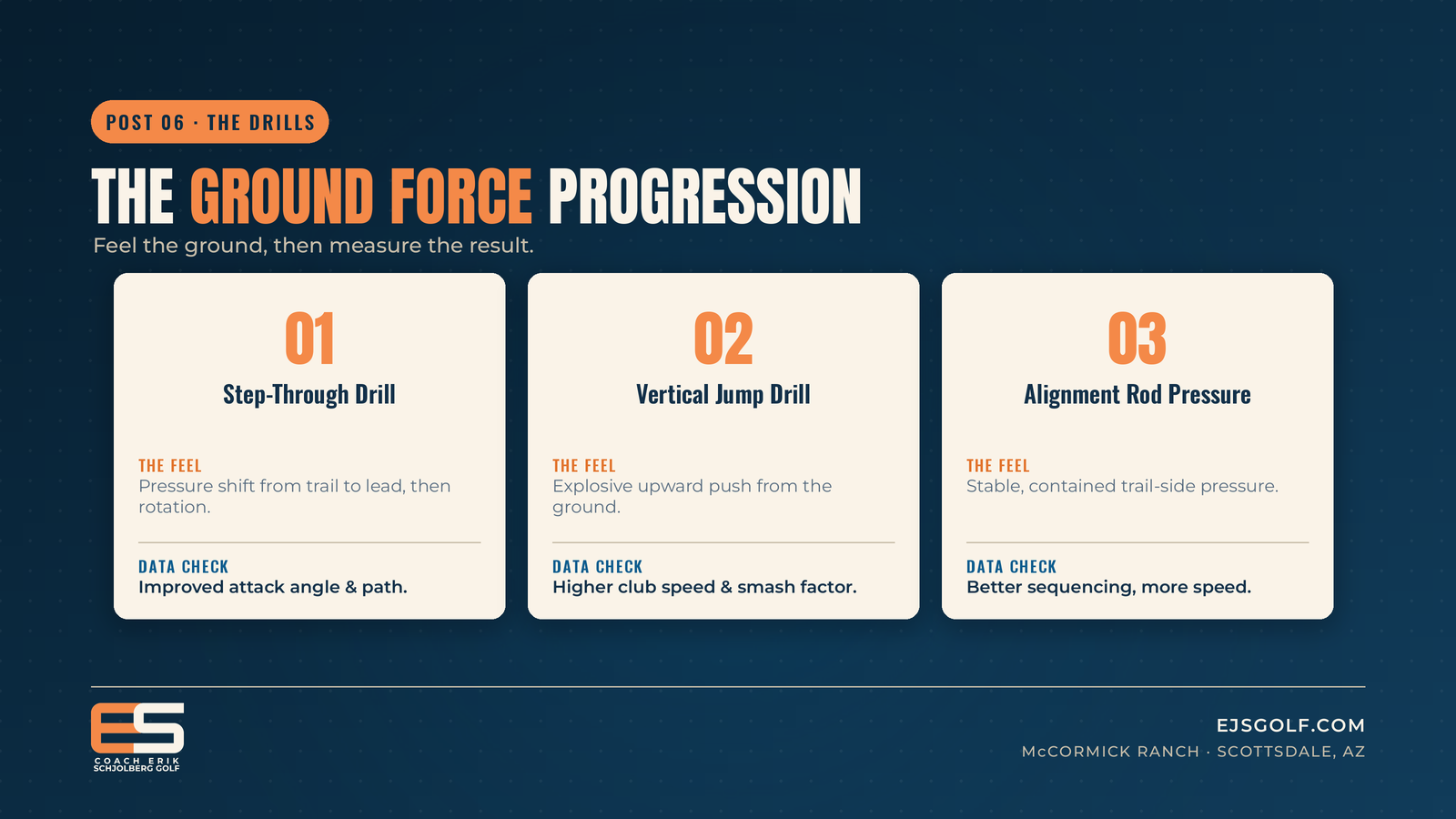
To effectively integrate proper ground reaction forces into your swing, you need drills that provide clear, observable feedback. These drills are designed to help you feel the correct pressure shifts and vertical thrust, translating those feelings into measurable improvements in your ball striking.
Drill 1: The Step-Through Drill
This drill is excellent for feeling the correct sequence of pressure shift and rotation.
Setup: Take your normal address position without a club.
Execution: Make a backswing motion, shifting your pressure to your trail side. As you begin your downswing, step your trail foot forward, past your lead foot, as if you were walking through the shot.
The Feel: You should feel a clear shift of pressure from your trail side to your lead side, followed by a powerful rotation of your body.
Feedback: The key is to ensure your body is moving forward and rotating, not just swaying. You should feel balanced and powerful at the end of the movement.
Data Confirmation: When you transition this feel to hitting balls, you should see an improvement in your attack angle and a more consistent low point, as measured by TrackMan.
Drill 2: The Vertical Jump Drill
This drill isolates the vertical force component, helping you understand how to use the ground for power.
Setup: Take your normal address position with a mid-iron.
Execution: Make a backswing, focusing on loading pressure into your trail leg. As you transition into the downswing, aggressively push off the ground with both feet, feeling as though you are trying to jump straight up.
The Feel: You should feel a powerful surge of energy from the ground up through your legs and torso.
Feedback: The goal is to feel the explosive upward movement, not necessarily to hit the ball perfectly. However, you should notice an increase in club head speed and a more dynamic release.
Data Confirmation: On TrackMan, look for an increase in club head speed and a higher smash factor, indicating more efficient energy transfer.
Constraint Drill: The Alignment Rod Pressure Drill
This drill uses an alignment rod to provide immediate feedback on your pressure shift.
Setup: Place an alignment rod on the ground, perpendicular to your target line, just inside your trail foot.
Execution: Take your normal address position. As you make your backswing, ensure your pressure shifts to the inside of your trail foot, not outside the alignment rod.
The Feel: You should feel a solid, stable base on your trail side, ready to push off into the downswing.
Feedback: If your pressure shifts outside the alignment rod, you'll lose stability and power. The rod provides a physical constraint to keep your pressure contained.
Data Confirmation: This drill helps improve the efficiency of your pressure shift, leading to better sequencing and a more consistent strike, which will be reflected in tighter dispersion patterns on TrackMan.
For a complete library of drills designed to improve your ball striking and ground interaction, I highly recommend downloading my EJS Golf Drill Library.
Your Next Seven Days: A Practice Protocol for Power
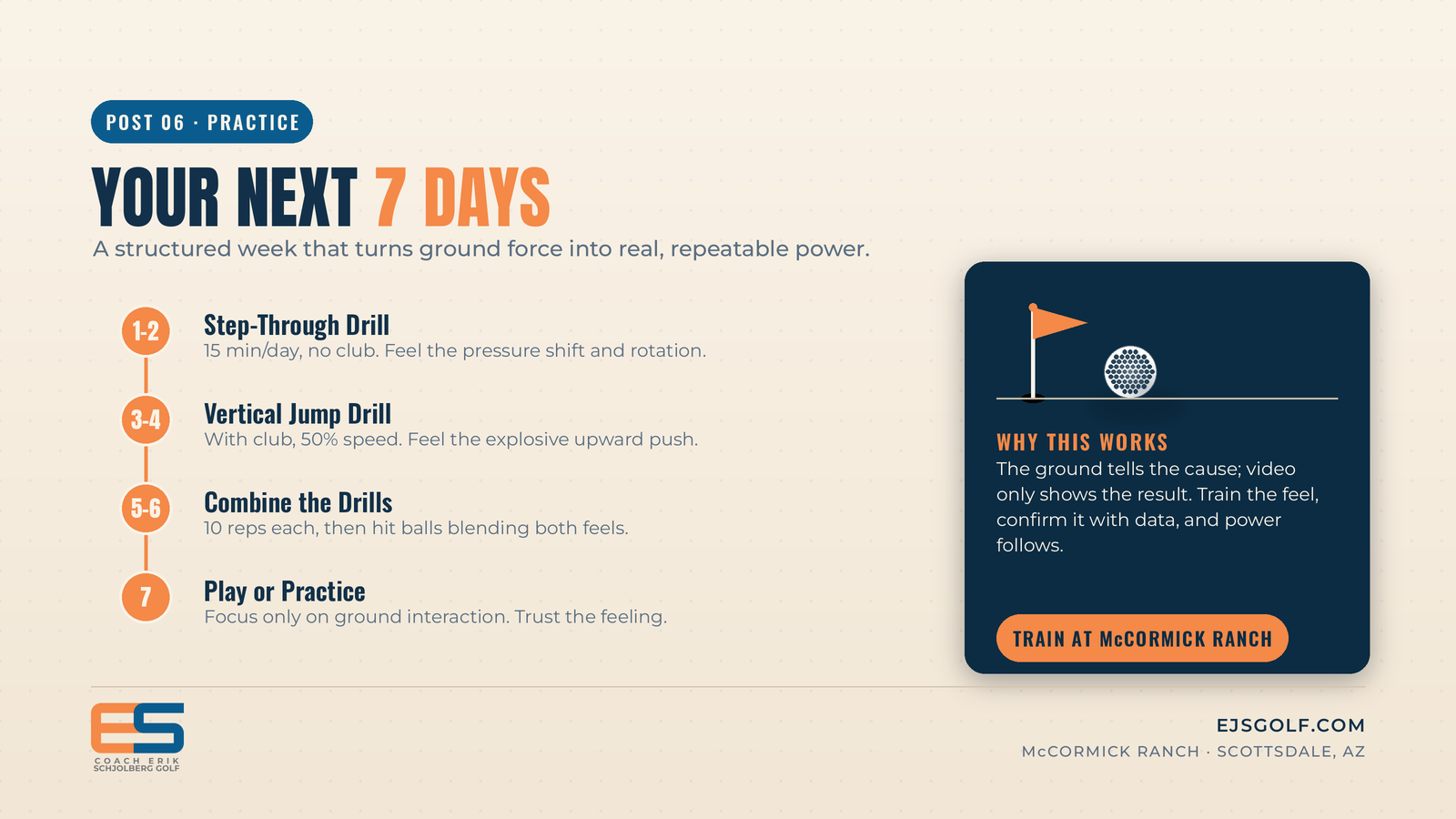
To make these changes stick, you need a structured practice plan. Here is a seven-day protocol to help you integrate proper ground reaction forces into your swing:
Days 1-2: Focus on the Step-Through Drill (without a club) for 15 minutes each day. Concentrate on the feeling of the pressure shift and rotation.
Days 3-4: Introduce the Vertical Jump Drill (with a club, hitting balls at 50% speed). Focus on the explosive upward movement and the feeling of using the ground for power.
Days 5-6: Combine the drills. Start with 10 reps of the Step-Through Drill, followed by 10 reps of the Vertical Jump Drill, and then hit 20 balls focusing on integrating both feelings into your full swing.
Day 7: Play a practice round or hit balls on the range, focusing solely on your ground interaction. Don't worry about the score; focus on the process and the feeling of power generation from the ground up.
Remember, the goal is measurable improvement. Use video to check your sequencing, but rely on the feeling of the ground and the resulting ball flight to confirm your progress. If you're struggling to feel these changes, it might be time to consider Online Golf Lessons where I can analyze your swing and provide personalized feedback.
Train With Me in Scottsdale
If you're serious about unlocking your true power potential and improving your ball striking, there is no substitute for personalized, data-driven instruction. At my coaching studio at McCormick Ranch, I use state-of-the-art technology, including TrackMan and force plates, to provide a precise diagnosis of your swing mechanics.
Whether you're a local resident or visiting the area, booking Scottsdale Golf Lessons with me is the fastest way to achieve measurable improvement. We won't waste time on generic tips; we'll focus on the specific cause-and-effect relationships in your swing, starting with how you interact with the ground. If you're ready to stop guessing and start improving, book your in-person Scottsdale Golf Lessons today.
Frequently Asked Questions
What are ground reaction forces in the golf swing?
Ground reaction forces (GRF) are the forces exerted by the ground on your body in response to the force you apply to it. In golf, these forces—vertical, horizontal, and rotational—are essential for generating power, controlling the club face, and achieving a consistent low point. Efficient use of GRF is a hallmark of elite ball striking.
How do I know if I have poor ground forces?
Common symptoms of poor ground interaction include a lack of distance, inconsistent contact (fat or thin shots), early extension, and a feeling of "swinging from the arms." Force plate data provides the most accurate diagnosis, revealing inefficiencies in pressure shift and vertical force generation that video often misses.
Can I improve ground forces without a force plate?
Yes, while force plates provide precise data, you can improve your ground interaction through targeted drills. Exercises that focus on feeling pressure shifts, such as the Step-Through Drill, and explosive movements, like the Vertical Jump Drill, can help you develop a better sense of how to use the ground for power.
How does vertical force affect my low point control?
Proper vertical thrust creates space for the club to shallow out and approach the ball from the correct path. It also helps maintain forward shaft lean at impact, which is crucial for compression and a consistent low point. Without sufficient vertical force, golfers often compensate by early extending, which disrupts low point control.
Is there one ideal ground force pattern for all golfers?
No, there is no single "perfect" pattern. While the principles of efficient energy transfer are universal, the exact timing and magnitude of ground forces vary based on individual matchups, physical capabilities, and swing characteristics. My coaching focuses on optimizing your unique pattern for maximum performance.
The Science of Better Golf Awaits
Understanding and optimizing your ground reaction forces is a game-changer for any golfer seeking more power and consistency. By focusing on the root cause of your swing issues and utilizing data-driven feedback, you can unlock a level of performance you never thought possible. Whether you train with me in person at my Scottsdale Golf Lessons studio or join my online golf lessons program from anywhere in the world, the system is the same—measurable, science-driven, immediate improvement. Don't settle for generic advice; demand the truth about your swing.
About Coach Erik Schjolberg
Coach Erik Schjolberg is a PGA-level golf coach based in Scottsdale, Arizona, and the founder of EJS Golf at McCormick Ranch Golf Club. He is a science-driven, no-nonsense instructor whose philosophy is The Science of Better Golf. He teaches from impact and ball flight backward, utilizing advanced technology like TrackMan, HackMotion, and force plates to provide precise, cause-and-effect diagnoses. Coach Erik is dedicated to helping golfers achieve fast, measurable change through individualized solutions and a deep understanding of swing mechanics. Learn more about his coaching philosophy on the About Coach Erik Schjolberg page.
Related EJS Golf Reading
The Science of Better Golf: Why Scottsdale's Most Serious Players Are Choosing Data Over Feel
Scottsdale Golf Lessons: Data-Driven Ball Striking Improvement
Scottsdale Golf Lessons: Real Student Results & Data-Driven Fixes
Master Low Point Control: Scottsdale Golf Lessons For Better Impact
Forward Shaft Lean: Real Mechanics for Better Golf Compression
Get my full drill library at EJSGolf.com/my-drills
Read more at EJSGolf.com/blog
Book a session at EJSGolf.com
Follow me and reach out to me on:

What You Can Expect from Our Blog
1. Expert Insights on Swing Mechanics:
With over 25 years of experience as a PGA Professional Golf Instructor, I delve deep into the nuances of golf swing mechanics. My articles break down complex theories into understandable concepts, focusing on ground reaction forces (GRFs), biomechanics, and efficient energy transfer.
2. Advanced Technological Guidance:
Our academy is equipped with state-of-the-art tools like the Trackman 4 Launch Monitor, 3D Pressure Plates, and Hackmotion, among others. On the blog, I share how to leverage these technologies to gain precise feedback on your swing, helping you make informed adjustments and see measurable improvements.
3. Tailored Practice Routines:
My philosophy is built on the belief that improvement should be evident from the first lesson. I advocate a '15 minutes per day' practice model, designed to fit into your busy schedule while ensuring consistent progress. Each blog post aims to offer practice drills and routines that are easy to implement and effective in refining your skills.
4. Real Success Stories:
Read about the experiences of those who have trained at EJS Golf Academy. These testimonials not only inspire but also illustrate the practical application of our teaching methodologies and the real results achieved.
5. Interactive Learning:
We occasionally feature video tutorials and interactive content that allows you to visually grasp techniques and corrections. This blended approach helps reinforce learning and allows you to engage with the content actively.
How Our Blog Helps Golfers Get Better
Every post is crafted with the intent to educate. We cover everything from basic fundamentals to advanced techniques, ensuring there's something valuable for every skill level. By presenting data and evidence-backed strategies, our blog demystifies the 'why' and 'how' behind effective golf training. This analytical approach empowers you to make smarter decisions about your practice and play. We understand that generic advice does not suit everyone. Our blog posts are designed to help you identify your own needs and adapt our techniques accordingly. Whether it’s adjusting your grip, stance, or swing path, you’ll find personalized tips that resonate with your specific challenges. Beyond just reading, our blog serves as a community hub where you can interact with fellow golfers and share your experiences. This supportive environment encourages learning and improvement through collective wisdom.
Join Us on Your Path to Mastery
Whether you’re looking to refine your swing, understand the biomechanics of your body, or simply get more enjoyment out of the game, our blog at EJS Golf Academy is your go-to resource. Bookmark our page, subscribe to updates, and start transforming your game today.
Remember, at EJS Golf, we don’t just teach golf; we craft master golfers. Let’s begin this journey together. Visit us atEJSGolf.com to learn more about our programs and start your training online or at our Scottsdale location. Let’s make every swing count!
DO YOU HAVE QUESTIONS?
Fill out my contact form and I will respond to you within 24 hours.


phone: 480.861.9370 email: [email protected]

I've taken multiple private lessons with Erik and he's been by far the best swing coach I have ever worked with. He has the ability to dissect your swing and make small changes for big improvements. What I love most about his lessons is they go far beyond the 1 or 2 hours you're with him. He follows up with videos of how you can improve at home and on the range. The value he provides is absolutely worth the cost of his sessions. I would recommend any golfer at any level who truly wants to get better to go see Erik.”
- Reanol H.
Erik is the best! and that is not an exaggeration. There has not been a single lesson where I haven't walked out and felt like a far better golfer than before. What can't be praised enough is the effort and dedication that Eric puts into each of his students, as his approach to fixing and improving my golf swing was specific to me. While teaching, Erik takes the extra time to truly dive into what he is trying to convey rather than just telling you, allowing for a better understanding. Beyond the instruction at the course, Erik sends specific drills to you from an app that allows for slow motion replays, letting you break down everything and work on your game at any time. I genuinely mean it when I say that I would recommend Erik to anyone wanting to improve their golf game, as he is not only a top not instructor but also a top notch person who cares about his students.
- Brennan K.
Erik is flat out a great coach and mentor! I highly recommend him! Working from the ground up, my swing is healthier and smooth! I wanted a coach that shared the same main principles as the late Tony Manzoni and Erik hits the mark! Found Erik by listening to the Golf Smarter podcast by Fred Greene and connected with EJS Golf through the Perfect Motion app. Erik is motivated and incredibly gifted at his craft!
- Bryan B., Indiana, USA