
Master Low Point Control: Scottsdale Golf Lessons for Better Impact
If you're a serious golfer in Scottsdale, Arizona, frustrated by inconsistent contact, thin shots, or fat divots, you understand the critical importance of low point control.
My Scottsdale Golf Lessons at McCormick Ranch are built on a simple, undeniable truth: the golf ball does not make mistakes. Every poor shot is a direct consequence of what the club face and club head do at impact, and the most fundamental variable governing consistent impact is precisely where your club head bottoms out relative to the golf ball.
This article will dissect the mechanics of low point control, reveal its root causes, and provide you with the exact drills I use to transform my students into ball-striking machines, ensuring you achieve consistent ball-first contact and predictable divot patterns.
The Short Answer
Low point control is the ability to consistently strike the golf ball first, followed by the turf, ensuring optimal compression and predictable ball flight. It is primarily governed by effective pressure shift and proper sequencing, allowing the club head to reach its lowest point just after impact, leading to a descending blow with irons and a level-to-ascending blow with the driver.
What Is Really Happening at Impact
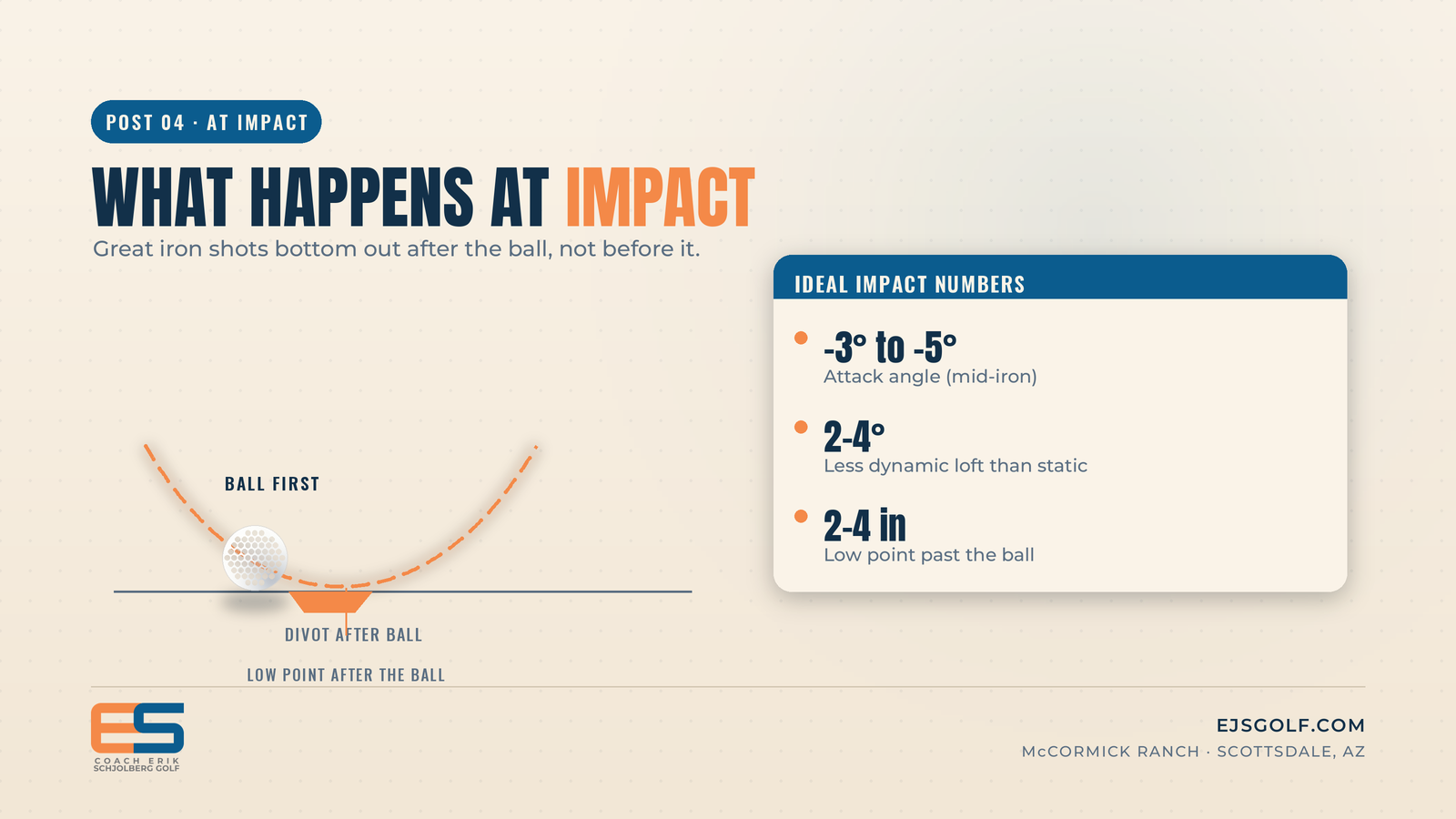
When I analyze a golfer's impact data on TrackMan, poor low point control immediately stands out. It's not just about hitting behind the ball; it's about a fundamental misunderstanding of how the club head should interact with the ground and the ball.
A golfer struggling with low point control typically exhibits an attack angle that is too shallow or even ascending with irons, or too steeply descending with a driver. This often results in a dynamic loft that is either too high (scooping) or too low (driving the ball into the ground), leading to significant spin loft issues and a dramatic loss of ball speed and carry distance.
The divot, if present, will be inconsistent-either too far behind the ball, indicating a fat shot, or non-existent, suggesting a thin or bladed contact. The club face might be attempting to compensate for the poor low point, leading to erratic face-to-path numbers and unpredictable start lines and curvatures.
This isn't a matter of 'feel'; it's a measurable mechanical reality. The club head is simply not reaching its lowest point at the correct position relative to the ball, which for irons, means just after the ball, creating that coveted ball-first, then turf contact. Without this, true compression and consistent ball striking are impossible.
The Cause Upstream: Pressure Shift and Sequencing
In my experience coaching serious golfers in Scottsdale, the root cause of poor low point control almost invariably traces back to an inefficient pressure shift and flawed sequencing in the downswing. Many golfers attempt to control the low point with their hands and arms, trying to 'hold lag' or 'force a descending blow,' but this is a symptom-based approach. The true mechanism is far more fundamental: it begins with how you use the ground.
If your pressure does not shift effectively to your lead side early enough in the downswing, your body will instinctively try to save the shot. This often manifests as an early extension, a 'flip' of the club head, or a desperate attempt to shallow the club too late.
The result? The club head bottoms out too early, behind the ball, leading to those frustrating fat or thin shots. I teach that the golf swing is a chain reaction, and if the first link-the pressure shift-is broken, the entire sequence unravels.
Without a dynamic and timely transfer of pressure to the lead foot, the body cannot rotate efficiently, the hands and arms cannot deliver the club head on the correct path, and low point control becomes a game of chance. This is why I emphasize understanding the body's role in creating a functional impact, a core tenet of The Science of Better Golf system.
Another critical factor is the relationship between your lead wrist conditions and the club face. While not the primary cause of low point location, an unstable or excessively extended lead wrist at impact can certainly exacerbate low point issues and make consistent ball-first contact nearly impossible.
If the lead wrist is extended (cupped) at impact, it adds dynamic loft and often causes the club head to 'bounce' off the turf prematurely, leading to thin shots. Conversely, excessive flexion (bowing) can deloft the club too much, driving the club head into the ground too early.
The goal is a relatively flat lead wrist at impact, allowing the club face to remain stable and the club head to maintain its intended path through the hitting zone. This interplay of pressure, sequencing, and wrist conditions is what I diagnose daily in my Scottsdale Golf Lessons, because understanding the cause is the only path to a lasting fix.
What I Change First: Mastering the Lead Side Pressure Shift
When a golfer comes to me in Scottsdale struggling with low point control, my first priority is almost always to address their lead side pressure shift. This isn't about simply moving your weight; it's about understanding the dynamic transfer of energy that allows the club head to approach the ball from the correct angle and bottom out precisely where it should.
The impact target I set for my students is clear: I want to see a significant majority of their pressure-typically 70-80%-on their lead foot by the time the club head reaches impact (P7). This isn't a static position; it's the culmination of a dynamic movement that begins early in the downswing. When this pressure shift is correctly executed, it naturally pulls the low point forward, ensuring that the club head makes contact with the ball first, followed by the turf. This single change unlocks a cascade of positive effects.
Why is this the primary fix? Because a proper lead side pressure shift is the engine that drives the entire downswing sequence. It allows the lead hip to clear, creating space for the arms and club to drop into the slot. It promotes a more descending angle of attack with irons, increasing compression and reducing dynamic loft. It also stabilizes the lead side, providing a firm brace against which the club can be delivered powerfully and consistently. Without this foundational movement, any attempt to manipulate the club head or hands will be a compensatory move, leading to inconsistency and frustration.
I see it daily in my Scottsdale Golf Lessons: golfers trying to force a descending blow with their arms, only to find their low point still behind the ball because their body isn't supporting the movement. By focusing on the lead side pressure shift, we address the root cause, allowing the golfer to naturally achieve the ball-first contact that defines true ball striking. This is a core principle of The Science of Better Golf philosophy—addressing the cause, not just the symptom.
Drills That Make the Change Stick
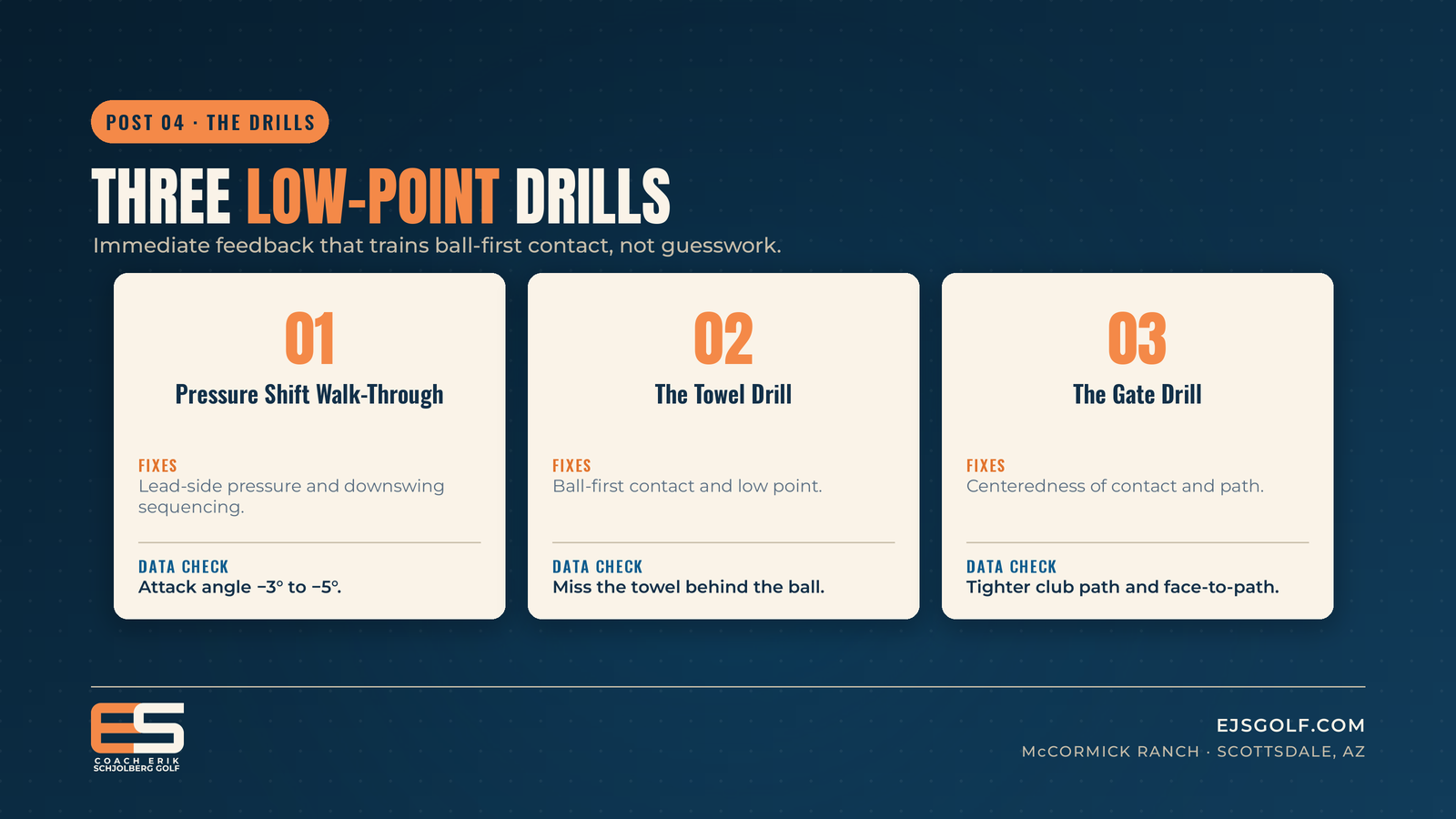
To engrain the proper lead side pressure shift and achieve consistent low point control, I use a series of drills that provide immediate, undeniable feedback. These aren't about 'feel' alone; they're about measurable changes you can see and replicate. The goal is to create a motor pattern that naturally delivers the club head to the ball first, then the turf.
Drill 1: The Lead-Side Pressure Shift Walk-Through
This drill is foundational for understanding how to use your lower body to drive the downswing and control your low point. It directly addresses the upstream cause of poor low point control: an insufficient lead side pressure shift.
To set up for this drill, start with a short iron (8-iron or 9-iron) and address the ball as normal. However, instead of your usual stance, place your trail foot directly next to your lead foot, almost like you are standing at attention. The ball should be positioned off the lead heel. This exaggerates the feeling of starting with pressure on the lead side.
From this narrow stance, take a normal backswing. As you initiate the downswing, step your trail foot back to its normal address position. The key is that this step back initiates the downswing and helps you feel the pressure transferring to your lead side. As your trail foot plants, focus on rotating your lead hip open and delivering the club head to the ball. The feeling should be that your lead side is pulling the club through impact, not your arms.
You should feel a distinct shift of pressure into your lead heel and the outside of your lead foot as you step back and begin the downswing. This creates a stable, braced lead side. You should also feel your lead hip rotating aggressively open, clearing the way for the club head. The sensation is one of your body leading the club, rather than your arms dominating the motion. It is a powerful, athletic move.
The most immediate feedback is the divot. You should see a shallow, consistent divot that starts after the ball. If the divot is behind the ball, you have not shifted enough pressure forward. Another key indicator is the sound and feel of impact—a crisp, solid strike that feels like the ball is compressed against the club face. On TrackMan, we are looking for a more negative attack angle (for irons) and a lower dynamic loft, indicating a more powerful, penetrating ball flight. The ball should launch with a predictable start line and controlled curvature. If you are still hitting thin or fat, exaggerate the pressure shift even more.
The most common failure is not committing to the pressure shift, allowing the trail side to hang back. This often leads to a 'hang back' or 'reverse pivot' feeling. Another failure is trying to swing too hard with the arms, overriding the body's lead. Focus on the lower body initiating the movement. You can find more drills like this in my free drills guide.
On TrackMan, we aim for an attack angle of -3 to -5 degrees with a mid-iron, and a dynamic loft that is 2-4 degrees less than the static loft of the club. This indicates a powerful, descending blow. You should also see a significant improvement in smash factor, indicating better centeredness of contact. The ball flight will be more penetrating, with less spin, leading to greater distance and control.
Drill 2: The Towel Drill for Ball-First Contact
This classic drill is excellent for providing immediate, undeniable feedback on your low point control and ensuring you are hitting the ball before the turf.
To set up for this drill, place a small hand towel about 2-3 inches behind your golf ball. The goal is to hit the ball cleanly without touching the towel. Use a mid-iron (7-iron or 8-iron) for this drill.
Execute your normal swing, focusing on the lead-side pressure shift we discussed. Your objective is to strike the ball first, then take a divot after the ball, leaving the towel undisturbed. This forces you to control your low point and ensure a descending blow.
You should feel a crisp, clean strike on the ball. The sensation is that the club head is moving down and through the ball, not trying to scoop it. You will immediately know if you have failed if you hit the towel. Success means the towel stays put, and you hear and feel solid contact.
Common failures include hitting the towel, which indicates your low point is still too far behind the ball, or trying to lift the ball, which often results in a thin shot. If you are hitting the towel, slow down your swing and exaggerate the feeling of shifting your pressure to your lead side and letting the club head work down into the ball.
The measurable result is consistent ball-first contact, which will be evident in the flight of the ballmore penetrating, less spin, and a predictable trajectory. On TrackMan, this translates to a consistent attack angle and dynamic loft, leading to improved smash factor and tighter dispersion. This drill is a cornerstone for building the habit of ball-first, then turf contact.
Drill 3: The Gate Drill for Centeredness of Contact and Low Point
This constraint drill refines both low point control and centeredness of contact, crucial for maximizing energy transfer and consistency.
To set up for this drill, place two alignment sticks or golf tees in the ground, one just outside the toe of your club head and one just inside the heel, creating a narrow 'gate' for your club head to pass through at impact. The gate should be just wide enough for your club head to pass without touching either stick. Place the golf ball in the center of this gate. Use a mid-iron.
Execute your swing, focusing on delivering the club head through the gate and striking the ball cleanly. The constraint of the gate immediately tells you if your club head path is off or if you are struggling with centeredness of contact. This drill also indirectly helps low point control, as an inconsistent low point often leads to an inconsistent club head path through impact.
You should feel the club head passing freely through the gate, making solid contact with the ball. The feedback is instant: if you hit either stick, you know your club head path or centeredness of contact needs adjustment. Success is a clean pass through the gate and a solid strike. This drill forces precision.
Common failures include hitting the inside stick (indicating an out-to-in path or a tendency to hit off the heel) or hitting the outside stick (indicating an in-to-out path or a tendency to hit off the toe). Adjust your swing thought to focus on a neutral path and maintaining the club head's center through impact. This drill, combined with the pressure shift and towel drills, builds a comprehensive approach to impact mastery.
On TrackMan, this drill helps refine club path and face-to-path numbers, leading to more consistent start lines and controlled curvature. Improved centeredness of contact will also boost your smash factor, translating directly to more ball speed and distance. The ultimate measurable result is a tighter dispersion pattern and more consistent distances, which are hallmarks of a true ball-striking machine.
Your Next Seven Days: A Practice Protocol for Low Point Mastery
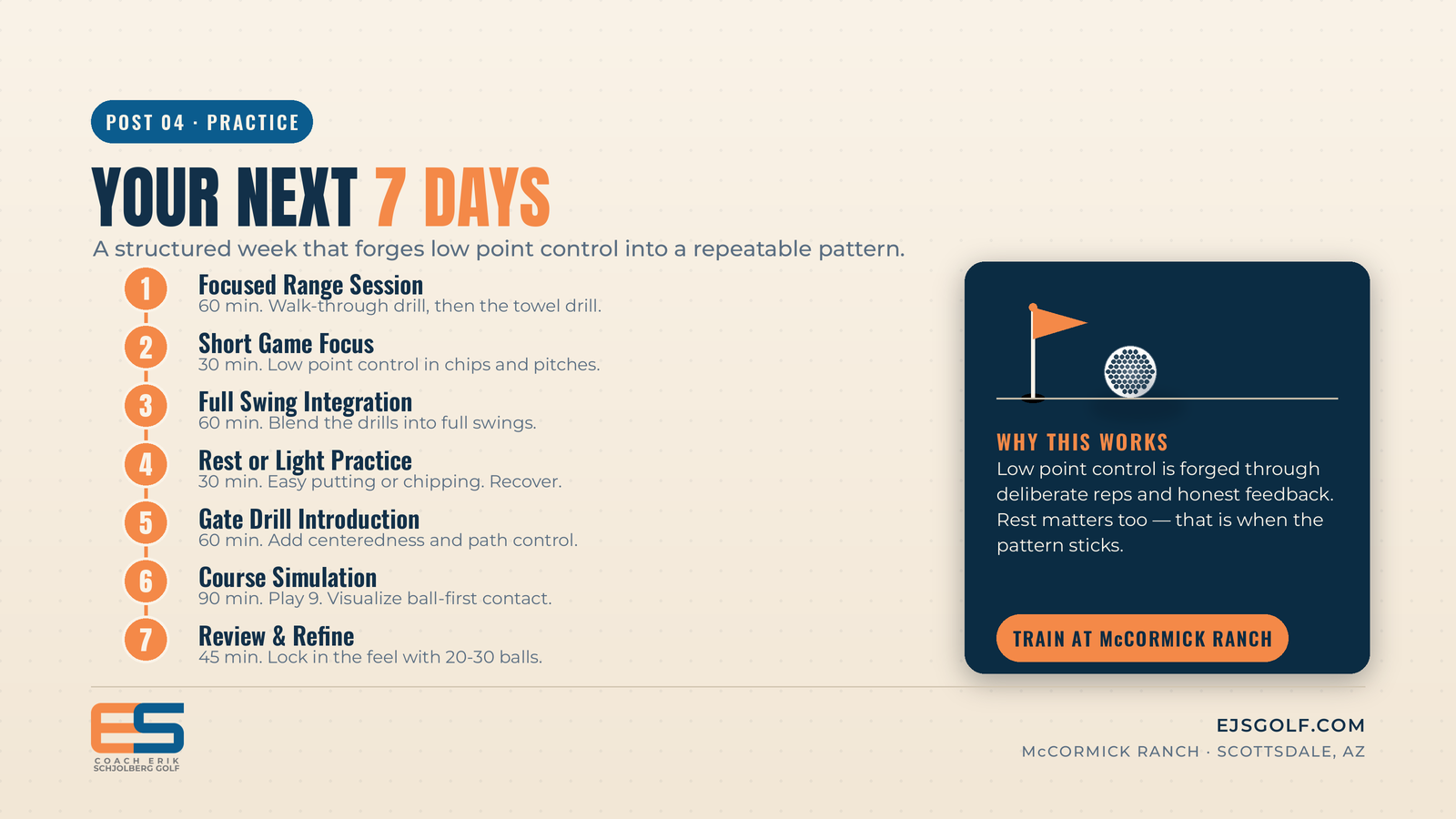
Consistent low point control isn't built in a single session; it's forged through deliberate, structured practice. Here's how I would guide a student through the next seven days to solidify the gains from these drills.
Day 1: Focused Range Session (60 minutes)
Start with a 15-minute dynamic warm-up. Dedicate the first 30 minutes exclusively to the Lead-Side Pressure Shift Walk-Through drill. Hit 10-15 balls, focusing purely on the pressure shift and the feeling of the lead side pulling the club. Observe your divots. Take a 5-minute break. For the next 15 minutes, integrate the Towel Drill. Hit 10-15 balls, ensuring you clear the towel every time. The goal for today is to establish the feel of ball-first contact. Do not worry about ball flight too much, just the strike. Finish with 10 minutes of light stretching.
Day 2: Short Game Focus (30 minutes)
Take a break from full swings. Practice chipping and pitching, focusing on low point control. Use the Towel Drill concept around the green. Place a towel behind your ball and practice hitting clean chips. This reinforces the ball-first contact without the complexity of a full swing. Pay attention to the sound and feel of impact.
Day 3: Full Swing Integration (60 minutes)
Warm up for 15 minutes. Spend 20 minutes on the Lead-Side Pressure Shift Walk-Through, then 20 minutes on the Towel Drill. Now, for the final 10 minutes, hit balls with your mid-irons without any aids, trying to replicate the feelings and mechanics from the drills. Pay attention to your divot location and the crispness of contact. Record a few swings on your phone if possible and review them, looking for that lead-side drive. This is where you start to integrate the new pattern into your natural swing. If you are serious about measurable improvement, consider booking an online golf lesson with me to review your progress.
Day 4: Rest or Light Practice (30 minutes)
Rest is crucial for motor learning. If you feel fresh, spend 30 minutes on light putting or chipping. If you are tired, take the day off. Review your swing videos from Day 3 and visualize the correct movements.
Day 5: Gate Drill Introduction (60 minutes)
After a 15-minute warm-up, spend 20 minutes revisiting the Lead-Side Pressure Shift Walk-Through and Towel Drill. Then, introduce the Gate Drill for 25 minutes. Start slowly, ensuring you can pass the club head through the gate without touching the sticks. Focus on centeredness of contact. This drill will sharpen your club head delivery. Finish with 10 minutes of full swings, trying to combine the pressure shift, ball-first contact, and precise club head path. This is where the pieces start to come together.
Day 6: Course Simulation (90 minutes)
Play 9 holes, but with a purpose. On every iron shot, visualize the Lead-Side Pressure Shift and the ball-first contact. Don't worry about score; focus on the quality of strike and divot. If you hit a poor shot, take a moment to reset and visualize the correct movement before your next shot. This is where the practice transfers to the course. Pay attention to how your body reacts under pressure and what adjustments you need to make. This is where you truly test your low point control under real conditions.
Day 7: Review and Refine (45 minutes)
Hit a small bucket of balls (20-30). Focus on replicating the feeling of the lead-side pressure shift and ball-first contact. Review your notes from the week. What felt good? What still needs work? This is a diagnostic session. If you are consistently hitting solid shots with predictable divots, you have made significant progress. If you are still struggling, it is time to reassess. Remember, the goal is measurable improvement, and if you are not seeing it, we need to adjust the plan. This is the essence of The Science of Better Golf – constant evaluation and refinement. For personalized feedback and to refine your low point control even further, consider booking a Scottsdale Golf Lesson with me at McCormick Ranch or exploring my online golf lessons program.
Train With Me in Scottsdale: Master Your Low Point
My coaching philosophy, "The Science of Better Golf," is built on delivering measurable, immediate improvement. If you are serious about transforming your ball striking and mastering low point control, I invite you to train with me. At EJS Golf, located at the beautiful McCormick Ranch Golf Club in Scottsdale, Arizona, I utilize state-of-the-art technology like TrackMan and high-speed video to precisely diagnose your swing and provide you with clear, actionable fixes. My Scottsdale Golf Lessons are not about generic tips; they are about understanding the cause-and-effect relationships in your swing and building a functional, repeatable impact. Many of my students, just like you, come to me frustrated with inconsistent contact, and they leave with a clear understanding of their swing, a personalized drill progression, and most importantly, immediate improvement in their ball striking. Whether you are a local resident or visiting our beautiful city, I am here to help you unlock your true potential on the golf course. Don't settle for vague advice; demand measurable results.
Frequently Asked Questions
How does low point control affect my iron play?
Low point control is paramount for effective iron play because it dictates whether you strike the ball first, then the turf. With irons, a slightly descending blow is ideal. If your low point is behind the ball, you will hit fat shots, losing distance and control. If your low point is too far in front, you might hit thin shots or struggle to get the ball airborne. Consistent low point control ensures optimal compression, proper spin, and predictable trajectory, which are all critical for hitting greens and controlling your distances. It's the foundation of crisp iron contact.
Can I improve low point control without a TrackMan?
Absolutely. While TrackMan provides invaluable data for precise diagnosis and measurable feedback, you can significantly improve your low point control through diligent practice with simple aids. Drills like the Towel Drill or observing your divot patterns provide immediate, tangible feedback. The key is understanding the cause-and-effect: if your divot is behind the ball, your low point is too far back. If you're hitting thin, your low point might be too far forward or you're adding loft. Focus on the lead-side pressure shift and the feeling of ball-first contact, and you'll see improvement. For a deeper dive into drills you can do anywhere, check out my free drills guide.
What is the relationship between low point and shaft lean?
Low point control and shaft lean are intimately connected. Proper forward shaft lean at impact is a result of effective low point control, not a cause. When your low point is correctly positioned just after the ball, the club head is still moving downwards, naturally creating forward shaft lean. If your low point is behind the ball, you'll often see a lack of shaft lean or even negative shaft lean (shaft leaning away from the target), as the body tries to scoop the ball. The lead-side pressure shift is the primary driver for both. Master the pressure shift, and both your low point and shaft lean will improve concurrently, leading to that powerful, compressed impact I teach in my Scottsdale Golf Lessons.
Does low point control matter with a driver?
Yes, low point control is crucial for driver performance, though the objective is different than with irons. With a driver, the ideal low point is typically slightly before the ball, allowing for a slightly ascending blow at impact. This helps reduce spin and maximize launch angle, leading to greater distance. If your low point is too far behind the ball with a driver, you'll hit up on it too much, potentially creating too much spin or even topping the ball. If your low point is too far in front, you'll hit down on it, losing distance and potentially creating a slice. Understanding and controlling your low point with the driver is key to optimizing launch conditions and maximizing your tee shot distance and accuracy.
How quickly can I improve my low point control?
With focused effort and the right drills, you can see measurable improvement in your low point control from day one. My coaching philosophy rejects the idea that you must get worse before you get better. By understanding the cause (pressure shift and sequencing) and applying the correct drills with immediate feedback, my students at McCormick Ranch often experience a significant shift in their ball striking within their first session. Consistency takes time and repetition, but the initial breakthrough can be remarkably fast. The key is to practice with purpose and to understand what you are trying to achieve, rather than just hitting balls. If you're ready for immediate, measurable improvement, consider starting with my online golf lessons or an in-person session.
What are common misconceptions about low point control?
One of the most common misconceptions is that low point control is solely about hand action or trying to force a descending blow. In reality, low point control is primarily a function of your body's dynamic movement, specifically your pressure shift and sequencing. Another misconception is that a large divot always indicates good low point control. While a divot is desirable with irons, its depth and location are more important than its size. A deep, fat divot behind the ball indicates poor low point control, while a shallow, consistent divot after the ball signifies optimal impact. Finally, many golfers believe they need to 'keep their head down' to control the low point, which is a myth that often leads to restricted rotation and further issues. Focus on the body's movement, not static positions or outdated advice.
Train With Me in Scottsdale: Master Your Low Point
My coaching philosophy, "The Science of Better Golf," is built on delivering measurable, immediate improvement. If you are serious about transforming your ball striking and mastering low point control, I invite you to train with me. At EJS Golf, located at the beautiful McCormick Ranch Golf Club in Scottsdale, Arizona, I utilize state-of-the-art technology like TrackMan and high-speed video to precisely diagnose your swing and provide you with clear, actionable fixes. My Scottsdale Golf Lessons are not about generic tips; they are about understanding the cause-and-effect relationships in your swing and building a functional, repeatable impact. Many of my students, just like you, come to me frustrated with inconsistent contact, and they leave with a clear understanding of their swing, a personalized drill progression, and most importantly, immediate improvement in their ball striking. Whether you are a local resident or visiting our beautiful city, I am here to help you unlock your true potential on the golf course. Don't settle for vague advice; demand measurable results.
Related EJS Golf Reading
The Science of Better Golf: Scottsdale Golf Lessons for Data
Scottsdale Golf Lessons: Real Student Results & Data-Driven Fixes
Ground Reaction Forces: Power Leaks & Scottsdale Golf Lessons
About Coach Erik Schjolberg
Coach Erik Schjolberg is a professional golf instructor based in Scottsdale, Arizona, and the founder of EJS Golf at McCormick Ranch Golf Club. With a philosophy centered on "The Science of Better Golf," Erik specializes in impact-first instruction, utilizing advanced technology like TrackMan and biomechanics tools to provide data-driven insights. He is dedicated to helping golfers achieve measurable, immediate improvement by focusing on cause-and-effect relationships in the swing, rather than generic advice. His coaching empowers students to become ball-striking machines, understanding their unique matchups and mastering crucial elements like low point control, shaft lean, and pressure shift.
Ready to Transform Your Game?
Mastering low point control is a game-changer for any serious golfer. It's the key to consistent ball-first contact, optimal compression, and predictable ball flight. Don't let inconsistent strikes hold you back any longer. Take the first step towards becoming a ball-striking machine. Download my free drills guide for more actionable insights, or better yet, book your Scottsdale Golf Lessons with me at McCormick Ranch. For those outside of Scottsdale, my online golf lessons offer the same data-driven diagnosis and personalized coaching, no matter where you are in the world. Let's build your better golf swing, starting today.
Related EJS Golf Reading
Scottsdale Golf Lessons: What to Expect from Data-Driven Coaching
Why I Don't Chase Golf Digest Rankings - And Why My Students' Handicaps Tell the Real Story
Master Low Point Control: Scottsdale Golf Lessons for Better Impact
The Science of Better Golf: Why Scottsdale's Most Serious Players Are Choosing Data Over Feel
Scottsdale Golf Lessons: Data-Driven Ball Striking Improvement
Scottsdale Golf Lessons: Real Student Results & Data-Driven Fixes
Get my full drill library at EJSGolf.com/my-drills
Read more at EJSGolf.com/blog
Book a session at EJSGolf.com
Follow me and reach out to me on:


