
Scottsdale Golf Lessons: Real Student Results & Data-Driven Fixes
Every golfer I meet in Scottsdale, Arizona, comes to me with a story of frustration. They’ve tried countless tips, watched endless YouTube videos, and perhaps even taken lessons that promised much but delivered little in the way of lasting change.
They’re tired of the vague advice and the fleeting improvements. What they truly seek is measurable progress, a clear understanding of why their ball does what it does, and a definitive path to consistent, functional impact.
This article isn't about feel-good stories; it's about the undeniable truth revealed by data. I'm going to show you how my approach to Scottsdale Golf Lessons focuses on real student results, demonstrating precisely how improvement should be measured, why data unequivocally beats vague testimonials, and what objective metrics truly prove progress in your golf swing. If you're ready to move beyond guesswork and into a world where every swing change is backed by hard numbers, you're in the right place.
The Short Answer
Real golf improvement is measured through objective data, not subjective testimonials. My Scottsdale Golf Lessons utilize advanced technology like TrackMan to quantify changes in critical impact variables such as low point, attack angle, dynamic loft, and club face control. This data provides irrefutable evidence of progress, allowing us to diagnose root causes, implement precise fixes, and ensure that every student achieves measurable, lasting improvement from day one.
What Is Really Happening at Impact: The Truth About Student Results
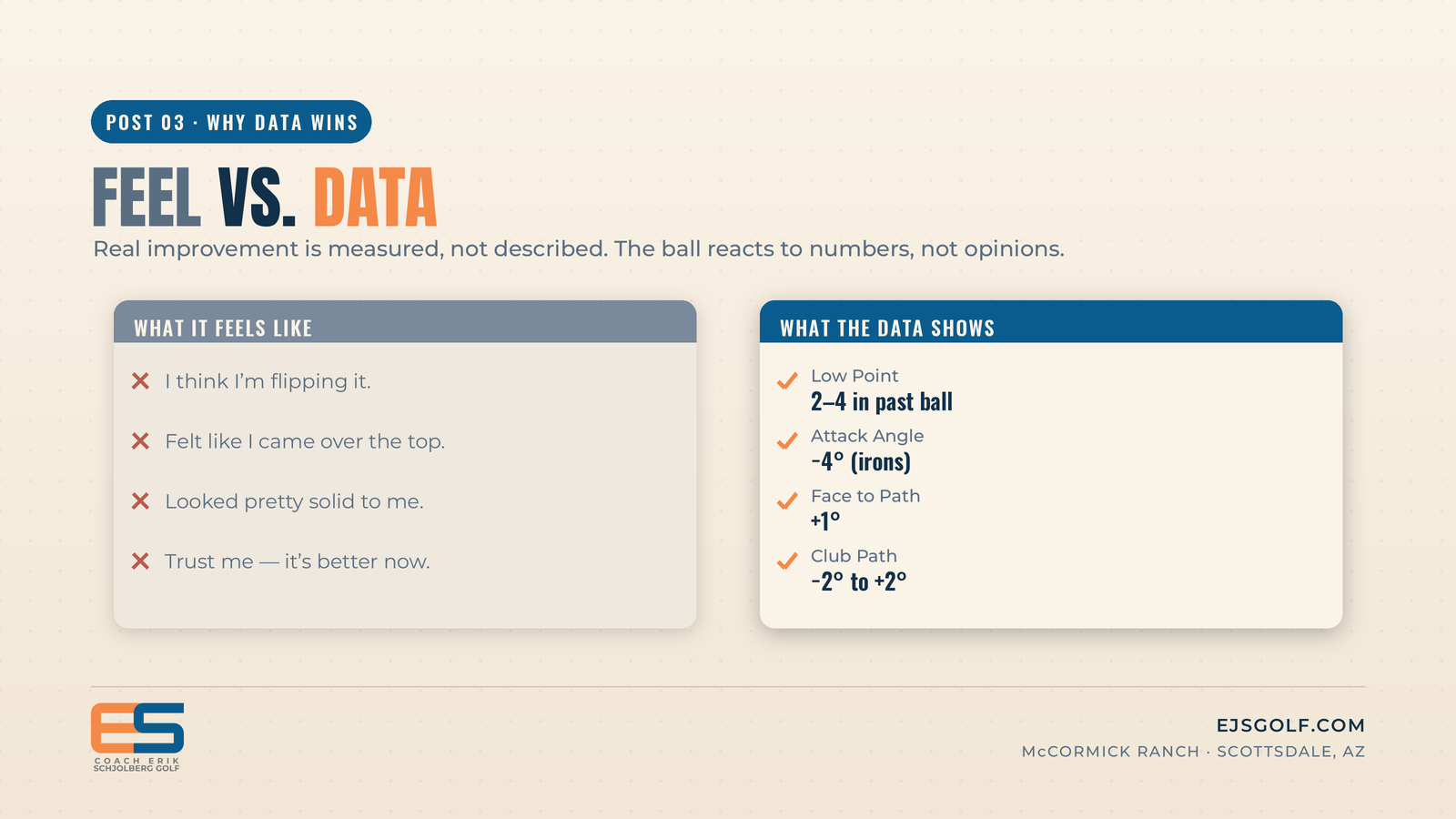
When a golfer comes to me, they often describe symptoms: a slice that won't quit, thin shots, fat shots, or a general lack of power. These are merely the ball flight and contact outcomes. My job, as a science-driven golf coach, is to work backward from these outcomes to understand what is really happening at impact. The golf ball does not make mistakes; it simply reacts to the club face and club head at the moment of truth. Vague testimonials about ‘feeling better’ or ‘hitting it further’ are meaningless without objective proof. This is why I reject them. My focus is on what the data reveals.
Consider the golfer who struggles with inconsistent contact. They might say they are ‘flipping’ at impact. While that’s a common observation, it’s not a diagnosis. A true diagnosis comes from understanding the underlying mechanics. For instance, a common pattern I see in Scottsdale Golf Lessons is a golfer whose low point is consistently behind the ball. This forces them to add loft and ‘flip’ the club head through impact to make contact, leading to weak, inconsistent strikes. The TrackMan data will show a positive attack angle with irons (hitting up on the ball), an excessively high dynamic loft, and often a poor smash factor. These are not opinions; these are facts. This is the measurable truth that allows me to pinpoint the exact issue.
Another example is the golfer who struggles with a persistent slice. They might feel like they are swinging ‘over the top.’ Again, a common observation. But what does the data say? TrackMan will often reveal an out-to-in club path and an open club face relative to that path. The ball flight confirms this: a left-to-right shot for a right-handed golfer. The problem isn't just the 'over the top' feel; it's the combination of path and club face orientation at impact. Without this precise data, we are guessing. With it, we have a roadmap for improvement. This is the foundation of The Science of Better Golf system, where every fix is rooted in measurable reality.
My students in Scottsdale don't just feel like they're getting better; they know they are. We track key impact variables: low point control, attack angle, dynamic loft, club face control relative to path, shaft lean, and centeredness of contact. These are the metrics that directly dictate ball flight and impact quality. When these numbers improve, so does performance. This is why I don't chase Golf Digest rankings; I chase measurable student outcomes. The data tells the real story of progress, not anecdotal evidence. It’s about transforming a golfer from someone who hopes to hit it well into a ball-striking machine that knows how to produce functional impact consistently.
The Cause Upstream: Why Vague Advice Fails and Data Prevails
Understanding what happens at impact is crucial, but it’s only half the battle. To truly fix a problem, we must trace it back to its root cause, the upstream motion that dictates the downstream result. This is where vague advice like “keep your head down” or “swing easy” utterly fails. These clichés address symptoms, not causes, and often lead to compensations that create new problems. My coaching philosophy, honed through countless hours of Scottsdale Golf Lessons and deep analysis, is built on identifying these precise cause-and-effect relationships.
Take the example of the golfer with the low point behind the ball, leading to a positive attack angle with irons. The root cause is rarely a conscious decision to hit up on the ball. More often, it stems from a failure in pressure shift or sequencing during the downswing. If a golfer fails to adequately shift their pressure to their lead side early enough, or if their upper body outraces their lower body, the club head will naturally bottom out too early. This forces the body to compensate, often by extending the trail wrist (the dreaded ‘flip’) to try and salvage contact. Without force plate data or high-speed video analysis, this critical pressure shift issue often goes undiagnosed, leaving the golfer to endlessly chase cosmetic positions that offer no real solution.
Similarly, the persistent slice, characterized by an out-to-in path and open club face, isn't just about a poor swing thought. It’s often rooted in how the golfer initiates the downswing and manages the club face. An early, steep descent of the club, often accompanied by an open club face, forces the golfer to swing across the ball to make contact. This can be a result of poor wrist conditions at the top of the backswing, where the lead wrist is extended (cupped) and the club face is wide open. This open club face then dictates an out-to-in path as the body attempts to square it, leading to the characteristic slice. My work with students involves using tools like HackMotion to precisely measure these wrist angles, providing objective feedback that video alone cannot.
My approach is to strip away the guesswork. I don't teach generic swing models; I teach matchups. Every golfer's grip, body type, and natural tendencies create a unique set of circumstances. The goal is to optimize these matchups for functional impact, not to force a player into an unnatural, uncomfortable, or inefficient position. This means understanding how a strong grip might require a different release pattern than a weak grip, or how a golfer with limited hip mobility needs a different pressure shift strategy. This individualized, data-driven diagnosis is what truly separates effective coaching from the endless cycle of tips and temporary fixes. It’s about understanding the why behind the what, and that understanding is the bedrock of impact-first instruction.
What I Change First: Focusing on Measurable Impact Variables
When a student comes to me for Scottsdale Golf Lessons, my priority is always the fastest, clearest, most effective fix that leads to measurable improvement on day one. I reject the notion that golfers must get worse before they get better. That’s an excuse for ineffective coaching. My standard is simple: ball first, then turf, with proper shaft lean, rotation, low point control, compression, a predictable start line, and controlled curvature. To achieve this, I focus on one primary change at a time, targeting the most impactful variable revealed by our initial data analysis.
For the golfer struggling with a low point behind the ball and a positive attack angle with irons, my first focus is almost always on improving their pressure shift into the lead side during the downswing. This is a fundamental driver of low point control and proper shaft lean. If the pressure isn't moving correctly, everything else becomes a compensation. We use force plates to provide immediate, objective feedback on their pressure trace, allowing them to feel and see the correct movement. The target is a clear, early shift of pressure to the lead foot, peaking around impact, which naturally helps the club bottom out in front of the ball.
For the slicer with an out-to-in path and an open club face, my initial focus often shifts to club face control and the lead wrist condition at the top of the backswing and through transition. An open club face at the top often dictates the rest of the downswing. By using a HackMotion sensor, we can identify if the lead wrist is excessively extended (cupped), which opens the club face. My primary fix would be to encourage a flatter or slightly flexed lead wrist at the top, which helps square the club face earlier and allows for a more in-to-out path. This single change can dramatically reduce the need for compensatory movements and lead to a more neutral club path and a square club face at impact.
I don't overwhelm students with multiple swing thoughts. We identify the single most critical variable, understand its root cause through data, and then implement a targeted fix. This focused approach ensures that the change is not only measurable but also sustainable. It’s about building a solid foundation based on cause and effect, not chasing fleeting feels. This is the essence of data-driven golf instruction, where every adjustment is a step towards becoming a true ball-striking machine.
Drills That Make the Change Stick: Data-Backed Practice for Scottsdale Golfers
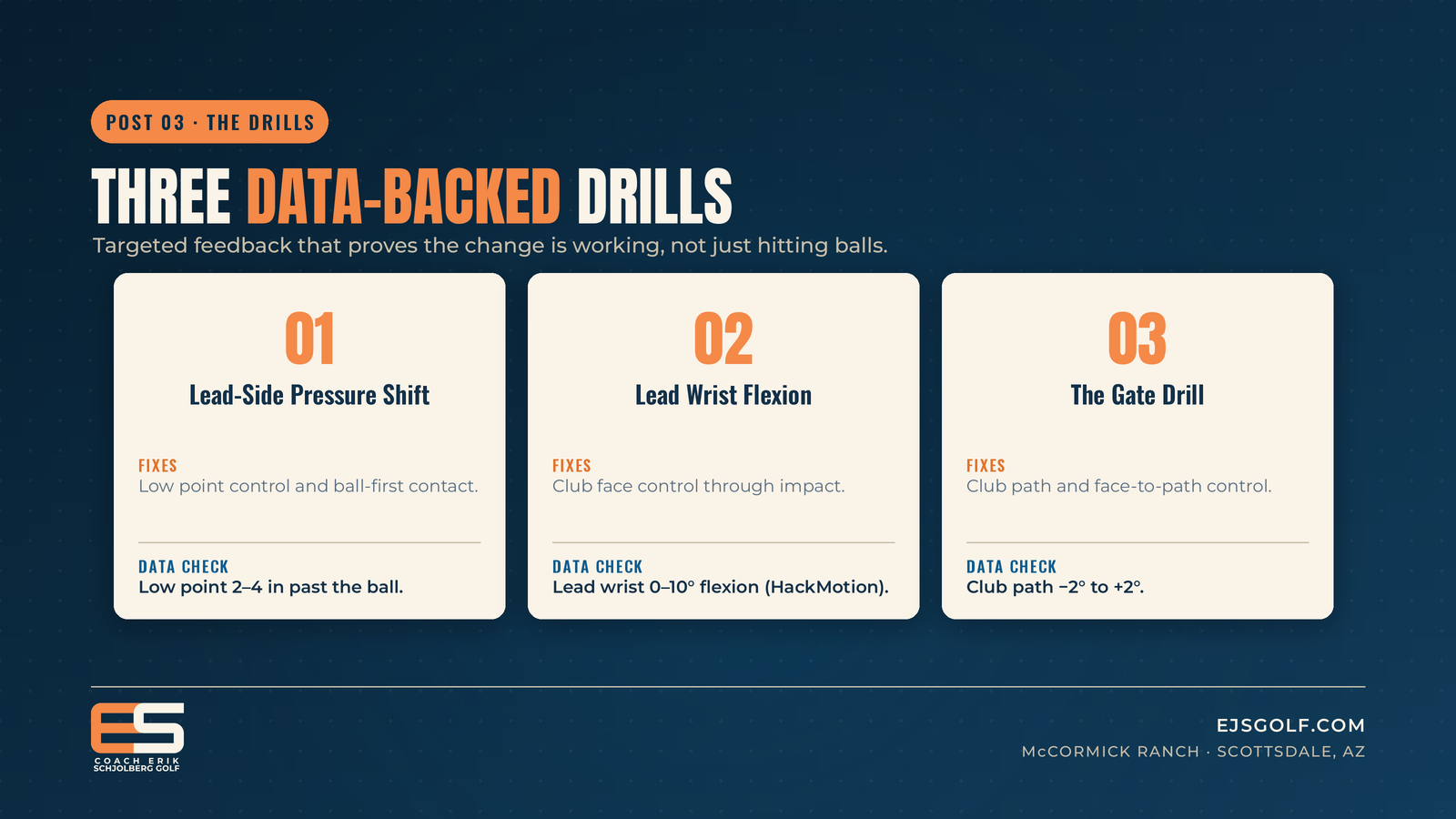
Effective drills are not about mindless repetition; they are about targeted feedback that reinforces the desired change and provides measurable results. My drills are designed to be constraint-led, meaning they guide the golfer into the correct movement pattern without requiring complex swing thoughts. Here are a few examples of the types of drills I use in my Scottsdale Golf Lessons to create lasting change, always backed by data.
Drill 1: The Lead-Side Pressure Shift Drill (for Low Point Control)
Setup: Begin with a short iron (7-iron or 8-iron). Place an alignment stick about 6-8 inches in front of your lead foot, parallel to the target line. Your goal is to make a divot after the ball, on the target side of the alignment stick.
Execution: Make half swings, focusing intensely on feeling your pressure shift fully to your lead foot before the club head reaches the ball. Imagine pushing off your trail foot and rotating around your lead hip. The sensation should be one of driving your lead hip towards the target and feeling grounded on your lead side at impact. Do not try to hit the ball hard; focus on the pressure transfer.
What the Golfer Should Feel: You should feel a distinct weight transfer to your lead side, almost like you are posting up on your lead leg. Your trail heel might naturally lift off the ground. The feeling is less about swinging your arms and more about driving your body to create the low point. You should feel your lead hip rotating open and clearing out of the way.
Feedback That Confirms Success: The primary feedback is the divot. It must be on the target side of the ball, ideally just past the alignment stick. If your divot is behind the ball, you haven't shifted your pressure effectively. TrackMan data will confirm this with a negative attack angle (hitting down on the ball) and a low point location that is consistently in front of the ball. You should also see improved compression and smash factor, indicating more efficient energy transfer.
Common Failures: The most common failure is staying on the trail side too long, resulting in a divot behind the ball. Another is trying to force the club down with the arms, which often leads to a steep, out-to-in path. The key is to let the body's pressure shift and rotation create the downward strike, not the arms.
Measurable Result to Check: Consistent low point location (TrackMan: Low Point parameter) in front of the ball (e.g., -2 to -4 inches for a 7-iron). Attack angle (TrackMan: Attack Angle parameter) should be negative (e.g., -3 to -5 degrees for a 7-iron). Improved smash factor (TrackMan: Smash Factor parameter) above 1.40.
Drill 2: The Lead Wrist Flexion Drill (for Club Face Control)
Setup: Use a HackMotion sensor on your lead wrist if available. If not, use a visual cue like a flat lead wrist at the top of the backswing. Start with half swings, focusing on the transition.
Execution: During the backswing, ensure your lead wrist remains flat or slightly flexed (bowed), avoiding any extension (cupping). As you transition into the downswing, maintain this flat or slightly flexed lead wrist. The goal is to deliver the club face square or slightly closed to the path at impact. Focus on the feeling of the back of your lead hand facing the target throughout the downswing.
What the Golfer Should Feel: You should feel a sense of control over the club face, almost like the club face is ‘hooded’ or slightly closed. There should be no feeling of the club face opening excessively. For those with a tendency to cup the lead wrist, this will feel like a significant change, potentially even feeling like you are bowing your wrist too much initially.
Feedback That Confirms Success: With HackMotion, the data is immediate: your lead wrist flexion numbers should be within your target range (e.g., 0 to 10 degrees of flexion at impact, depending on your grip and desired club face). Without HackMotion, visual feedback from video can help confirm a flat or slightly flexed lead wrist. Ball flight feedback is also critical: a reduction in slice or fade, and a more predictable start line. The club face should be square or slightly closed to the target line at impact.
Common Failures: The most common failure is reverting to the old habit of cupping the lead wrist, especially under pressure. Another is trying to force the wrist into position, which can create tension. The key is to make it a natural, fluid motion, focusing on the feel of the club face remaining stable.
Measurable Result to Check: HackMotion: Lead Wrist Flexion (target range 0-10 degrees flexion at impact). TrackMan: Face to Path closer to zero, indicating a more square club face relative to the path. Club Face Angle at impact closer to zero (square to target).
Constraint Drill: The Gate Drill (for Path and Face Control)
Setup: Place two alignment sticks vertically in the ground, forming a narrow gate just outside the target line, about 6-8 inches in front of the ball. The gate should be wide enough for your club head to pass through without touching, but narrow enough to provide a clear constraint. The goal is to swing through the gate without hitting either stick.
Execution: Start with half swings, focusing on swinging the club head through the gate. This drill forces you to control both your club path and club face. If you swing too far out-to-in, you’ll hit the outside stick. If you swing too far in-to-out with an open club face, you’ll hit the inside stick. The constraint provides immediate, undeniable feedback. Gradually increase swing speed and range of motion as you become more proficient.
What the Golfer Should Feel: You should feel a sense of precision and control over the club head’s movement through impact. It encourages a more neutral club path and a stable club face. For those who tend to swing excessively out-to-in, it will feel like you are swinging more to the right (for a right-handed golfer). For those who struggle with an open club face, it will encourage a feeling of squaring the face earlier.
Feedback That Confirms Success: The most obvious feedback is not hitting the sticks. Consistent passage through the gate indicates improved path and face control. Ball flight will show a straighter shot, or a slight draw if you are working on an in-to-out path with a square-to-slightly-closed club face. TrackMan data will confirm a more neutral Club Path and Face to Path number.
Common Failures: Hitting the sticks, which provides immediate feedback that your path or face control is off. Trying to steer the club, which often leads to tension and poor contact. The key is to trust the constraint to guide your swing, rather than consciously manipulating the club.
Measurable Result to Check: TrackMan: Club Path closer to zero (e.g., -2 to +2 degrees). Face to Path closer to zero. Improved Centeredness of Contact on the club face.
Your Next Seven Days: A Data-Driven Practice Protocol
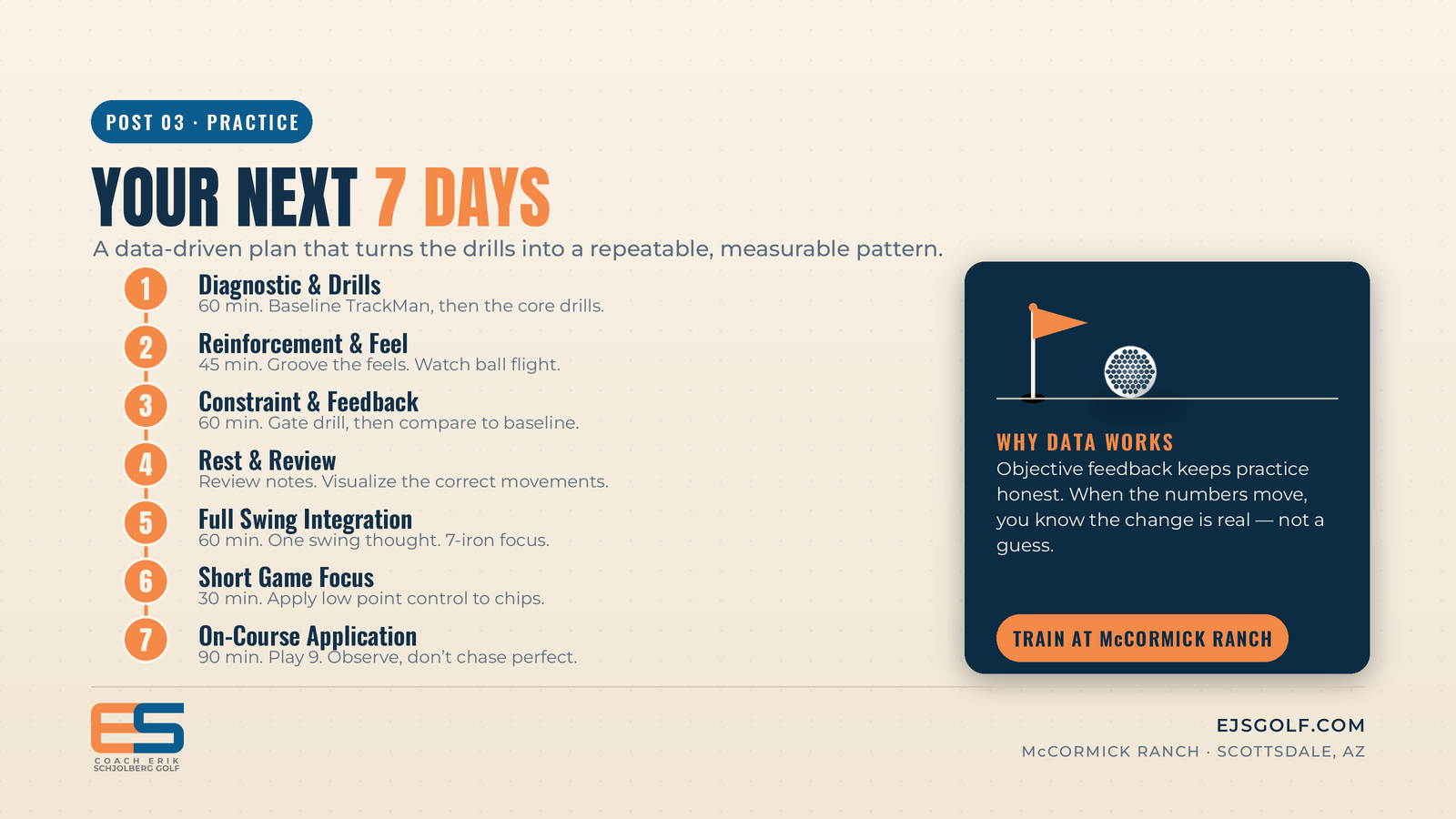
Consistency is built through deliberate practice, not just hitting balls. Here’s a structured practice plan designed to integrate the changes from your Scottsdale Golf Lessons and ensure measurable progress. Remember, the goal is not just to swing, but to learn and adapt based on feedback.
Day 1: Diagnostic & Drill Introduction (60 minutes)
Warm-up (10 min): Dynamic stretches, light swings.
Baseline Data (10 min): Hit 10-15 balls with a 7-iron, recording TrackMan data (Low Point, Attack Angle, Face to Path, Club Face Angle). This is your starting point.
Drill Focus (30 min): Spend 15 minutes on the Lead-Side Pressure Shift Drill, focusing on divot location and feel. Then, 15 minutes on the Lead Wrist Flexion Drill (with HackMotion if available), focusing on wrist position and club face control. Hit 5-10 balls after each set of practice swings to check ball flight.
Cool-down (10 min): Light stretching.
Day 2: Reinforcement & Feel (45 minutes)
Warm-up (5 min): Review key feels from Day 1.
Drill Focus (30 min): 15 minutes on Lead-Side Pressure Shift, 15 minutes on Lead Wrist Flexion. Focus purely on the feel of the correct movement. Don't worry about ball flight yet.
Integration (10 min): Hit 10 balls with a 7-iron, trying to integrate the feels without overthinking. Observe ball flight.
Day 3: Constraint & Feedback (60 minutes)
Warm-up (10 min): Dynamic stretches.
Drill Focus (30 min): 15 minutes on the Lead-Side Pressure Shift Drill, 15 minutes on the Gate Drill. Pay close attention to the immediate feedback from the constraint. If you hit a stick, understand why.
Data Check (10 min): Hit 10 balls with a 7-iron, recording TrackMan data. Compare to Day 1 baseline. Look for small improvements.
Cool-down (10 min): Light stretching.
Day 4: Rest & Review
Review notes from your lesson and practice sessions. Visualize the correct movements and feels.
Day 5: Full Swing Integration (60 minutes)
Warm-up (10 min): Focus on the feels from the drills.
Drill Refresher (15 min): Quick 5-minute refresh on each drill.
Full Swings (30 min): Hit 20-30 balls with a 7-iron, focusing on one key thought from your drills (e.g., “lead-side pressure shift”). Don't try to implement everything at once. Record TrackMan data for every 5-10 balls.
Cool-down (5 min): Light stretching.
Day 6: Short Game Focus (30 minutes)
Practice chipping and pitching, applying the principles of low point control and club face stability to your short game. This helps transfer the feel.
Day 7: On-Course Application (90 minutes)
Play 9 holes. Focus on one swing thought from your practice. Don't chase perfection; simply observe how your new movements translate to the course. Note any patterns or areas for further improvement. The goal is to apply, not to perfect.
This structured approach, combined with the objective feedback from technology, ensures that your practice is efficient and leads to tangible results. It’s how my students in Scottsdale consistently improve.
Train With Me in Scottsdale: Experience Real Improvement
If you’re serious about transforming your golf game and are tired of generic advice that yields no lasting results, then it’s time to experience the difference of data-driven coaching. My studio at McCormick Ranch Golf Club in Scottsdale, Arizona, is equipped with the latest technology-TrackMan, HackMotion, force plates-to provide you with the most precise diagnosis and effective solutions available. I don’t guess; I measure. I don’t offer temporary fixes; I build sustainable, functional impact patterns.
My commitment to you is simple: measurable improvement from day one. Whether you’re a local Scottsdale golfer looking for in-person Scottsdale Golf Lessons or seeking to refine your swing from anywhere in the world through my online golf lessons program, my approach is consistent: identify the root cause, implement a targeted fix, and confirm progress with objective data. Stop wasting time on methods that don’t work. Invest in a coaching philosophy that is built to create measurable progress instead of vague hope. Book your introductory lesson today and let’s start building your ball-striking machine.
Frequently Asked Questions
Q1: How do you measure real improvement in golf lessons?
I measure real improvement through objective data collected from advanced technology like TrackMan and HackMotion. This includes quantifying changes in critical impact variables such as low point location, attack angle, dynamic loft, club face angle, and club path. We also track ball speed, carry distance, and dispersion patterns. For long-term progress, we monitor handicap index movement and scoring averages. Unlike subjective assessments, these metrics provide irrefutable evidence of a golfer's progress and the effectiveness of the coaching. Every lesson begins and ends with data, ensuring transparency and accountability in the improvement process.
Q2: Why do you emphasize data over testimonials?
While testimonials can offer social proof, they are inherently subjective and lack the precision required for true golf instruction. Data, on the other hand, provides objective, quantifiable evidence of what is actually happening in a golfer's swing and at impact. My emphasis on data ensures that diagnoses are accurate, fixes are targeted, and improvements are measurable and repeatable. It removes guesswork and allows both myself and my students to understand the exact cause-and-effect relationships in their swing. This scientific approach is the cornerstone of The Science of Better Golf, ensuring that every student receives coaching based on verifiable facts, not anecdotal feelings.
Q3: What are the most common metrics you track for student progress?
For irons, I primarily track low point location, attack angle, dynamic loft, club face angle, and club path. These five metrics are paramount for consistent ball-first contact and optimal trajectory. For drivers, we focus on attack angle, club speed, ball speed, smash factor, and launch angle to maximize distance and efficiency. Additionally, HackMotion data provides precise insights into lead and trail wrist angles, which are crucial for club face control. We also monitor pressure shift patterns using force plates. These comprehensive metrics allow me to build a complete picture of a golfer's swing and track their progress with unparalleled accuracy.
Q4: Can I see measurable improvement in my first lesson?
Absolutely. My coaching philosophy is built on the premise that improvement should begin on day one. During your introductory Scottsdale Golf Lessons, we establish a baseline using TrackMan and other technologies. We then identify the most critical root cause of your primary issue and implement a targeted fix. In nearly every case, students see immediate, measurable changes in their impact data—whether it's a more consistent low point, a squarer club face, or improved attack angle. This initial success is not a fluke; it's a demonstration of the power of data-driven diagnosis and precise instruction, proving that getting better doesn't have to mean getting worse first.
Q5: How do your Scottsdale Golf Lessons differ from traditional instruction?
My Scottsdale Golf Lessons differ significantly from traditional instruction by prioritizing data-driven diagnosis and individualized matchups over generic swing models or feel-based advice. Traditional lessons often focus on cosmetic positions or subjective feelings, which rarely translate to lasting improvement. I use advanced technology to identify the precise mechanical cause of your ball flight issues, then prescribe constraint-led drills that force the correct movement. My approach is impact-first, meaning we work backward from the desired ball flight and impact conditions to optimize your unique swing. This scientific, cause-and-effect methodology ensures faster, more sustainable results, transforming golfers into true ball-striking machines.
Coach Erik Schjolberg: The Science of Better Golf
I am Coach Erik Schjolberg, founder of EJS Golf at McCormick Ranch Golf Club in Scottsdale, Arizona. My coaching philosophy, "The Science of Better Golf," is dedicated to helping golfers achieve rapid, measurable improvement through a data-driven, impact-first approach. I leverage cutting-edge technology like TrackMan, HackMotion, and force plates to diagnose root causes, not just symptoms, and provide precise, individualized instruction. I believe in teaching understanding, performance, and real change, rejecting generic tips in favor of verifiable facts. My goal is to empower every student to become a ball-striking machine, equipped with the knowledge and skills to consistently produce functional impact.
Related EJS Golf Reading
Scottsdale Golf Lessons: What to Expect from Data-Driven Coaching
Why I Don't Chase Golf Digest Rankings - And Why My Students' Handicaps Tell the Real Story
Master Low Point Control: Scottsdale Golf Lessons for Better Impact
The Science of Better Golf: Why Scottsdale's Most Serious Players Are Choosing Data Over Feel
Scottsdale Golf Lessons: Data-Driven Ball Striking Improvement
If you're ready to move beyond the frustration of inconsistent golf and embrace a proven path to measurable improvement, my Scottsdale Golf Lessons are your next step. I invite you to explore my free drills guide to get started with actionable insights, or better yet, book your first session at McCormick Ranch Golf Club. Stop guessing and start improving. The data doesn't lie, and neither do the results my students achieve. Let's build your ball-striking machine together. Your journey to better golf starts now.
Get my full drill library at EJSGolf.com/my-drills
Read more at EJSGolf.com/blog
Book a session at EJSGolf.com
Follow me and reach out to me on:


