
EJS GOLF BLOG
Learn about the golf swing and what you can do to improve your score on the golf course. Fill out the form below if you have any questions or want to set up a time to talk.
Mastering the Art of Golf with Coach Erik Schjolberg
I’m Coach Erik Schjolberg, and welcome to the EJS Golf blog—Scottsdale’s authority on science-driven ball-striking. Here you’ll find in-depth analyses of swing mechanics, data-backed breakdowns of impact and launch dynamics, and actionable practice routines designed to rewire your muscle memory from day one. Each post peels back the curtain on cause-and-effect in your swing, whether you’re chasing Tour-level precision, collegiate consistency, or lower weekend scores. Dive into our deep-dive articles, master the drills that drive real improvement, and transform your game with proven science and strategy.
But let’s be clear: golf isn’t only about perfecting swing mechanics. The mental battle you fight on each tee is often the one that determines whether you stay in the game or walk off the course. Here, we’ll tackle the psychological hurdles—the pressure of a tight leaderboard, the frustration when a swing fails under stress, the self-doubt that creeps in after a bad hole. You’ll learn evidence-based mental strategies—visualization routines, pre-shot rituals, stress-management techniques—that fortify your focus and resilience. Mastering these mind-set tools is just as critical as dialing in your impact position, and I’ll show you exactly how to integrate mental training into your practice for lasting confidence on every shot.
Explore Our Blogs
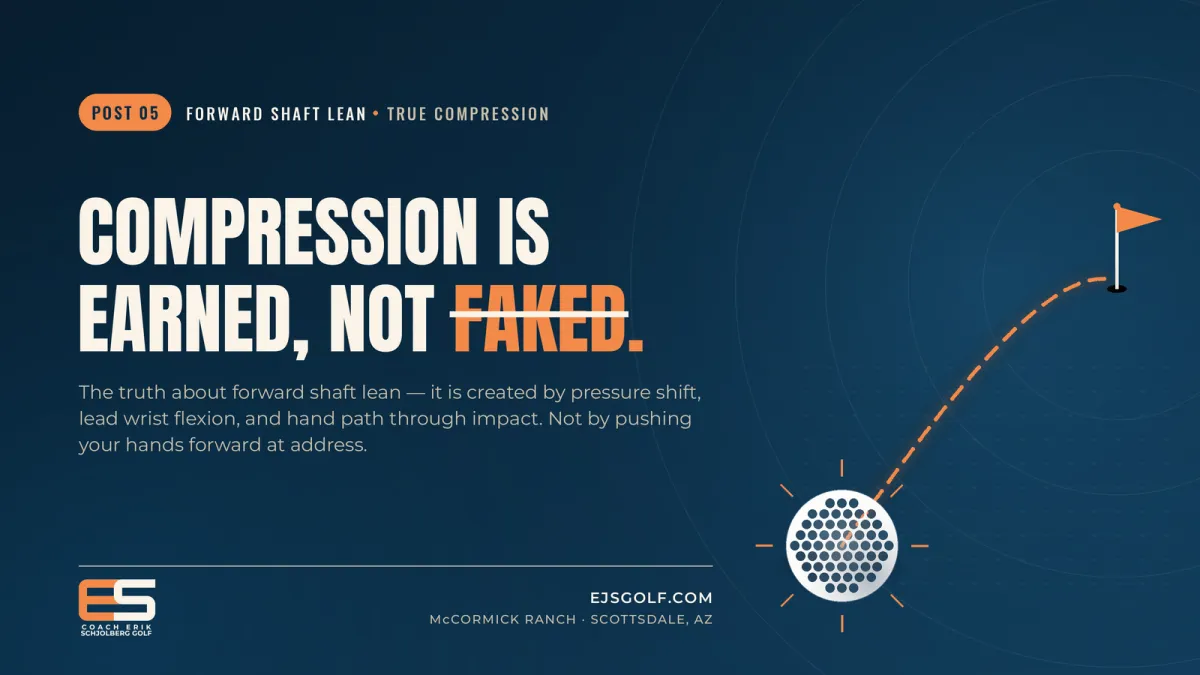
Forward Shaft Lean: Real Mechanics for Better Golf Compression
Forward Shaft Lean: The Truth About Impact and Compression in Scottsdale Golf Lessons
If you’ve ever struggled with inconsistent contact, thin shots, or a lack of power, chances are you’ve heard the advice to “get more forward shaft lean.” It’s a common refrain in golf instruction, often presented as a magic bullet for better ball striking.
But here’s the truth: most golfers, even those taking Scottsdale Golf Lessons, are taught this concept entirely wrong. They’re told to push their hands forward at address, or to hold off the club face through impact, creating a host of new problems.
As a coach who teaches from impact backward, I can tell you that true forward shaft lean is not a position you force; it’s a natural output of a correctly sequenced downswing, a result of precise mechanics that lead to superior compression and control. My goal in this deep dive is to demystify forward shaft lean, explain its true mechanical causes, and provide you with actionable insights and drills that will transform your ball striking, not just cosmetically, but fundamentally.
The Short Answer
Forward shaft lean is the angle of the club shaft leaning towards the target at impact, a critical component for compressing the golf ball, controlling dynamic loft, and achieving ball-first contact. It is not created by static setup positions or forced manipulation, but rather emerges from a proper pressure shift, precise lead wrist conditions, and an efficient hand path in the downswing, leading to a descending blow and optimal energy transfer.
What Is Really Happening at Impact: The Mechanics of True Compression
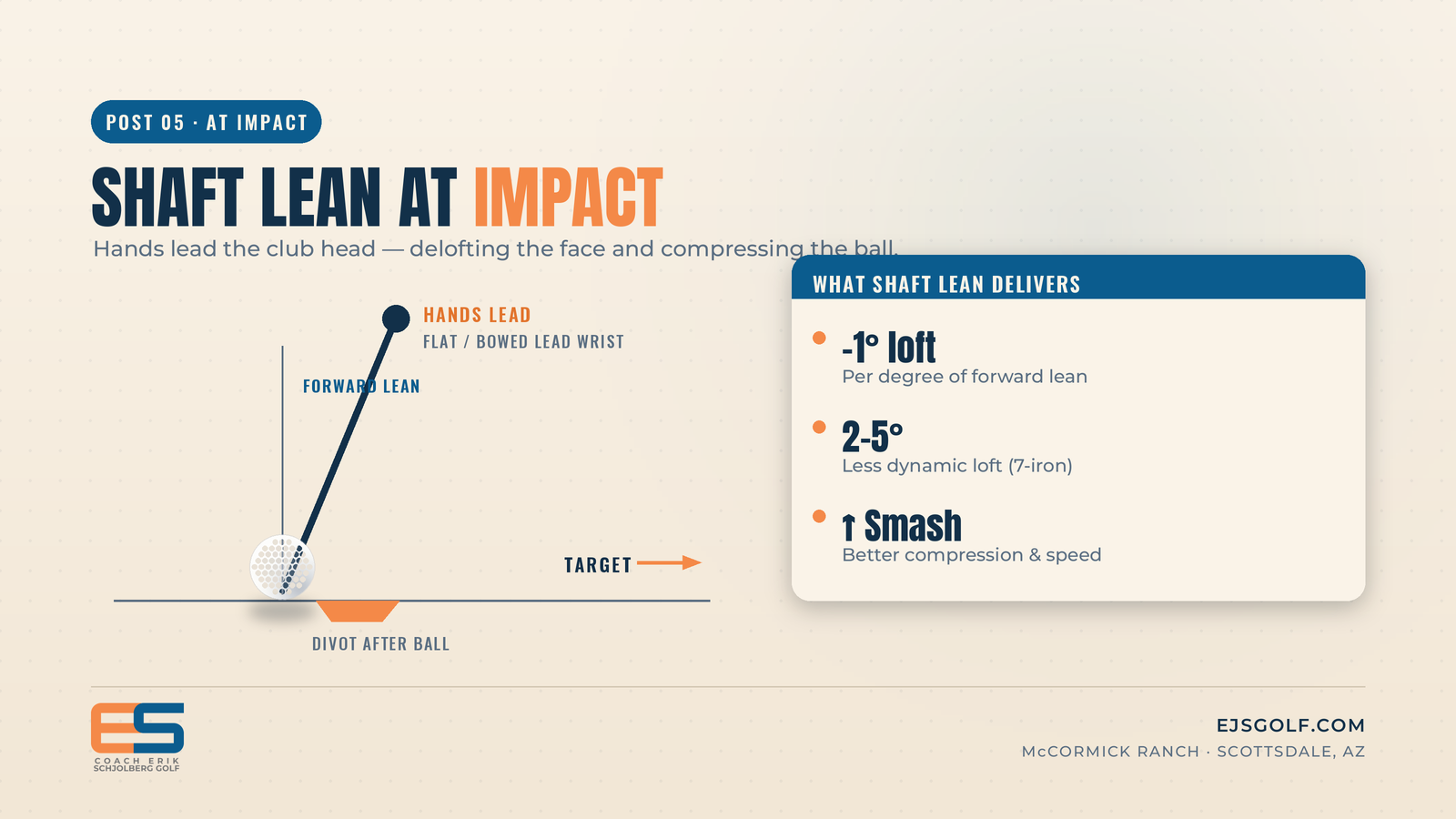
When I analyze a golfer’s impact data on TrackMan, forward shaft lean is one of the most critical metrics I assess. It’s directly linked to several other vital parameters: dynamic loft, attack angle, low point control, and ultimately, compression. Many golfers mistakenly believe that forward shaft lean is simply about having their hands ahead of the club head at impact. While that’s visually true, the why and how are far more complex and often misunderstood. True forward shaft lean is the result of maintaining lag and delivering the club head to the ball with a descending blow, effectively delofting the club face and maximizing energy transfer.
Consider dynamic loft: this is the amount of loft on the club face at the moment of impact. For every degree of forward shaft lean you achieve, you effectively reduce the dynamic loft of the club by approximately one degree. This isn't about hitting down on the ball harder; it's about presenting the club face with less loft, which allows for a more penetrating ball flight, increased ball speed, and greater control over spin. A golfer with a 7-iron that has 34 degrees of static loft might deliver it with 24 degrees of dynamic loft if they have 10 degrees of forward shaft lean. This delofting is what creates the powerful, compressed strike we all chase. Without sufficient forward shaft lean, the dynamic loft increases, leading to higher, weaker shots that lack penetration and distance.
Wrist conditions play an absolutely pivotal role here. Specifically, the condition of your lead wrist (left wrist for right-handed golfers) at impact is a primary determinant of both dynamic loft and shaft lean. A lead wrist that is flat or slightly flexed (bowed) at impact promotes forward shaft lean and delofts the club face. Conversely, a lead wrist that is extended (cupped) at impact adds loft, reduces shaft lean, and often leads to the dreaded flip. I use HackMotion wrist sensors extensively in my Scottsdale Golf Lessons to precisely measure these wrist conditions, because what a golfer feels is often not what is actually happening. The data tells the truth.
Furthermore, forward shaft lean is directly tied to your low point control. For consistent ball-first contact, the low point of your swing arc must occur after the ball. When you achieve proper forward shaft lean, you are inherently setting up a descending blow, ensuring the club head strikes the ball before the turf. This is the hallmark of a true ball striker. Without it, you’re either hitting fat (low point before the ball) or thin (trying to lift the ball, often with an early release that adds loft). The golf ball does not make mistakes; it simply reacts to the club face and path at impact. If you’re struggling with contact, the answer lies in understanding and controlling these impact parameters.
The Cause Upstream: Why You Might Be Lacking Forward Shaft Lean
If you’re not achieving sufficient forward shaft lean, it’s not because you’re not trying hard enough. It’s because there’s a mechanical issue upstream in your swing that prevents it. The most common culprits I see in my students at McCormick Ranch Golf Club in Scottsdale boil down to three interconnected areas: an inefficient pressure shift, incorrect lead wrist conditions in the downswing, and a compromised hand path.
First, let’s talk about pressure shift. Many golfers fail to properly shift their pressure to their lead side early enough in the downswing. They hang back on their trail side, or they slide excessively without rotating. This prevents the body from creating the necessary leverage and space for the club to approach the ball from an effective angle. When pressure remains on the trail side, the body often compensates by releasing the club early (casting or flipping), which actively destroys forward shaft lean and adds dynamic loft. The correct sequence involves a dynamic transfer of pressure to the lead side, initiating the downswing and allowing the club to shallow and lag naturally. This is a foundational concept in The Science of Better Golf and something I emphasize in all my Scottsdale Golf Lessons.
Second, lead wrist conditions are paramount. As mentioned, a cupped (extended) lead wrist at impact is the enemy of forward shaft lean. But where does this cupping come from? Often, it’s a compensation for a club face that is too open in the downswing. To prevent a massive slice, the golfer instinctively extends their lead wrist to square the club face, which simultaneously adds loft and reduces shaft lean. This is a classic example of a golfer trying to fix a symptom (open club face) with a compensatory move that creates another problem (lack of shaft lean, poor compression). My coaching focuses on addressing the root cause – getting the club face in a better position earlier in the downswing – so the lead wrist can remain flat or slightly flexed, naturally promoting forward shaft lean. This is a key insight I share in my discussions on HackMotion wrist angles.
Finally, a compromised hand path can severely limit forward shaft lean. If your hands work too far out and away from your body in the downswing, or if they stall and get stuck behind you, it becomes incredibly difficult to deliver the club with the necessary lag and forward shaft lean. An efficient hand path is one that works slightly inward and then down, allowing the club to shallow and approach the ball from the inside. This creates space for the body to rotate and for the hands to lead the club head effectively through impact. Many golfers struggle with an over-the-top move, which is often a symptom of an inefficient hand path and leads to a steep attack angle and minimal forward shaft lean. Understanding these interconnected elements is crucial for any golfer serious about improving their ball striking, whether they are taking online golf lessons or working with me in person.
What I Change First: Prioritizing the Lead Wrist for Instant Improvement
When a student comes to me in Scottsdale struggling with a lack of forward shaft lean, my first priority is almost always to address the lead wrist condition in the downswing. Why? Because it’s often the most direct and impactful lever we can pull for immediate, measurable change. While pressure shift and hand path are critical, getting the lead wrist into a more functional position often unlocks improvements in those other areas naturally. My goal is to create ball-first contact with proper shaft lean, rotation, low point control, and compression, and the lead wrist is a powerful gateway to that.
I reject the notion that you need to get worse before you get better. My students see improvement on day one. By focusing on the lead wrist, we can quickly influence dynamic loft and attack angle, leading to better compression and a more predictable ball flight. The impact target is simple: deliver the club with a flat or slightly flexed lead wrist, ensuring the club face is stable and the shaft is leaning forward. This single change often eliminates the early release, prevents the club from flipping, and allows the golfer to experience what true compression feels like. It’s about creating a functional impact, not a cosmetic position. This is the core of my impact-first instruction philosophy.
Drills That Make the Change Stick: Mastering the Lead Wrist and Forward Shaft Lean
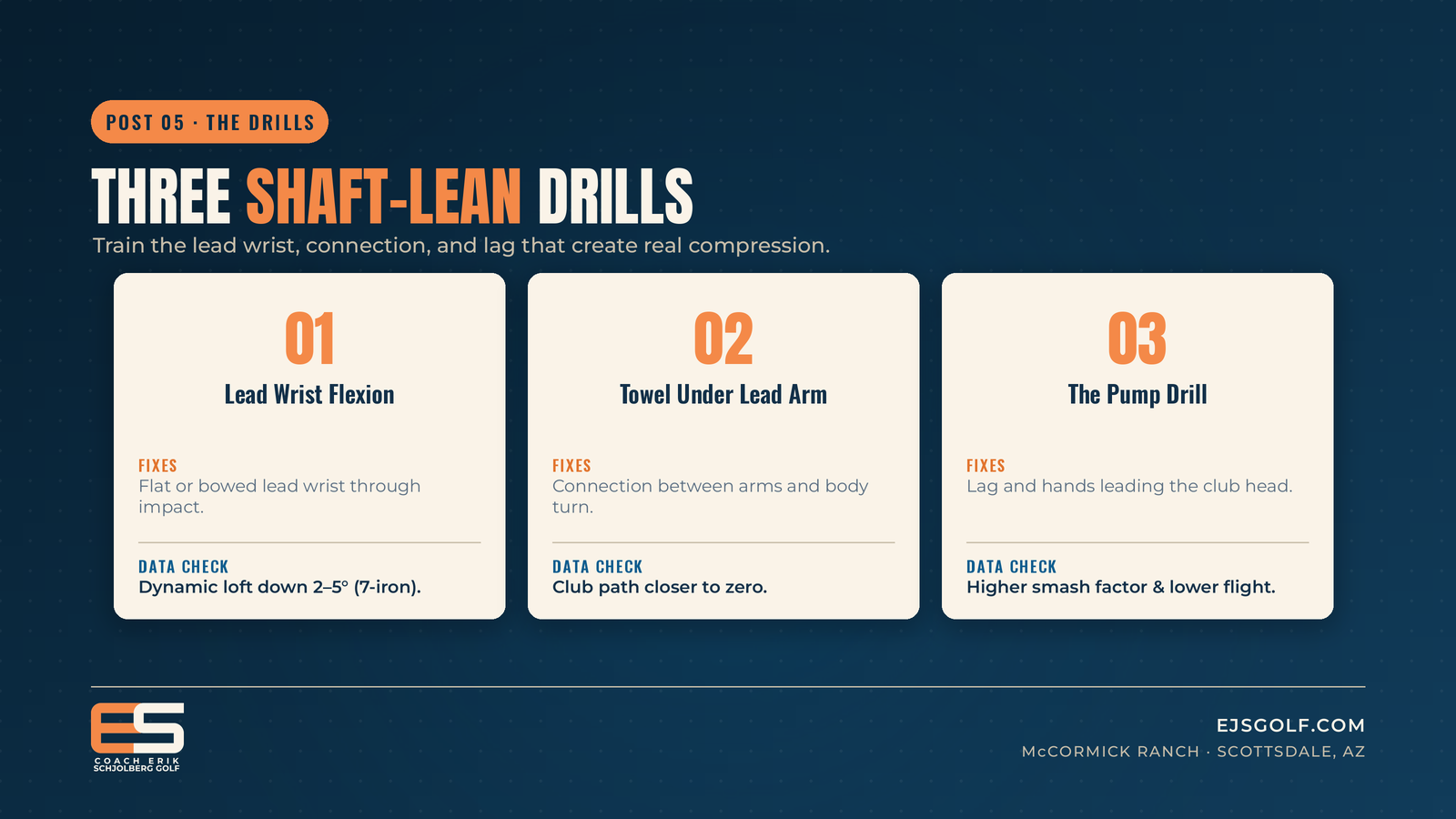
To truly ingrain the feeling and mechanics of a proper lead wrist condition and forward shaft lean, we need drills that provide immediate, undeniable feedback. These aren't about feel-good fluff; they’re about measurable truth. Here are three drills I use with my students to build a functional lead wrist and achieve consistent forward shaft lean.
Drill 1: The Lead Wrist Flexion Drill (Primary Drill)
This drill directly addresses the lead wrist condition, teaching you to maintain flexion (bowing) through impact, which is crucial for delofting the club and achieving forward shaft lean.
Setup: Take your normal address position with a mid-iron (7 or 8 iron). Place a ruler or a thin, flat object (like a credit card) on the back of your lead wrist, underneath your glove. Hold it in place with your trail hand initially, ensuring it’s flat against your wrist. The goal is to keep this object from falling off throughout the swing, especially through impact.
Execution: Make small, controlled swings, focusing solely on keeping the ruler pressed against the back of your lead wrist. Start with half swings, then progress to three-quarter swings. The sensation you’re looking for is a feeling of the back of your lead wrist staying flat or even slightly bowed towards the target. This prevents extension (cupping) and promotes the necessary lead wrist flexion for forward shaft lean. Hit small chips and pitches initially, then gradually increase swing speed.
What the Golfer Should Feel: You should feel a distinct flattening or bowing of your lead wrist, almost as if you’re trying to point the back of your lead hand towards the ground at impact. This will feel very different if you’re used to cupping your wrist. You might also feel the club face staying more stable and less prone to opening or closing rapidly.
Feedback Confirms Success: The most immediate feedback is the ruler staying on your wrist. If it falls off, you’ve extended your lead wrist. On impact, you should see a more penetrating ball flight, a smaller, shallower divot after the ball, and a feeling of the ball being “compressed” rather than scooped. Use impact spray on your club face to confirm centered contact. TrackMan data will show a decrease in dynamic loft and an increase in forward shaft lean.
Common Failures: The most common failure is allowing the ruler to fall off, indicating lead wrist extension. Another is trying to manipulate the club face with your trail hand, which can lead to pulls or pushes. Focus purely on the lead wrist. If you struggle, slow down your swing even further.
Measurable Result: A reduction in dynamic loft (typically 2-5 degrees for a 7-iron) and an increase in forward shaft lean (3-7 degrees) on TrackMan. Your ball flight will be lower and more penetrating, and your divots will be consistently in front of the ball, indicating improved low point control.
Drill 2: The Towel Under the Lead Arm Drill (Constraint Drill)
This drill helps synchronize your body rotation with your arm swing, preventing the arms from getting disconnected and promoting a more efficient path that supports forward shaft lean. It’s a classic constraint drill that I often use in my Scottsdale Golf Lessons.
Setup: Take a small hand towel and fold it once or twice. Place it under your lead armpit, ensuring it’s snug but not overly tight. Take your normal address position with a mid-iron.
Execution: Make half swings, focusing on keeping the towel securely in place throughout the backswing and downswing. The goal is to maintain connection between your lead arm and your torso. If the towel falls out, your lead arm has disconnected, often leading to an over-the-top move or a loss of width. This drill encourages a more compact, connected swing that promotes proper sequencing and allows the club to shallow naturally, which is a prerequisite for effective forward shaft lean.
What the Golfer Should Feel: You should feel a strong connection between your lead arm and your chest. This will likely feel like your arms and body are working together as a unit, rather than your arms swinging independently. It can feel restrictive at first, but this restriction forces better body rotation.
Feedback Confirms Success: The primary feedback is the towel staying under your armpit. If it drops, you know you’ve lost connection. On impact, you should feel a more solid strike and see a straighter ball flight, as the drill helps prevent excessive club path deviations. Video analysis will show a more unified body and arm movement.
Common Failures: The towel falling out too early in the backswing (lack of rotation) or too early in the downswing (arms outracing the body). Another failure is trying to swing too hard, which often leads to disconnection. Focus on smooth, controlled movements.
Measurable Result: Improved club path (closer to zero or slightly in-to-out) and a more consistent strike location on the club face. This drill supports the overall mechanics that allow for better forward shaft lean by improving the swing plane and preventing compensations that lead to early release. It’s a key part of building a ball striking machine.
Drill 3: The Pump Drill (Feel Drill for Lag and Release)
This drill helps you feel the sensation of maintaining lag and delivering the club with forward shaft lean, rather than casting or flipping. It’s a dynamic drill that emphasizes the proper sequence of the downswing.
Setup: Take your normal address position with a mid-iron. Make a full backswing.
Execution: From the top of your backswing, initiate the downswing by shifting your pressure to your lead side. As your hands drop down to about waist height, pause and “pump” the club down slightly, feeling the weight of the club head and the lag you’ve created. Then, continue through to impact, focusing on maintaining that lag and delivering the club with your hands leading the club head. Repeat this pump action 2-3 times before making a full swing. The pump action is not about stopping; it’s about feeling the transition and the club’s position. This helps engrain the feeling of a delayed release and the creation of forward shaft lean. This is a drill I often recommend to students in my online golf lessons as it can be done anywhere.
What the Golfer Should Feel: You should feel a significant amount of lag – the club head trailing your hands – during the pump action. Through impact, you should feel your hands leading the club head, and the club face staying stable and delofted. It’s a powerful, compressed feeling, not a flicking or scooping sensation.
Feedback Confirms Success: The immediate feedback is the sensation of lag and the hands leading through impact. On the range, you’ll see a more penetrating ball flight and a solid, compressed strike. The divot will be consistently in front of the ball. Video analysis will confirm a later release and more forward shaft lean at impact.
Common Failures: Releasing the club too early during the pump, or losing the lag. Another failure is trying to hit the ball too hard from the pumped position, which can lead to tension. Focus on the feeling of lag and the sequence.
Measurable Result: Increased club head speed due to more efficient energy transfer, a higher smash factor, and a noticeable increase in forward shaft lean and reduction in dynamic loft. This drill directly translates to better ball striking and more consistent distance control. You can find more drill progressions like this in my free drills guide.
Your Next Seven Days: A Practice Protocol for Lasting Change
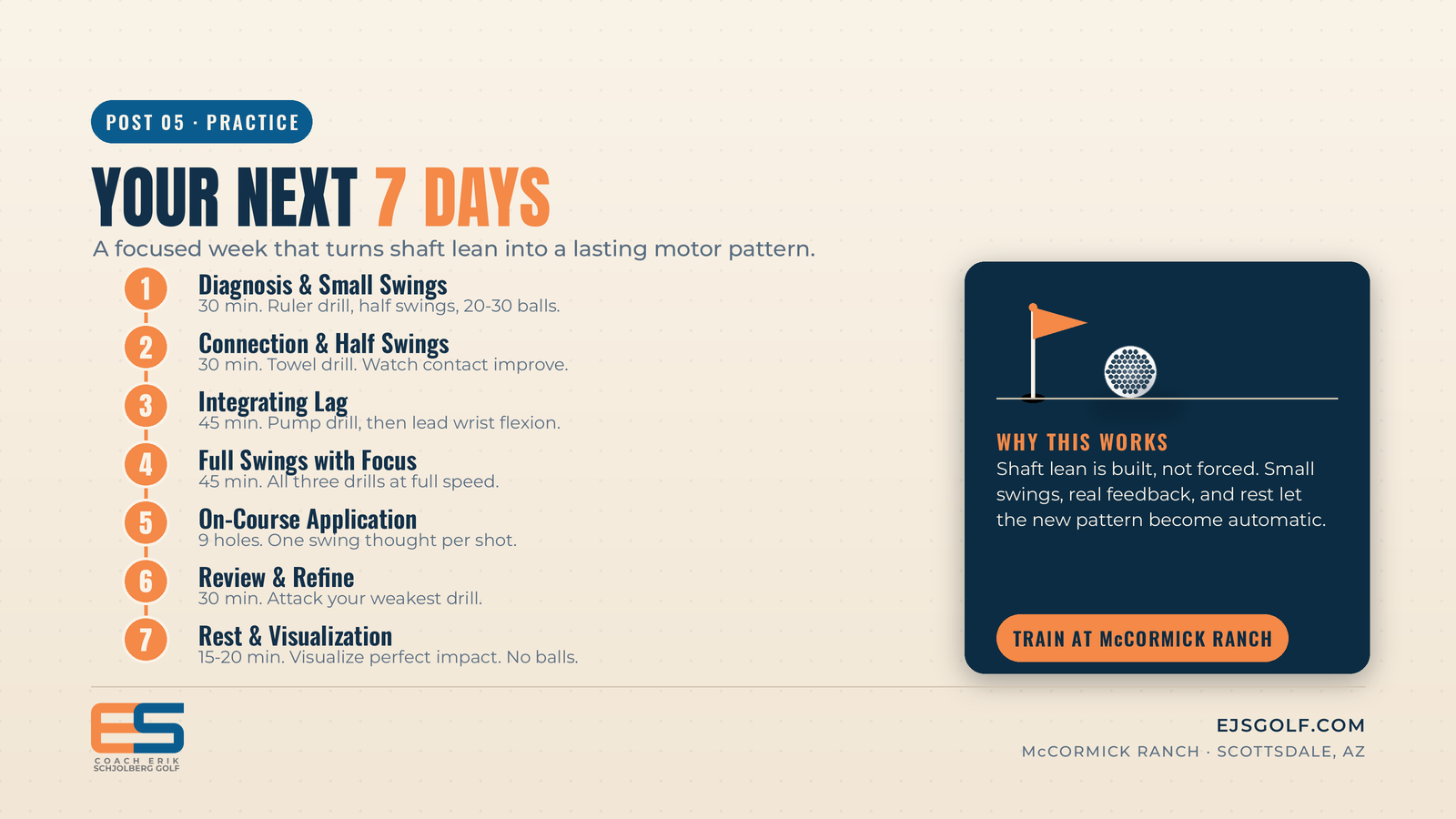
Making a lasting change in your golf swing requires consistent, focused practice. It’s not about hitting a thousand balls; it’s about hitting the right balls with the right intent. Here’s a seven-day practice protocol to help you ingrain proper lead wrist conditions and achieve consistent forward shaft lean.
Day 1: Diagnosis and Small Swings (30 minutes)
Warm-up: 5-10 minutes of dynamic stretches.
Lead Wrist Flexion Drill: 15 minutes. Focus on half swings with the ruler drill. Hit 20-30 balls, prioritizing the feeling of a flat/bowed lead wrist. Don’t worry about distance, focus on contact and feel. Use impact spray to check strike location.
Feedback: Observe ball flight (lower, more penetrating) and divot location (after the ball). If you have access to TrackMan, check dynamic loft and forward shaft lean.
Day 2: Connection and Half Swings (30 minutes)
Warm-up: 5-10 minutes.
Towel Under Lead Arm Drill: 15 minutes. Focus on half swings, keeping the towel in place. Hit 20-30 balls, emphasizing connection and body rotation. If the towel falls, reset and repeat.
Feedback: Note consistency of contact and straighter ball flight. Video yourself to ensure connected movement.
Day 3: Integrating Lag (45 minutes)
Warm-up: 5-10 minutes.
Pump Drill: 15 minutes. Perform 10-15 pump repetitions without a ball, then hit 15-20 balls with the pump drill, focusing on feeling the lag and hands leading. Start with half swings, then progress to three-quarter swings.
Lead Wrist Flexion Drill: 15 minutes. Revisit the ruler drill for 15-20 balls, reinforcing the lead wrist condition.
Feedback: Focus on the compressed feeling at impact and the penetrating ball flight. Track dynamic loft and forward shaft lean if possible.
Day 4: Full Swings with Focus (45 minutes)
Warm-up: 5-10 minutes.
Towel Under Lead Arm Drill: 10 minutes, 10-15 balls, focusing on full swings with connection.
Lead Wrist Flexion Drill: 10 minutes, 10-15 balls, focusing on full swings with a flat/bowed lead wrist.
Pump Drill: 10 minutes, 10-15 balls, focusing on full swings with lag and hands leading.
Feedback: Observe how these drills integrate into your full swing. Are you maintaining the feelings and positions? Record your swing and compare.
Day 5: On-Course Application (9 holes)
Focus: Take the feelings from your practice to the course. On each shot, pick one swing thought related to lead wrist flexion, connection, or lag. Don’t try to hit perfect shots; focus on executing your swing thought.
Self-Correction: If you hit a poor shot, identify which element (lead wrist, connection, lag) broke down and try to correct it on the next shot.
Day 6: Review and Refine (30 minutes)
Warm-up: 5-10 minutes.
Mixed Drills: 20 minutes. Choose the drill you feel you need the most work on and dedicate your time to it. Hit 20-30 balls.
Feedback: Review your notes from Day 5. What worked? What didn’t? Adjust your focus for the next practice session.
Day 7: Rest and Visualization
Take a break from hitting balls. Spend 15-20 minutes visualizing perfect impact, feeling the lead wrist flexion, the connection, and the lag. Mental practice is just as important as physical practice.
Consistency is key. This protocol is designed to build new motor patterns. Stick with it, and you’ll see measurable improvements in your ball striking. Remember, improvement should begin on day one. This is the core of The Science of Better Golf.
Train With Me in Scottsdale: Unlock Your Ball Striking Potential
Are you tired of inconsistent contact, thin shots, and a golf swing that feels out of sync? My Scottsdale Golf Lessons at McCormick Ranch Golf Club are designed to cut through the noise and provide you with clear, data-driven solutions. I don’t teach generic tips; I diagnose the root cause of your ball striking issues using advanced technology like TrackMan and HackMotion, and then provide you with a precise plan for measurable improvement. Whether you’re a local Arizona golfer or visiting Scottsdale, I offer both in-person and online golf lessons to help you become a ball striking machine. My philosophy is simple: ball first, then turf, with proper shaft lean, rotation, low point control, compression, predictable start line, and controlled curvature. If you’re serious about transforming your game, let’s work together.
Frequently Asked Questions
Q: What is forward shaft lean and why is it important?
Forward shaft lean is the angle at which the club shaft leans towards the target at impact. It’s crucial because it effectively delofts the club face, leading to a more penetrating ball flight, increased ball speed, and better compression. Without it, golfers often hit high, weak shots that lack power and control. It’s a key indicator of efficient energy transfer and consistent ball-first contact, which are hallmarks of a skilled ball striker. I focus on this extensively in my Scottsdale Golf Lessons to help students achieve optimal impact.
Q: Can I achieve forward shaft lean by pushing my hands forward at address?
No, absolutely not. This is one of the most common misconceptions in golf instruction. Pushing your hands forward at address creates a static, artificial position that often leads to compensations during the swing. True forward shaft lean is a dynamic event, an output of a correctly sequenced downswing, proper pressure shift, and functional lead wrist conditions. Trying to force it at address will likely lead to a stalled rotation, an early release, or an inability to square the club face naturally, ultimately hindering your ball striking. My approach focuses on building the mechanics that create shaft lean, not forcing a cosmetic position.
Q: How does my lead wrist condition affect forward shaft lean?
Your lead wrist condition is perhaps the most direct determinant of forward shaft lean. A flat or slightly flexed (bowed) lead wrist at impact promotes forward shaft lean and delofts the club. Conversely, an extended (cupped) lead wrist at impact adds loft, reduces shaft lean, and often results in a flipping motion. I use HackMotion wrist sensors to give my students precise, real-time feedback on their wrist conditions, allowing them to make immediate, measurable improvements. Understanding and controlling your lead wrist is fundamental to achieving consistent forward shaft lean and superior ball striking.
Q: What role does low point control play in achieving forward shaft lean?
Low point control is inextricably linked to forward shaft lean. For optimal ball striking, the low point of your swing arc must occur after the ball, ensuring you hit the ball first and then take a divot. Forward shaft lean is a key component in achieving this descending blow. If your low point is behind the ball, you’ll likely be trying to lift the ball, which often involves an early release of the club and a loss of forward shaft lean. By improving your low point control, you naturally create the conditions for effective forward shaft lean, leading to more consistent and powerful contact. These two concepts are foundational to my coaching philosophy.
Q: How can TrackMan help me improve my forward shaft lean?
TrackMan is an invaluable tool for diagnosing and improving forward shaft lean. It provides precise data on your dynamic loft, attack angle, and club path at impact. By measuring these parameters, I can accurately assess your current shaft lean and identify any compensations. For example, if your dynamic loft is too high for a given club, it’s a clear indication of insufficient forward shaft lean. TrackMan allows us to set measurable goals and track your progress in real-time, ensuring that the changes you’re making are actually translating into better impact conditions. It takes the guesswork out of improvement and provides objective truth. This is why TrackMan lessons in Scottsdale are so effective.
Q: Are there different types of forward shaft lean based on my swing or body type?
While the principle of forward shaft lean remains consistent for optimal compression, the amount and mechanics that create it can vary based on a golfer's individual matchups, body type, and swing characteristics. For instance, a golfer with a stronger grip might naturally exhibit different wrist conditions than someone with a weaker grip. My coaching emphasizes that the swing must fit the golfer, but impact must still be functional. This means we work to optimize your forward shaft lean within the context of your unique swing, rather than forcing a generic model. Understanding your individual release patterns and how they interact with shaft lean is key to personalized improvement.
About Coach Erik Schjolberg
Coach Erik Schjolberg is a professional golf instructor based in Scottsdale, Arizona, and the founder of EJS Golf at McCormick Ranch Golf Club. With a philosophy rooted in The Science of Better Golf, Erik specializes in impact-first instruction, helping golfers of all skill levels achieve rapid, measurable improvement. He leverages cutting-edge technology such as TrackMan, HackMotion, and SportsBox AI to provide precise diagnostics and clear, cause-and-effect explanations. Erik is dedicated to debunking golf myths and empowering his students to become ball-striking machines through individualized solutions and drills that transfer quickly to the course. His commitment is simple: improvement from day one.
Related EJS Golf Reading
The Science of Better Golf: Why Scottsdale's Most Serious Players Are Choosing Data Over Feel
Scottsdale Golf Lessons: Data-Driven Ball Striking Improvement
Scottsdale Golf Lessons: Real Student Results & Data-Driven Fixes
Master Low Point Control: Scottsdale Golf Lessons For Better Impact
Conclusion: Your Path to Superior Ball Striking Starts Now
Achieving consistent forward shaft lean is not a mystery; it’s a mastery of fundamental mechanics that lead to superior impact. By understanding the true causes - proper pressure shift, functional lead wrist conditions, and an efficient hand path-you can unlock a new level of compression, control, and power in your golf swing. I’ve seen countless students transform their game by focusing on these core principles, and you can too. Don’t settle for generic advice or cosmetic fixes. Embrace the science, commit to the drills, and experience the satisfaction of hitting the ball with authority. If you’re ready to take your game to the next level, explore my free drills guide or schedule your Scottsdale Golf Lessons with me at McCormick Ranch. Let’s build your ball-striking machine together. You can also find more insights on my blog and follow my swing breakdowns on Instagram or YouTube.
Get my full drill library at EJSGolf.com/my-drills
Read more at EJSGolf.com/blog
Book a session at EJSGolf.com
Follow me and reach out to me on:

What You Can Expect from Our Blog
1. Expert Insights on Swing Mechanics:
With over 25 years of experience as a PGA Professional Golf Instructor, I delve deep into the nuances of golf swing mechanics. My articles break down complex theories into understandable concepts, focusing on ground reaction forces (GRFs), biomechanics, and efficient energy transfer.
2. Advanced Technological Guidance:
Our academy is equipped with state-of-the-art tools like the Trackman 4 Launch Monitor, 3D Pressure Plates, and Hackmotion, among others. On the blog, I share how to leverage these technologies to gain precise feedback on your swing, helping you make informed adjustments and see measurable improvements.
3. Tailored Practice Routines:
My philosophy is built on the belief that improvement should be evident from the first lesson. I advocate a '15 minutes per day' practice model, designed to fit into your busy schedule while ensuring consistent progress. Each blog post aims to offer practice drills and routines that are easy to implement and effective in refining your skills.
4. Real Success Stories:
Read about the experiences of those who have trained at EJS Golf Academy. These testimonials not only inspire but also illustrate the practical application of our teaching methodologies and the real results achieved.
5. Interactive Learning:
We occasionally feature video tutorials and interactive content that allows you to visually grasp techniques and corrections. This blended approach helps reinforce learning and allows you to engage with the content actively.
How Our Blog Helps Golfers Get Better
Every post is crafted with the intent to educate. We cover everything from basic fundamentals to advanced techniques, ensuring there's something valuable for every skill level. By presenting data and evidence-backed strategies, our blog demystifies the 'why' and 'how' behind effective golf training. This analytical approach empowers you to make smarter decisions about your practice and play. We understand that generic advice does not suit everyone. Our blog posts are designed to help you identify your own needs and adapt our techniques accordingly. Whether it’s adjusting your grip, stance, or swing path, you’ll find personalized tips that resonate with your specific challenges. Beyond just reading, our blog serves as a community hub where you can interact with fellow golfers and share your experiences. This supportive environment encourages learning and improvement through collective wisdom.
Join Us on Your Path to Mastery
Whether you’re looking to refine your swing, understand the biomechanics of your body, or simply get more enjoyment out of the game, our blog at EJS Golf Academy is your go-to resource. Bookmark our page, subscribe to updates, and start transforming your game today.
Remember, at EJS Golf, we don’t just teach golf; we craft master golfers. Let’s begin this journey together. Visit us atEJSGolf.com to learn more about our programs and start your training online or at our Scottsdale location. Let’s make every swing count!
DO YOU HAVE QUESTIONS?
Fill out my contact form and I will respond to you within 24 hours.


phone: 480.861.9370 email: [email protected]

I've taken multiple private lessons with Erik and he's been by far the best swing coach I have ever worked with. He has the ability to dissect your swing and make small changes for big improvements. What I love most about his lessons is they go far beyond the 1 or 2 hours you're with him. He follows up with videos of how you can improve at home and on the range. The value he provides is absolutely worth the cost of his sessions. I would recommend any golfer at any level who truly wants to get better to go see Erik.”
- Reanol H.
Erik is the best! and that is not an exaggeration. There has not been a single lesson where I haven't walked out and felt like a far better golfer than before. What can't be praised enough is the effort and dedication that Eric puts into each of his students, as his approach to fixing and improving my golf swing was specific to me. While teaching, Erik takes the extra time to truly dive into what he is trying to convey rather than just telling you, allowing for a better understanding. Beyond the instruction at the course, Erik sends specific drills to you from an app that allows for slow motion replays, letting you break down everything and work on your game at any time. I genuinely mean it when I say that I would recommend Erik to anyone wanting to improve their golf game, as he is not only a top not instructor but also a top notch person who cares about his students.
- Brennan K.
Erik is flat out a great coach and mentor! I highly recommend him! Working from the ground up, my swing is healthier and smooth! I wanted a coach that shared the same main principles as the late Tony Manzoni and Erik hits the mark! Found Erik by listening to the Golf Smarter podcast by Fred Greene and connected with EJS Golf through the Perfect Motion app. Erik is motivated and incredibly gifted at his craft!
- Bryan B., Indiana, USA