
Why Amateur Golfers Still Suck: Diagnosis & Better Impact
Why Amateur Golfers Still Suck at Golf, and the Handicap Data Proves It
The Problem Is Not Effort. The Problem Is Diagnosis
Amateur golfers are not failing because they are lazy. They are not failing because they need one more motivational saying, one more random swing tip, or one more club promising forgiveness. They are failing because most golf improvement starts in the wrong place. It starts with appearances instead of impact. It starts with positions instead of ball flight. It starts with generic advice instead of a correct diagnosis.
That is why the title of this article is intentionally uncomfortable. Why do amateur golfers still suck at golf? Not every golfer, not every day, and not because golfers are stupid. The real issue is that the golf improvement system keeps giving serious players incomplete answers. Golfers are drowning in information, but they are starving for diagnosis.
The data makes the argument harder to ignore. The National Golf Foundation reports that 77% of U.S. golfers keep score regularly, and the roughly 20 million golfers who do keep score tend to average 94 for 18 holes. NGF also says that the number has not changed substantially in recent years. At the same time, the USGA reports that more than 3.68 million U.S. golfers with a Handicap Index posted a record 82 million domestic scores in 2025, with Handicap Index participation up more than 46% since 2020. Current USGA handicap statistics show average year-end 2025 Handicap Indexes of 14.0 for men and 28.8 for women.
So here is the question serious golfers should be asking: if players are posting more scores, watching more instruction, using more technology, buying better equipment, and measuring more than ever, why is the average score-keeping golfer still stuck around bogey golf?
My answer is simple. Golfers are not short on information. They are short on correct diagnosis.
That is the foundation of my work at Coach Erik Schjolberg Golf at McCormick Ranch Golf Club in Scottsdale. I teach from ball flight and impact backward. The ball is not confused. The club delivered a message. Your job is to understand what it said.
What the Handicap and Scoring Data Actually Shows
The numbers do not prove that improvement is impossible. They do not prove that every golfer is doomed to stay the same. They prove something more useful and more uncomfortable: generic improvement systems are inefficient. Golfers are measuring more, but measurement alone does not fix low point, club face, strike location, shaft lean, pressure shift, rotation, start line, or curvature.
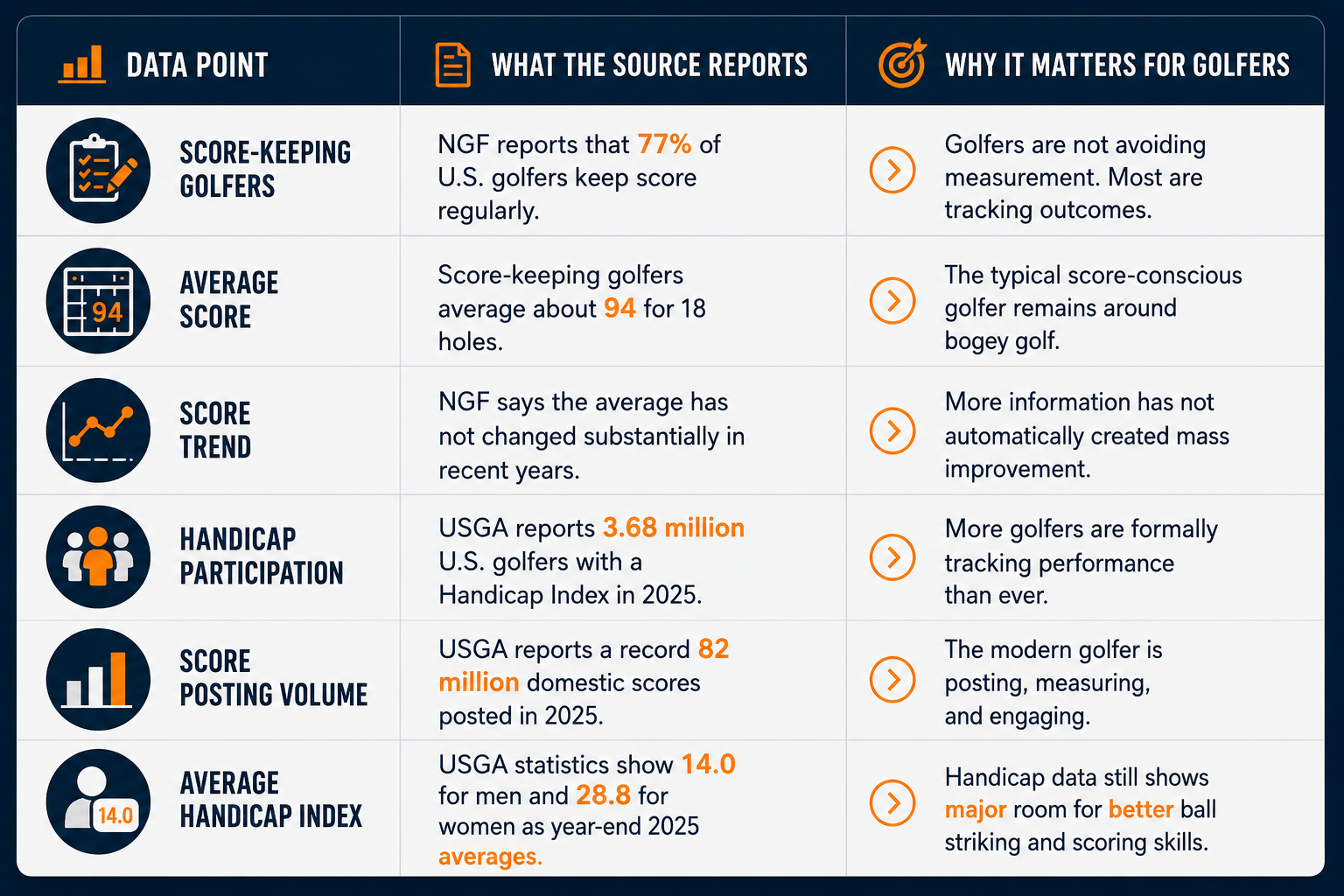
The important distinction is this: posting scores is not the same as diagnosing why those scores happen. A scorecard can tell you that you made six bogeys, four doubles, and a triple. It does not tell you why the ball started right, why the 7-iron curved into the bunker, why the wedge hit two inches behind the ball, or why your driver pattern disappears under pressure.
That is where most golfers get trapped. They see a result and guess at a cause. They hit a slice and assume they came “over the top.” They hit it fat and assume they lifted their head. They think an iron and assume they need to stay down. They hook one left and assume they used too many hands. Sometimes those guesses are partly right. Often, they are completely wrong. Even when they are close, they usually do not identify the first priority.
Good coaching is not a list of tips. Good coaching is a hierarchy of causes. The shot pattern tells me what happened at impact. Impact tells me what the club was doing. The club tells me what the body and matchup created. Then I decide what needs to change first.
Golfers Have More Information Than Ever. That Is Not the Same as Understanding
Golf instruction has never been more accessible. A golfer can open a phone and find thousands of swing videos, club reviews, grip fixes, release drills, tempo drills, shallowing tips, wrist-angle explanations, pressure shift ideas, and ball-flight theories. There is good information out there. There is also a lot of noise. The bigger problem is that even good information becomes bad information when it is applied to the wrong golfer.
That is the part the average player does not hear enough. A tip is only useful if it matches the problem. A stronger grip may help one golfer square the club face earlier. It may make another golfer hit low hooks. A feel for more rotation may help one golfer move low point forward. It may make another golfer leave the club face open and wipe across the ball. A drill for shallowing may help one player control path. It may make another player dump the club head, lose shaft lean, and hit the ground before the ball.
This is why I do not teach one perfect swing model. Golf is about matchups. Grip, club face, wrist conditions, pressure shift, pivot, release pattern, path, low point, speed, and ball flight must work together. The swing should fit the golfer, but impact still has to function.
The golf industry often sells the opposite. It sells the idea that one move will solve every pattern. It sells “do this, not that” without asking what the ball is doing. It sells positions that look clean on video but do not produce ball-first contact. It sells endless cosmetic swing improvement while the golfer still cannot control where the club head hits the ground.
That is why the average golfer can spend years “working on the swing” without becoming a better ball striker. Work is not the issue. Misallocated work is the issue.
The Data Does Not Mean Golfers Are Hopeless. It Means the System Is Backward.
I am not using the NGF and USGA data to insult golfers. I am using it to expose a system that lets golfers blame themselves for a bad process. The average golfer is not stuck because he or she lacks desire. Most golfers I see are trying. They practice. They care. They buy training aids. They watch the instructions. They play. They post scores. They want to get better.
The problem is that effort without diagnosis often reinforces the same pattern. If your low point is behind the ball and you spend another month hitting range balls with the same release pattern, you do not own a practice plan. You own a repetition machine for poor contact. If your club face is open at impact and you keep trying to swing more left to stop the slice, you may be making the start line and curvature worse. If you hit toe strikes because your body stalls and the club head throws past you, “keep your head down” is not a fix. It is a distraction.
A serious golf lesson has to start with the truth. What is the ball doing? Where does it start? How much does it curve? Where is contact on the face? Where is the low point? What is the divot pattern? What does the launch, spin, and face-to-path relationship suggest? What is the body doing that produced the club delivery? What matchup is functional, and what compensation is costing the golfer shots?
Technology can help answer these questions. I use tools such as TrackMan, video, and measurable feedback because they reveal patterns the naked eye can miss. The USGA World Handicap System gives golfers a useful performance framework. The PGA has helped grow access to coaching and player development. Researchers and coaches such as Dr. Sasho MacKenzie have pushed the game toward better biomechanics and better questions. But technology and information only matter when they serve judgment.
A launch monitor is not a coach. A video is not a diagnosis. A statistic is not a fix. They are tools. The coach still has to decide what the numbers mean, which number matters first, and what change will transfer to the golf course.
The Real Problem: Golfers Do Not Understand Impact
The average golfer talks about swing shape more than impact. That is backward. Impact is where the ball gets its instructions. The ball does not care what the swing looked like at the top if the club face, path, strike, dynamic loft, attack, and low point are wrong when the club reaches the ball.
My standard is simple: ball first, then turf. That does not mean every shot has the same divot. It does not mean every golfer needs the same shaft lean, same release, same grip, or same pivot pattern. It means functional impact has non-negotiables. The club has to arrive with a usable club face, a predictable low point, enough centeredness of contact, enough compression, and a start line and curvature pattern the golfer can play.
Most amateur golfers struggle because one or more of those impact variables is unstable. They cannot control the club face, so the ball does not start where they expect. They cannot control low point, so contact moves between fat, thin, and occasionally solid. They cannot control strike location, so distance changes even when the swing feels similar. They do not create functional shaft lean, so they add loft, lose compression, and watch irons float instead of penetrate. They do not shift pressure and rotate in a way that supports the club delivery, so the hands and club head try to save the shot late.
That is not a character flaw. That is a diagnosis problem.
The phrase “impact-first” does not mean I ignore the rest of the swing. It means I refuse to guess. If the impact pattern says the club face is open, I need to know why. Is the grip too weak for the release? Are the wrists poorly matched? Is the body spinning open without the club? Is the player holding the face off because the path is too far left? Is the golfer afraid of the left miss? The same ball flight can have different causes.
That is why generic instruction fails. It gives one answer to problems that require diagnosis.
Ball Flight Tells the Truth, but Only If You Know How to Read It
Ball flight is not random. The ball starts, curves, launches, spins, and lands because the club delivered a specific message. A serious coach reads that message. A guessing golfer often argues with it.
If the ball starts right for a right-handed golfer, I am looking first at the club face. If it curves more right, I need to understand the face-to-path relationship. If the golfer hits the ground before the ball, I am looking at low point, pressure, pivot, radius, release, and how the club head is being delivered. If contact moves across the face, I need to understand posture, balance, handle location, arm structure, and rotation. I am not going to hand that golfer a random tip because a random tip may attack a symptom while leaving the cause untouched.
A good diagnosis asks better questions.
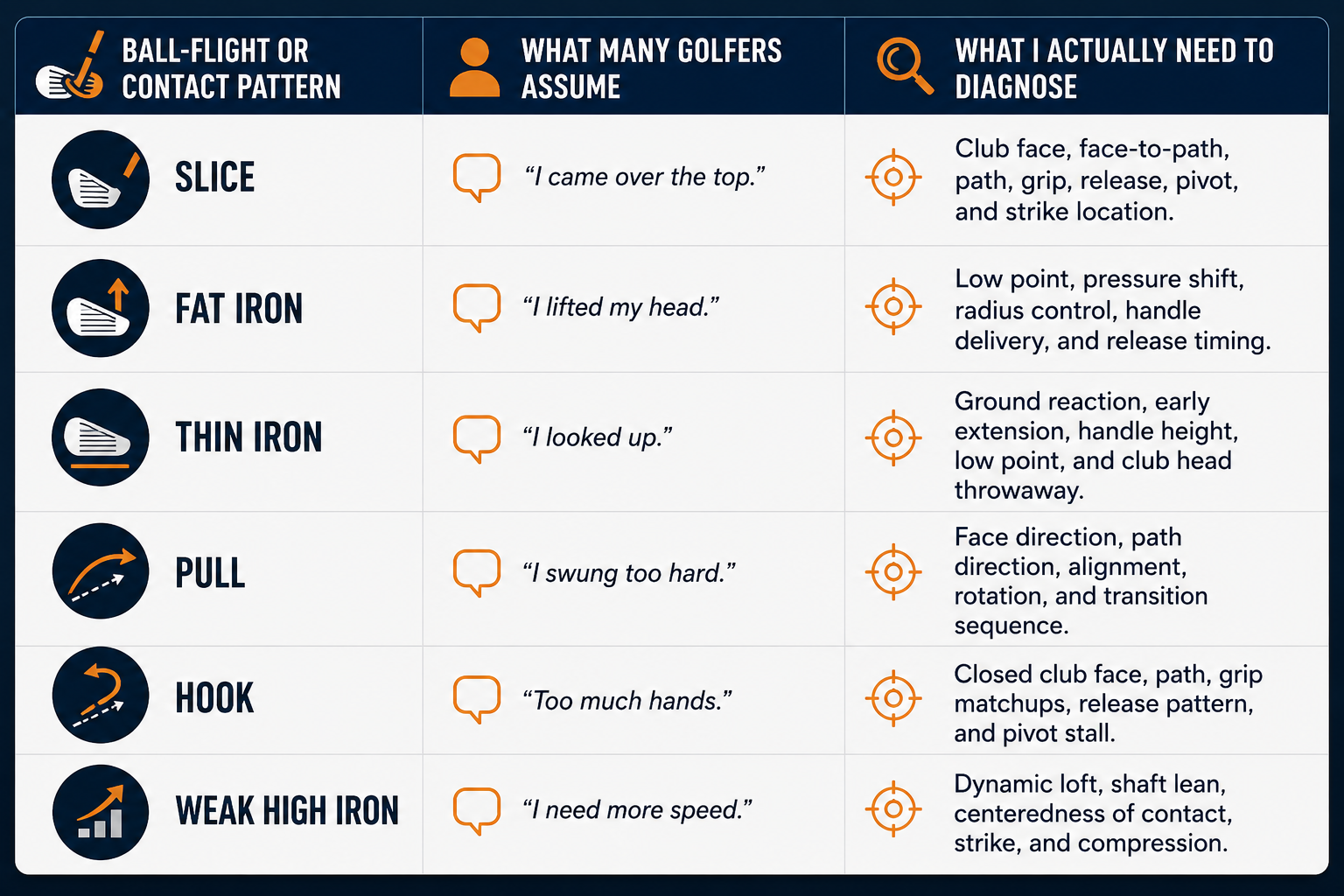
This is why I challenge common golf clichés. Advice like “keep your head down” often survives because it sounds disciplined, not because it identifies cause and effect. GOLF.com has discussed how common advice like keeping the head down can restrict the movement needed for speed and contact. I agree with the broader point: the head is usually an effect, not the root cause. When a golfer freezes the head, stalls rotation, and throws the club head early, the low point often gets worse, not better.
The answer is not to replace one cliché with another. The answer is to diagnose impact.
Why Equipment and Technology Have Not Saved the Average Golfer
Modern equipment is better. Launch monitors are better. Fitting is better. Ball design is better. Data is better. The USGA, PGA, TrackMan, National Golf Foundation, and other golf organisations have all contributed to a more measured and more informed golf environment. I am not anti-technology. I am anti-misinterpretation.
A better driver can reduce punishment on off-center hits. It cannot teach the golfer to control the club face. A fitted iron can improve launch windows. It cannot create low point control by itself. A launch monitor can show face angle, path, attack angle, spin, carry distance, and curve. It cannot automatically tell the golfer which physical or technical change matters first.
The Garmin golf data report is a useful example of the nuance. Garmin reported average score improvement among launch monitor users after registration, which supports the value of feedback when players use it well.14 But broader scoring and handicap data still shows that information and measurement alone have not solved the average golfer’s game.
The tool is not the problem. The interpretation is the problem.
A golfer can stare at numbers all day and still not understand why the club face is open, why the low point is behind the ball, or why the same feel produces different shots under pressure. Data becomes useful when it is attached to cause and effect. If the data does not lead to a better drill, clearer feel, improved contact, and better transfer, it is just expensive feedback.
What I Do Differently in a First Session
When a player comes to me for Scottsdale golf lessons, I do not begin by trying to make the swing prettier. I begin by finding the pattern. I want to know what the ball is doing, what impact is doing, and what matchup is creating it.
I look at start line, curvature, contact, low point, strike location, divot pattern, launch, spin, speed, and the player’s physical tendencies. I listen to what the golfer thinks is wrong, but I do not let the golfer’s guess become the diagnosis. A golfer may say, “I know I lifted my head.” The ball flight and impact pattern may say something completely different.
Then I decide the fastest meaningful change. That may be a grip adjustment. It may be a club face priority. It may be a pressure shift drill. It may be a low-point drill. It may be a release pattern. It may be alignment, ball position, or a better understanding of the intended shot. It may be a body motion change, but only if that body motion affects the club delivery.
This is why I guarantee improvement in the first session or a refund. I am not promising that every golfer becomes scratch in an hour. That would be nonsense. I am saying the player should leave with measurable improvement, a clearer diagnosis, and a better understanding of cause and effect. The first session should not make the golfer more confused. It should make the pattern more obvious and the fix more specific.
At Coach Erik Schjolberg Golf, the goal is not to collect swing thoughts. The goal is to create Ball Striking Machines. That means golfers who understand their pattern, control their club face, move low point forward, strike the ball more centered, compress the ball better, and produce a predictable start line with controlled curvature.
Why Most Golfers Stay Stuck Around the Same Scores
The average golfer stays stuck because the improvement loop is broken. The player hits a bad shot, assigns the wrong cause, applies a random fix, gets temporary relief or worse contact, loses confidence, searches for another tip, and repeats the cycle. Over months and years, that creates a golfer who has heard every phrase in golf but still cannot explain why the ball did what it did.
That is why the NGF score average matters. An average of 94 among score-keeping golfers is not just a number.1 It is a mirror. It reflects a golf culture where participation and information have expanded, but diagnosis has not kept pace. The USGA score-posting data matters for the same reason. A record 82 million domestic scores in 2025 means golfers are engaged.2 They are playing, posting, and participating. But engagement without better ball striking does not automatically produce lower scores.
The industry often wants golfers to believe the next thing will save them. The next driver. The next swing video. The next putting tip. The next practice aid. The next feel. Some of those things can help when they match the diagnosis. None of them can replace diagnosis.
Serious improvement requires a different sequence.
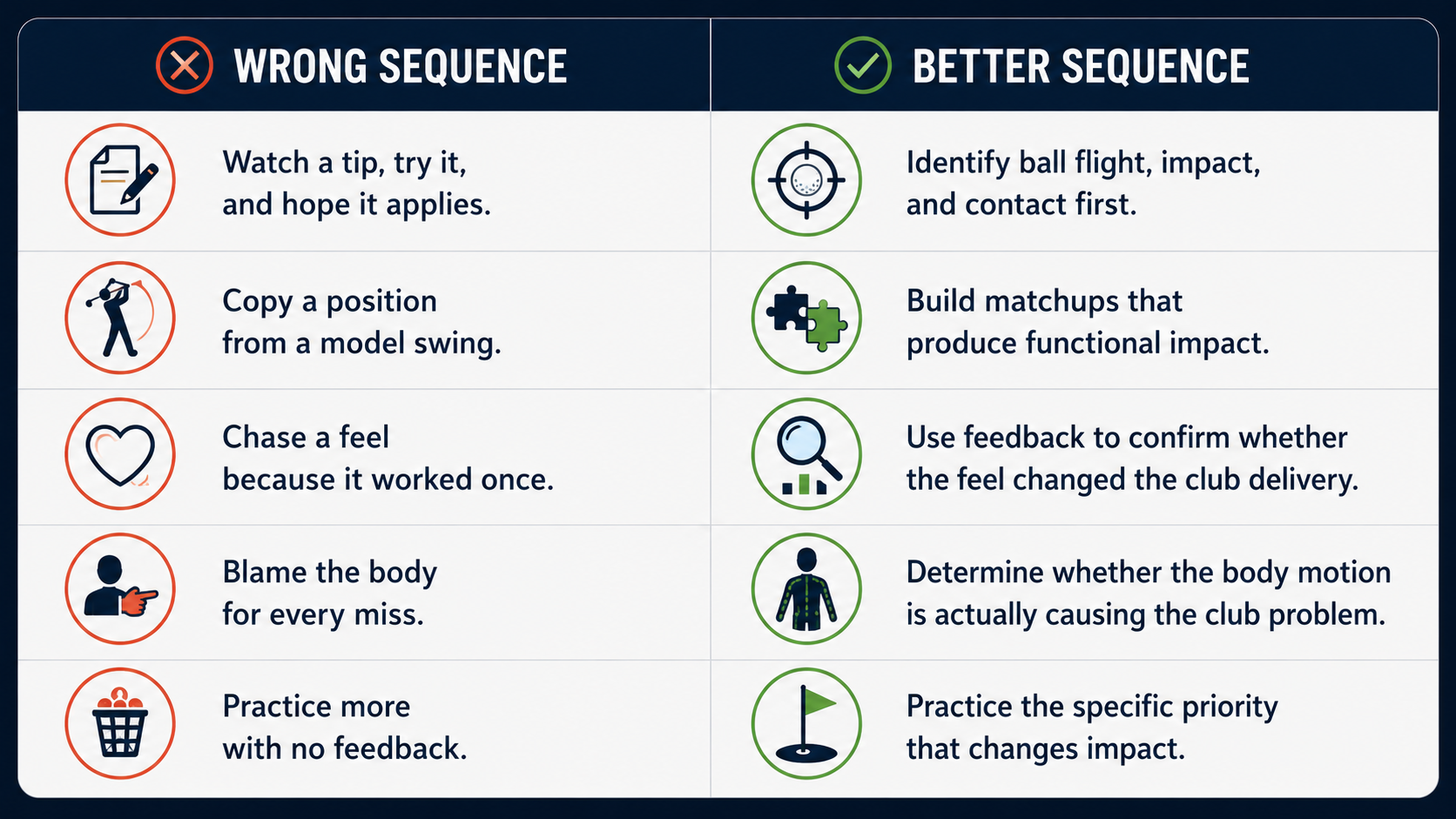
This is not complicated in theory. It is difficult in practice because golfers are emotionally attached to familiar explanations. A golfer who has believed for ten years that every bad shot came from lifting the head may resist hearing that the real issue is club face control, pressure shift, or low point. But improvement requires honesty. The ball does not care what explanation you prefer.
The Better Standard: Ball First, Then Turf
The better standard is not a prettier backswing. It is not a slower takeaway. It is not a perfect top position. It is not copying a tour player who has completely different mobility, speed, experience, grip, release, and practice history.
The better standard is ball first, then turf. The better standard is a club face that gives you a predictable start line. The better standard is a low point that does not wander behind the ball. The better standard is centered contact often enough that distance control becomes realistic. The better standard is shaft lean that creates compression without forcing the golfer into a position that does not match the rest of the swing. The better standard is a pressure shift and rotation pattern that supports the club instead of forcing the hands to rescue the shot at the last second.
This is why I talk about matchups so often. A golfer with a strong grip, closed club face, and aggressive rotation does not need the same lesson as a golfer with a weak grip, open face, stalled pivot, and early release. A golfer who hits a push-slice from an open face does not need the same first priority as a golfer who hits a pull-slice with a leftward path and poor face-to-path relationship. A golfer who chunks because pressure stays back does not need the same fix as a golfer who chunks because the club head is thrown early.
The swing has to fit the golfer, but impact still has to work.
That is the difference between instruction and diagnosis. Instruction tells you what to do. Diagnosis tells you why it matters, whether it applies, and what should change first.
What the Handicap Data Should Make Golfers Do Next
The answer is not to quit. The answer is not to accept bad golf. The answer is not to blame yourself. The answer is to stop confusing effort with progress.
If you have been playing for years and still do not know why the ball starts where it starts, why it curves the way it curves, why your contact changes from one swing to the next, or why your best range swing does not survive the golf course, you do not need another random tip. You need a diagnosis.
If you are in Scottsdale, Phoenix, Paradise Valley, Mesa, Tempe, or anywhere in the Valley and you are serious about changing your ball striking, start with a lesson built around impact. Start with the ball flight. Start with the club face. Start with low point. Start with strike location. Start with the truth.
You can learn more at EJSGolf.com or book Scottsdale golf lessons at McCormick Ranch Golf Club. I do not want you collecting swing thoughts. I want you understanding your pattern and building better impact.
Conclusion: The Data Is Not the Insult. The Guessing Is.
The controversial part of this article is not that amateur golfers still struggle. Every honest golfer knows that. The controversial part is saying out loud that the current improvement system is not good enough. Golfers have more information, more equipment, more data, more videos, and more score tracking than ever. Yet the average score-keeping golfer remains around 94, and the handicap data still shows massive room for improvement.
That does not mean golfers are hopeless. It means the process needs to change.
Stop starting with tips. Stop worshipping positions. Stop blaming your head, your tempo, or your effort before you understand the club. Start with ball flight. Work backward to impact. Understand the club face, low point, centeredness of contact, shaft lean, pressure shift, rotation, start line, and curvature. Build matchups that fit the golfer and produce functional impact.
That is The Science of Better Golf. That is how golfers stop guessing. That is how golfers become Ball Striking Machines.
Ball first. Then turf. Better impact. Better ball striking. Better golf.
FAQ: Why Amateur Golfers Do Not Improve
Why do most amateur golfers not improve?
Most amateur golfers do not improve because they practice and consume information without a correct diagnosis. They may work hard, but if they are working on the wrong cause, they reinforce the same impact pattern. Improvement starts when the golfer understands ball flight, club face, low point, strike location, and the matchup that created the shot.
What is the average score for amateur golfers who keep score?
The National Golf Foundation reports that 77% of U.S. golfers keep score regularly and that the roughly 20 million golfers who keep score average about 94 for 18 holes. NGF also reports that this average has not changed substantially in recent years.
What is the average golf handicap for men and women?
Current USGA handicapping statistics show average year-end 2025 Handicap Indexes of 14.0 for men and 28.8 for women.3 Those numbers do not mean every golfer is stuck, but they do show that many players still have major room to improve ball striking, contact, start line, and scoring consistency.
Are golf tips bad for amateurs?
Golf tips are not automatically bad. A tip becomes bad when it does not match the golfer’s actual pattern. A grip tip, release drill, pressure cue, or rotation thought can help one player and hurt another. The question is not whether the tip is popular. The question is whether it changes the correct piece of impact for that golfer.
Why is impact more important than swing positions?
Impact is where the ball receives its instructions. Swing positions only matter if they help deliver the club with a functional club face, predictable low point, centered strike, proper dynamic loft, and playable face-to-path relationship. A swing can look different and still work if the matchups create functional impact.
How can I stop hitting fat golf shots?
To stop hitting fat shots, you need to identify why the low point is behind the ball. It may be pressure staying back, early release, poor radius control, stalled rotation, ball position, or a matchup issue. The fix depends on the cause. That is why “keep your head down” is usually not a real diagnosis.
How do I fix a slice?
A slice requires a face-to-path diagnosis. For many golfers, the club face is open relative to the path at impact, but the reason can vary. Grip, wrist conditions, release pattern, path direction, alignment, strike location, and pivot can all contribute. A serious fix starts by identifying what the ball flight is telling you before choosing the drill.
What makes Coach Erik Schjolberg Golf different?
I teach from ball flight and impact backward. I do not sell random tips or force every golfer into one swing model. I diagnose the pattern, identify the matchup, and build the fastest path toward better contact, better start line, controlled curvature, and ball-first contact. At Coach Erik Schjolberg Golf, the standard is simple: ball first, then turf.
Get my full drill library at EJSGolf.com/my-drills
Read more at EJSGolf.com/blog
Book a session at EJSGolf.com
More from Coach Erik:
Follow me on:


