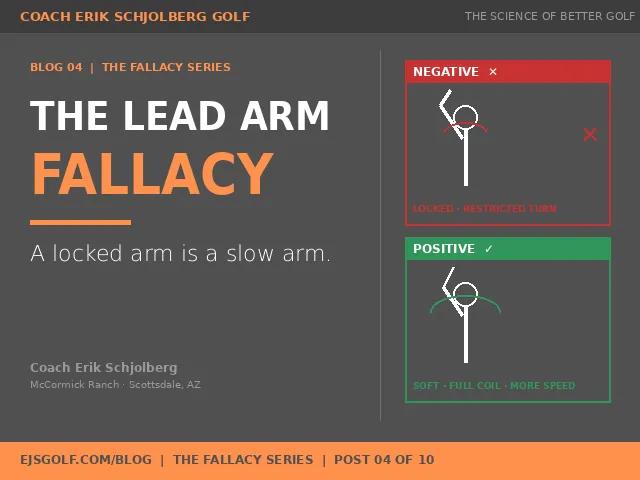
Stop Locking Your Lead Arm: Build Real Width and Compression
The Lead Arm Straight Fallacy: Why a Locked Lead Arm Is Costing You Speed, Width, and a Better Strike
If you are searching for Scottsdale Golf Lessons because your ball striking does not match the amount of work you put into your swing, this article is for you.
The problem is not that you need another generic tip. The problem is that one of golf instruction's most repeated phrases, “keep the lead arm perfectly straight,” is probably making you chase a look instead of organizing impact. I do not coach golf that way. I coach from ball flight and impact backward, because the golf ball only responds to what the club head and club face are doing at the moment of collision.
By the end of this article, you will understand why the phrase keep the lead arm perfectly straight is incomplete, what it tends to create at impact, how to diagnose the real cause, and one constraint-led drill you can use immediately. This is part of The Science of Better Golf: diagnose the ball, identify the impact condition, trace it back to the body and club matchup that created it, then train the fix in a way that transfers to the next shot.
The Better Title and Core Promise
The title of this article is built to pull in the golfer who has heard the old advice and still cannot strike the ball correctly. That matters for search, but it also matters for trust. A strong golf article should not tease a miracle. It should name the actual problem and then teach the reader a better model. The primary keyword for this post is lead arm straight golf swing, but the real subject is impact quality.
Coach Erik definition: A golf fix is only real if it changes the impact condition that created the ball flight. If it changes how the swing looks but does not improve low point, compression, club face, centeredness of contact, start line, or curvature, it is not a fix. It is a decoration.
This is why I am hard on clichés. They are not always entirely false. The problem is that they are usually too vague to be useful. A tour player can hear a phrase and attach it to a precise matchup. A mid-handicap golfer hears the same phrase and often turns it into a destructive exaggeration. That is exactly what happens with keep the lead arm perfectly straight.
The Problem: The Myth Creates the Wrong Impact
When a golfer over-applies this advice, the swing often turns into a locked lead arm, restricted shoulder turn, lifted hand path, and a club that gets narrow late instead of organized early. That may look like effort. It may even feel technically disciplined. But the ball does not reward discipline. The ball rewards a correct collision. TrackMan defines measurable impact and ball-flight parameters such as attack angle, dynamic loft, club path, face angle, face-to-path, spin loft, low point, ball speed, smash factor, and launch direction.1 Those numbers matter because they describe what actually happened, not what the golfer hoped happened.
In this pattern, the common impact result is thin contact, heavy contact, weak high strikes, heel-side misses, and a low point that wanders because the radius was manufactured with tension instead of supported by rotation. That is the evidence. I do not start by asking whether the motion matches a model. I start by asking what the ball did. Did it start where the player intended? Did it curve predictably? Was the strike centered? Did the club reach the ball before the ground? Did the divot begin on the target side of the ball? Did dynamic loft help compression, or did it turn the shot into a weak glancing strike?
The average golfer gets trapped because the bad advice sounds simple. Simplicity is attractive, especially when the player is frustrated. But simple is not the same thing as correct. A useful cue must connect to a measurable outcome. If it does not, the golfer is left judging the swing by feel, and feel is often the last thing to become accurate.
The True Cause: Work Backward From Ball Flight
The pattern usually starts when the player tries to make the arm look straight instead of making the arc functional. The lead arm becomes rigid, the chest stops turning, the hands lift, and the wrists lose responsiveness. By the time the club reaches transition, the golfer has created the appearance of width without the athletic support that makes width useful. This is the part most golfers miss. They see the symptom late in the downswing and try to fix it late in the downswing. That almost never works. The late motion is usually a compensation for something that already happened earlier.
My diagnostic order is always the same. First, what is the ball doing? Second, what does that reveal about impact? Third, what is the club doing? Fourth, what body motion or matchup created it? Fifth, what is the fastest, clearest, most effective fix? Sixth, what drill will create immediate change? That order prevents the coach and the player from chasing noise.
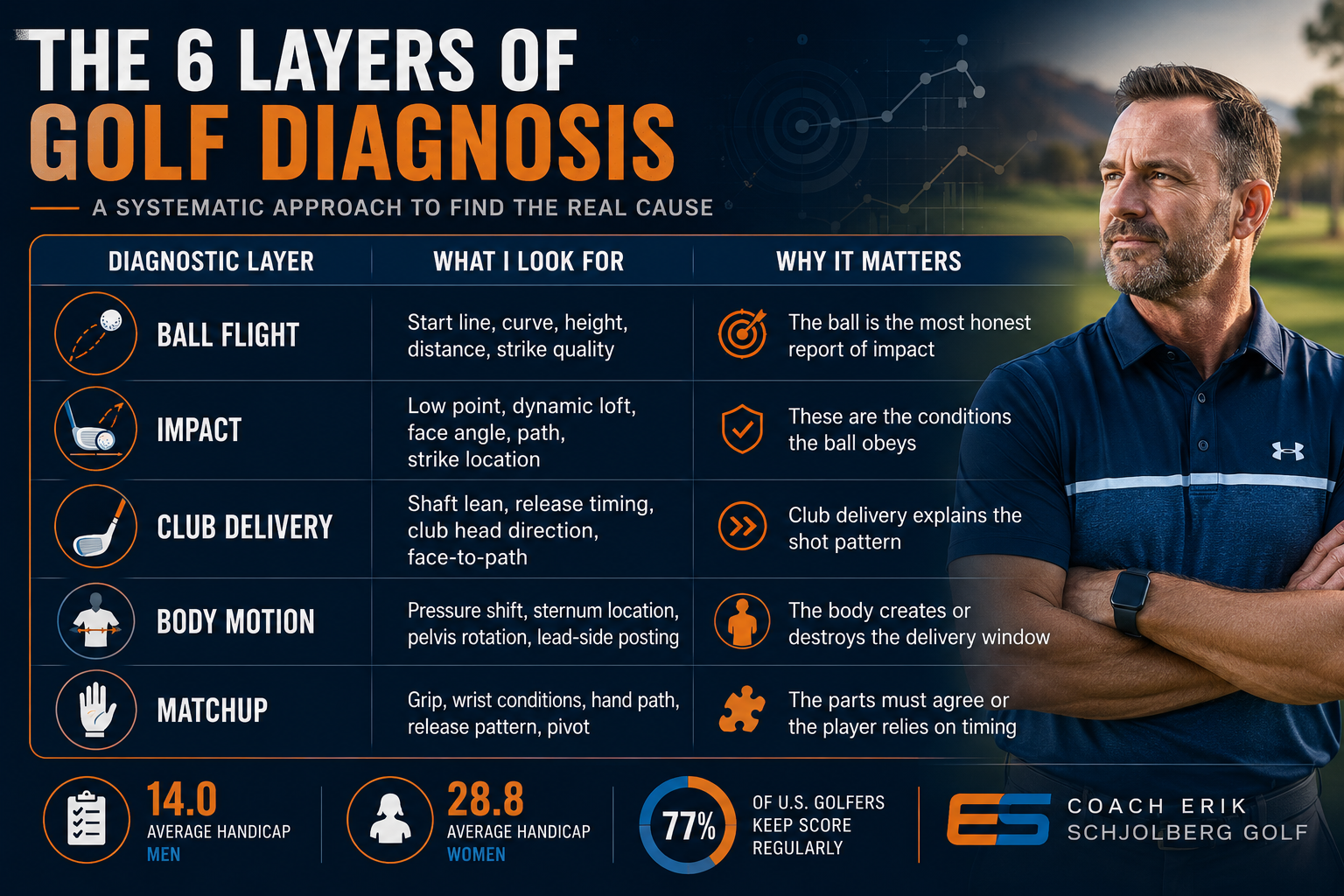
TrackMan's definition of attack angle is the up-or-down movement of the club head's geometric center at maximum compression, which is why I separate attack angle from low point in coaching.3 A golfer can have one number that looks acceptable and still produce poor contact if the rest of the delivery is mismatched. That is why I do not coach isolated numbers. I coach the relationship between the numbers.
Why the Common Fix Fails
The conventional phrase keep the lead arm perfectly straight fails because it gives the player a task without a diagnostic target. A task like that can create motion, but it does not guarantee a better impact. In many cases, it makes the golfer more rigid, later, steeper, more handsy, or more dependent on timing. The player then practices harder and gets the same ball flight, which is the fastest way to lose trust in instruction.
This is where my philosophy is different. I do not believe golfers have to get worse before they get better. They may need to feel something unfamiliar, and they may need to reorganize a pattern, but the correct diagnosis should create some measurable improvement quickly. It might be a cleaner strike, a divot that moves forward, a tighter start line, a stronger flight, or better centeredness of contact. Improvement should show up on day one because the ball is responding to better physics, not better motivation.
Ground interaction is a good example. Titleist's pressure and ground reaction force education explains that golf power is created from the ground up and that proper sequencing of pressure and ground reaction forces can improve both power potential and control.4 That does not mean every golfer should copy the same pressure trace. It means the body must support the delivery of the club. If the body motion and club motion do not match, the player is forced to rescue the shot with the hands.
The Matchup Framework: The Swing Must Agree With Itself
There is no single perfect golf swing. There are functional matchups. A strong grip, a weak grip, a steep hand path, a shallow hand path, an early-opening face, a shut face, a rotary pivot, and a more lateral pressure pattern can all work if the rest of the system agrees. The mistake is taking one isolated instruction and forcing it into every golfer's motion.
That is why a serious coach does not ask, “Does this look textbook?” The better question is, “Does this pattern deliver the club face, club head, and low point in a way that produces the intended ball flight?” If the answer is yes, the pattern is usable. If the answer is no, the pattern needs to be changed or matched differently.
For players who want a full system instead of random tips, I explain this throughout my EJS Golf Blog and in my in-person Scottsdale Golf Lessons. The goal is not to create a prettier practice swing. The goal is to build a golfer who can stand over the ball with a predictable start line, controlled curvature, and ball-first contact.
The Fix: The Soft-Structure Width Drill
Make three-quarter swings with a 7-iron while allowing the lead arm to feel structured but not locked. Keep a firm hold on the club without letting tension climb into the forearms and shoulders. Turn the chest enough that the hands gain depth, then deliver the club with the belt buckle clearing into the lead side. The goal is not a bent arm. The goal is a functional radius supported by rotation. This is a constraint-led drill, which means the setup and task are designed to make the correct motion easier to find and the wrong motion easier to detect. I like drills that give the golfer feedback without needing a paragraph of swing thoughts.
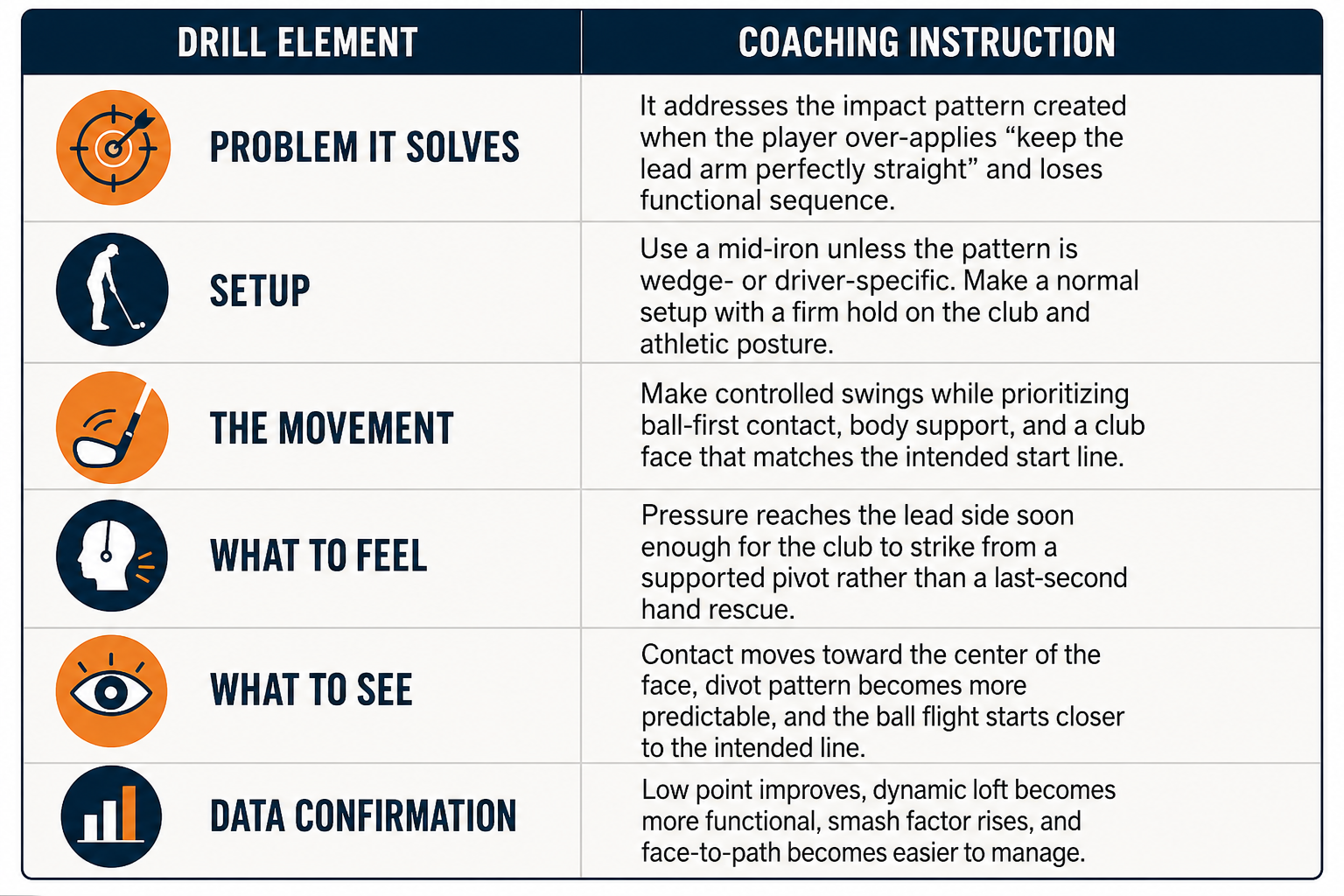
Do not turn the drill into a performance test on the first swing. The first job is to make the movement clear. The second job is to make the strike better. The third job is to blend it into a normal motion. That is how change transfers. Random tips fail because they never move through those stages.
What You Should See Immediately
When this drill is working, the first change should be contact. The strike should sound heavier. The ball should come off the club face with less glancing energy and more compression. The start line should become easier to predict because the club face is not being thrown into impact as a rescue move. The divot, when appropriate, should begin more consistently on the target side of the ball.
This is the standard I use in a real lesson. I want the golfer to see evidence. I want the golfer to understand why the evidence changed. I want them to leave with a cause-and-effect model they can use without me standing beside them. That is how a player becomes more independent, not more dependent on tips.
The research on speed also supports a broader point. MacKenzie, McCourt, and Champoux found that the work a golfer applies to the club is a primary determinant of clubhead speed, with factors such as hand-path length, force along that path, angular distance, and applied couple contributing to energy delivery. I care about that because better golf is not about looking soft or restricted. It is about organizing force into the ball.
Explore More
If you want this measured instead of guessed at, start with my Scottsdale Golf Lessons page, read more technical breakdowns on the EJS Golf Blog, and learn how I coach the full system at EJS Golf. Golfers outside Arizona can use Online Golf Lessons, while local players can book golf lessons in Scottsdale or McCormick Ranch golf lessons. For deeper context, review About Coach Erik, download the free drills guide, and study the training philosophy behind becoming a Ball Striking Machine. I also recommend browsing the golf instruction blog, exploring TrackMan golf lessons in Scottsdale, using golf swing analysis in Scottsdale, learning about golf biomechanics lessons, practicing with my golf drills, and reaching out through contact EJS Golf when you are ready for a precise diagnosis.
The Science of Better Golf
The phrase “keep the lead arm perfectly straight” is incomplete because it describes a visible intention, not a measured impact outcome. The correct coaching model is to read ball flight, identify the impact condition, trace that condition back to club delivery and body motion, then train a constraint that improves low point, compression, club face control, centeredness of contact, start line, and curvature.
That is the difference between instruction and guessing. Instruction has a chain of evidence. Guessing has a slogan. My job is to remove the slogan and give the player a system.
Frequently Asked Questions
Should my lead arm be straight in the backswing?
The answer depends on impact, not appearance. In this pattern, I would first measure ball flight, contact point, low point, club face, path, and the body motion creating those conditions. If the motion improves ball-first contact, compression, predictable start line, and controlled curvature, it belongs in the swing. If it only satisfies a traditional saying while impact stays poor, it is not a fix.
Is a bent lead arm always bad?
The answer depends on impact, not appearance. In this pattern, I would first measure ball flight, contact point, low point, club face, path, and the body motion creating those conditions. If the motion improves ball-first contact, compression, predictable start line, and controlled curvature, it belongs in the swing. If it only satisfies a traditional saying while impact stays poor, it is not a fix.
Why does locking the lead arm make me hit it worse?
The answer depends on impact, not appearance. In this pattern, I would first measure ball flight, contact point, low point, club face, path, and the body motion creating those conditions. If the motion improves ball-first contact, compression, predictable start line, and controlled curvature, it belongs in the swing. If it only satisfies a traditional saying while impact stays poor, it is not a fix.
What should I feel instead of a straight lead arm?
The answer depends on impact, not appearance. In this pattern, I would first measure ball flight, contact point, low point, club face, path, and the body motion creating those conditions. If the motion improves ball-first contact, compression, predictable start line, and controlled curvature, it belongs in the swing. If it only satisfies a traditional saying while impact stays poor, it is not a fix.
Can this help my driver too?
The answer depends on impact, not appearance. In this pattern, I would first measure ball flight, contact point, low point, club face, path, and the body motion creating those conditions. If the motion improves ball-first contact, compression, predictable start line, and controlled curvature, it belongs in the swing. If it only satisfies a traditional saying while impact stays poor, it is not a fix.
Summary
The myth of keeping the lead arm perfectly straight survives because it sounds simple, but better golf is not built on vague simplicity. Better golf is built on a clear diagnosis. If the advice does not improve impact, it does not matter how traditional it sounds.
If you want this pattern measured and fixed instead of guessed at, book Scottsdale Golf Lessons with me at McCormick Ranch, or use Online Golf Lessons if you are outside of Arizona. I will help you understand what the ball is doing, what the club is doing, and what your body needs to do differently so you can become a better ball striker.
Coach Erik Schjolberg coaches golfers of all levels at McCormick Ranch in Scottsdale, Arizona, and online worldwide through The Science of Better Golf. Learn more at EJS Golf.
Get my full drill library at EJSGolf.com/my-drills
Read more at EJSGolf.com/blog
Book a session at EJSGolf.com


