
Scottsdale Golf Lessons: Data-Driven Ball Striking Improvement
The Best Golf Instructor in Scottsdale: It's About Measurable Results, Not Just Reputation
When golfers search for Scottsdale Golf Lessons, they often encounter a dizzying array of options. Every instructor claims to be the "best," promising breakthroughs and lower scores.
But what truly defines the best golf instructor in Scottsdale? Is it a fancy title, a long list of celebrity students, or simply the ability to articulate complex swing theories? From my perspective, as Coach Erik Schjolberg, the answer is far simpler and far more profound: it's about measurable results.
It's about a coaching philosophy rooted in precise diagnosis, an unwavering focus on impact, the intelligent application of data, and a deep understanding of individual matchups. I reject the notion that you must get worse before you get better. My students see improvement from day one, because we focus on what the ball is doing, what that reveals about impact, and what specific, data-backed changes will produce immediate, tangible improvement.
The Short Answer
The best golf instructor in Scottsdale is defined by their ability to deliver consistent, measurable improvement through a data-driven, impact-first approach. This involves precise diagnosis of ball flight and impact conditions, leveraging technology like TrackMan and force plates for objective feedback, understanding individual golfer matchups, and implementing drills that produce immediate, verifiable changes in ball striking and scoring. It's about science, not guesswork, and a commitment to your progress from the very first session.
What Is Really Happening at Impact: The Truth the Ball Reveals
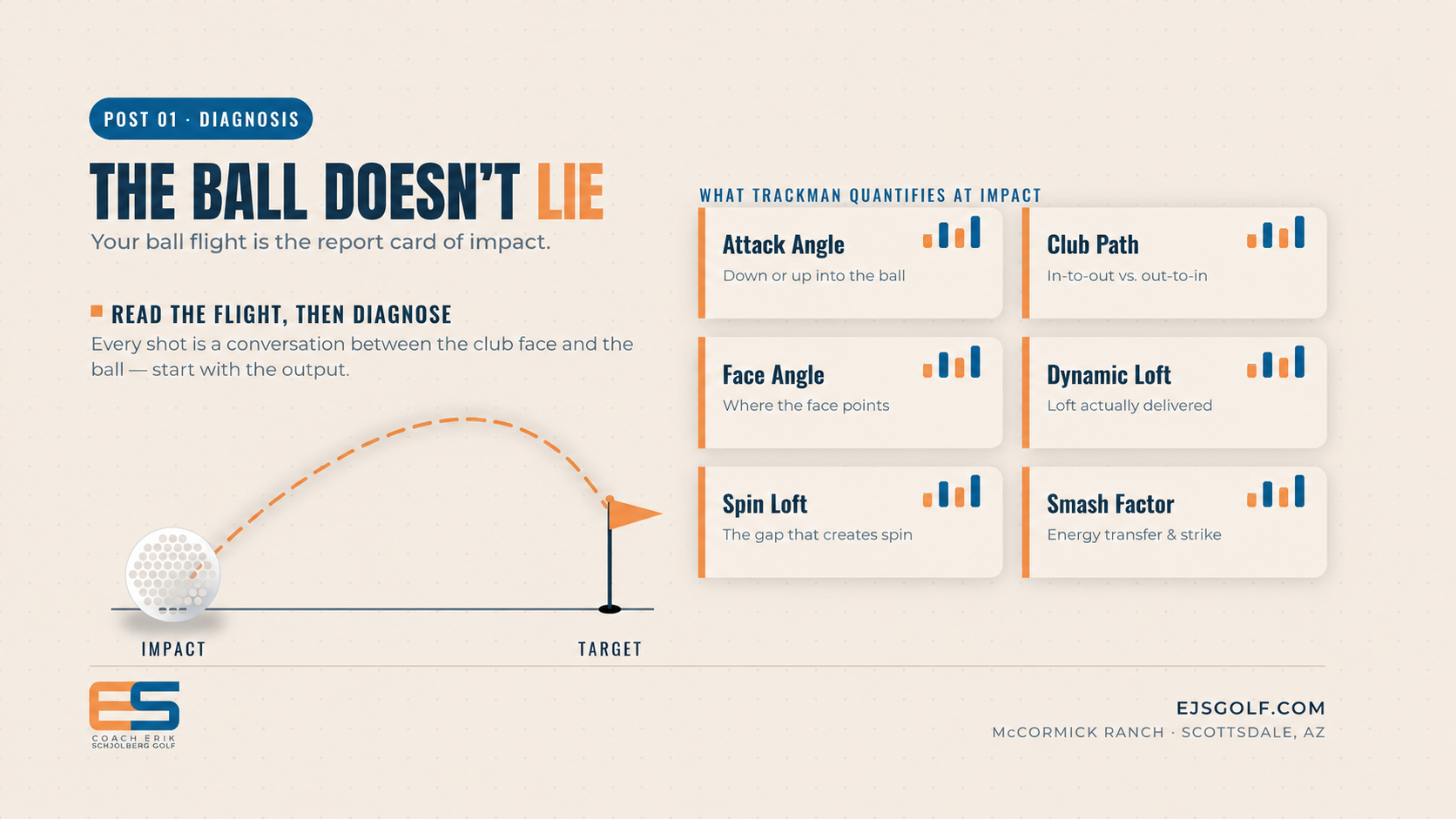
Every golf shot is a conversation between the club face, the club head, and the golf ball. The flight of that ball - its start line, curvature, trajectory, and distance - is the ultimate report card of your impact conditions. When a golfer comes to me, whether for Scottsdale Golf Lessons or online coaching, the first thing I analyze is the ball flight. The golf ball does not make mistakes; it simply reacts to what the club did at impact. This is the foundation of my diagnostic process. I don't start by looking at your backswing; I start by understanding the output.
For instance, a persistent slice tells me your club face was significantly open relative to your club path at impact. A fat shot indicates your low point was behind the ball, forcing you to "help" the ball into the air. A thin shot suggests your low point was too far forward, or you lifted your body. These aren't just observations; they are precise diagnostic indicators. My goal is to decode these messages from the ball and translate them into actionable insights. We use TrackMan to quantify these impact metrics: attack angle, dynamic loft, club path, face angle, spin loft, and smash factor. These numbers don't lie. They tell us exactly what the club was doing at the moment of truth, and they form the objective basis for our coaching. Without this data, we're guessing, and I don't guess with my students' games. This impact-first approach is central to The Science of Better Golf system I've developed.
The Cause Upstream: Tracing Impact Back to Motion
Once we understand what's happening at impact, the next step is to trace that impact back to its root cause in the swing. This is where true diagnostic precision separates an effective coach from one who merely offers cosmetic fixes. Many instructors focus on "positions" - get your club here, get your hands there. But I know, and the data confirms, that these positions are often symptoms, not causes. The real causes are upstream: how you shift your pressure, how you rotate your body, the condition of your wrists, and the path your hands take. These are the fundamental movements that dictate club delivery and, ultimately, impact.
Consider a golfer who consistently hits pulls. The impact data shows a club path that is too far left and a club face that is square to that path. The upstream cause might be an early rotation of the upper body, pulling the club outside the target line on the downswing. Or perhaps an insufficient pressure shift to the lead side, causing the body to hang back and the arms to swing across. These are not isolated events; they are interconnected components of a complex kinetic chain. My coaching focuses on identifying the primary driver of the undesirable impact condition. We use tools like HackMotion for wrist data and force plates for ground reaction forces to pinpoint these upstream causes with unparalleled accuracy. This allows us to make a single, targeted change that cascades through the entire swing, rather than chasing multiple symptoms. This diagnostic approach is why my Scottsdale Golf Lessons are so effective at producing rapid improvement.
What I Change First: The One Priority for Immediate Improvement
My coaching philosophy is built on the principle of one diagnosis, one drill. Once we've identified the root cause of your ball striking issue through data, my focus shifts to implementing the most efficient and effective fix. I don't overwhelm students with a laundry list of things to work on. Instead, we identify the single, highest-leverage change that will unlock the desired impact condition. This change is always tied to a measurable target and a clear cause-and-effect relationship.
For example, if your issue is a lack of forward shaft lean leading to scooping and inconsistent contact, the primary change might be to improve your pressure shift to the lead side in transition. The impact target is clear: increase dynamic loft reduction and achieve ball-first contact with a descending blow. The reason this single change is so powerful is that a proper pressure shift naturally facilitates a better hand path, improved lead wrist conditions, and a more stable club face through impact. It's a foundational movement that corrects multiple issues simultaneously. This targeted approach ensures that every minute you spend practicing is productive, leading to immediate and noticeable improvement. This is the core of what makes data-driven golf instruction so powerful.
Drills That Make the Change Stick: The Step-Through Drill for Pressure Shift
To illustrate how I implement change, let's consider a common issue: insufficient pressure shift to the lead side, which often leads to a "hang back" motion, poor low point control, and a lack of compression. The Step-Through Drill is one of my go-to constraint-based drills for teaching proper pressure transfer and sequencing.
Drill: The Step-Through Drill
Setup: Start with a short iron (7-iron or 8-iron) and address the ball as usual. However, instead of keeping your feet planted, set up with your lead foot slightly behind your trail foot, almost touching. Your weight should be predominantly on your trail side.
Execution: As you initiate your downswing, consciously step your lead foot forward towards the target, planting it firmly before impact. The goal is to feel your weight transfer aggressively to your lead side as you swing through the ball. It's a deliberate, exaggerated movement designed to ingrain the feeling of a powerful pressure shift. Focus on hitting the ball first, then taking a divot after the ball.
What the Golfer Should Feel: You should feel a distinct shift of weight and pressure into your lead heel as you step and swing. It should feel like you are "pushing off" the ground with your lead leg to create power and stability. You'll likely feel more rotational force and a sense of being "stacked" over the ball at impact, rather than falling back.
Feedback That Confirms Success: The most immediate feedback is the sound and feel of impact. A solid, crisp strike where you feel the ball compress against the club face is a strong indicator. Visually, you should see a divot that starts after the ball. On TrackMan, we're looking for an improved attack angle (more downward) and a more forward low point relative to the ball. Your shaft lean at impact should also increase, leading to a more penetrating ball flight.
Common Failures: Golfers often fail to fully commit to the step, or they step too early/late, disrupting timing. Another common failure is still trying to "help" the ball up, which prevents the proper descending blow. If the divot is still behind the ball, or impact feels weak, the pressure shift isn't happening effectively.
Measurable Result to Check: Use TrackMan to monitor your Attack Angle and Low Point. A successful drill will show a more negative attack angle (e.g., -3 to -5 degrees with an iron) and a low point that is consistently 1-3 inches after the ball. You should also see an increase in smash factor and ball speed due to better compression. This drill directly addresses the mechanics of low point control and helps create the necessary conditions for a powerful, consistent strike.
Your Next Seven Days: A Practice Protocol for Lasting Change
Implementing a new movement pattern requires consistent, deliberate practice. Here's how I would structure your next seven days to make the Step-Through Drill, or any similar foundational change, stick:
Day 1 (Today): Focused Repetition. Spend 30 minutes hitting balls with the Step-Through Drill. Focus purely on the feeling of the pressure shift and making ball-first contact. Don't worry about distance or direction yet. Hit 20-30 balls, taking breaks to reset and visualize the movement. End with 5-10 normal swings, trying to replicate the feeling.
Day 2 (Rest & Review): Review your TrackMan data or video from Day 1. Identify what felt good and what needs refinement. Visualize successful swings. No hitting today.
Day 3 (Integration): Back to the range for 45 minutes. Start with 15 minutes of the Step-Through Drill, focusing on crisp contact. Then, transition to hitting balls with a normal stance, trying to maintain the feeling of the pressure shift. Hit 30-40 balls, alternating between drill and normal swings. Pay attention to divot location and impact sound.
Day 4 (Short Game Focus): Work on chipping and pitching for 30 minutes. Focus on maintaining a forward low point and ball-first contact, even with shorter swings. This reinforces the core concept without the complexity of a full swing.
Day 5 (Full Swing with Feedback): 60 minutes on the range. Dedicate 20 minutes to the Step-Through Drill. Then, hit 40-50 full swings with your short iron, using alignment sticks to check your divot location and impact spray to check centeredness of contact. If you have access to TrackMan, monitor your attack angle and low point. The goal is consistency.
Day 6 (Course Simulation): Play 9 holes, but treat it as a practice round. Focus on making one good swing thought (e.g., "lead side pressure shift") for each shot. Don't worry about score. Pay attention to how your ball flight changes with better impact. This is where the transfer happens.
Day 7 (Refinement): 30 minutes on the range, focusing on any specific shots or clubs where the new movement feels less natural. Reinforce the Step-Through Drill as needed. This consistent, structured practice is how we build ball striking machines.
Train With Me in Scottsdale: Experience Data-Driven Improvement
If you're serious about transforming your golf game and are looking for Scottsdale Golf Lessons that deliver real, measurable results, I invite you to train with me at McCormick Ranch Golf Club. My coaching is not about quick fixes or generic advice; it's about a deep, data-driven diagnosis that uncovers the root cause of your ball striking issues and provides a clear, actionable path to improvement. I leverage state-of-the-art technology - TrackMan, HackMotion, 3D video, and force plates - to provide objective feedback and ensure every lesson is productive. My commitment is simple: measurable improvement from the first session because the work is tied to the ball flight, the impact conditions, and the specific matchup we are changing. Whether you're a local golfer in Scottsdale, Arizona, or seeking online golf lessons from anywhere in the world, my goal is to turn you into a ball striking machine. Book your introductory session today and experience The Science of Better Golf firsthand.
Frequently Asked Questions
What makes Coach Erik Schjolberg different from other golf instructors in Scottsdale?
My approach at EJS Golf is fundamentally different because it's built on The Science of Better Golf. I don't teach cosmetic positions or generic swing models. Instead, I diagnose ball flight and impact conditions first, then use data from TrackMan, HackMotion, and force plates to identify the root cause of your issues. My coaching is impact-first, focused on individual matchups, and designed to deliver measurable improvement from your very first session. I believe in understanding cause and effect, not just applying temporary fixes. You can learn more about my philosophy on the About Coach Erik Schjolberg page.
Do I need to be an advanced golfer to benefit from your Scottsdale Golf Lessons?
Absolutely not. My Scottsdale Golf Lessons are designed for golfers of all skill levels who are serious about improving. Whether you're a beginner struggling with consistent contact or an experienced player looking to fine-tune your ball striking, the principles of diagnosis, impact, data, and matchups apply universally. The goal is always the same: to help you understand your swing, identify what's holding you back, and implement changes that lead to immediate, measurable improvement. My methods are adaptable to any golfer's physical capabilities and learning style.
How does data and technology improve my golf game?
Data and technology, when used correctly, remove guesswork from golf instruction. Tools like TrackMan provide objective measurements of your club and ball at impact, revealing precisely what's happening. HackMotion quantifies wrist conditions, and force plates analyze how you use the ground. This data allows me to make an accurate diagnosis of the root cause of your issues, rather than relying on subjective observation or "feel." It also provides concrete feedback during drills, so you know immediately if you're making the correct change. Technology serves the golfer by making the learning process faster, clearer, and more efficient, leading to real student results.
What is "impact-first" instruction?
Impact-first instruction means we prioritize what the club and ball are doing at the moment of impact, and then work backward to understand the swing mechanics that create those conditions. Many traditional methods focus on achieving certain positions in the backswing or downswing, assuming those positions will lead to good impact. I reverse that. We analyze your ball flight, quantify your impact data, and then identify the most efficient way for your body and your unique matchups to deliver the club effectively. This ensures that every change we make directly contributes to better ball striking. This is a core tenet of my impact-first coaching philosophy.
Can I get online golf lessons if I'm not in Scottsdale?
Yes, absolutely. While I love working with students in person at McCormick Ranch Golf Club for Scottsdale Golf Lessons, I also offer comprehensive online golf lessons that utilize the same data-driven, diagnostic approach. Through video analysis and remote coaching, we can identify your swing faults, prescribe targeted drills, and track your progress just as effectively as in person. Many of my students achieve significant improvements through online coaching, demonstrating that quality instruction isn't limited by geography. You can access my free drills guide for a taste of my instructional style.
Related EJS Golf Reading
Scottsdale Golf Lessons: What to Expect from Data-Driven Coaching
Why I Don't Chase Golf Digest Rankings - And Why My Students' Handicaps Tell the Real Story
Master Low Point Control: Scottsdale Golf Lessons for Better Impact
The Science of Better Golf: Why Scottsdale's Most Serious Players Are Choosing Data Over Feel
About Coach Erik Schjolberg
Coach Erik Schjolberg is a professional golf instructor based in Scottsdale, Arizona, and the founder of EJS Golf at McCormick Ranch Golf Club. With a philosophy centered on "The Science of Better Golf," Erik specializes in impact-first instruction, leveraging advanced technology like TrackMan, HackMotion, and force plates to provide precise diagnosis and measurable results. He is dedicated to helping golfers of all levels achieve rapid, sustainable improvement by focusing on cause-and-effect mechanics and individualized matchups, rather than generic tips or cosmetic positions. His commitment is to turn every student into a ball striking machine, ensuring they understand not just what to do, but why it works.
Get my full drill library at EJSGolf.com/my-drills
Read more at EJSGolf.com/blog
Book a session at EJSGolf.com
Follow me and reach out to me on:


