EJS GOLF BLOG
Learn about the golf swing and what you can do to improve your score on the golf course. Fill out the form below if you have any questions or want to set up a time to talk.
Mastering the Art of Golf with Coach Erik Schjolberg
I’m Coach Erik Schjolberg, and welcome to the EJS Golf blog—Scottsdale’s authority on science-driven ball-striking. Here you’ll find in-depth analyses of swing mechanics, data-backed breakdowns of impact and launch dynamics, and actionable practice routines designed to rewire your muscle memory from day one. Each post peels back the curtain on cause-and-effect in your swing, whether you’re chasing Tour-level precision, collegiate consistency, or lower weekend scores. Dive into our deep-dive articles, master the drills that drive real improvement, and transform your game with proven science and strategy.
But let’s be clear: golf isn’t only about perfecting swing mechanics. The mental battle you fight on each tee is often the one that determines whether you stay in the game or walk off the course. Here, we’ll tackle the psychological hurdles—the pressure of a tight leaderboard, the frustration when a swing fails under stress, the self-doubt that creeps in after a bad hole. You’ll learn evidence-based mental strategies—visualization routines, pre-shot rituals, stress-management techniques—that fortify your focus and resilience. Mastering these mind-set tools is just as critical as dialing in your impact position, and I’ll show you exactly how to integrate mental training into your practice for lasting confidence on every shot.
Explore Our Blogs
Your YouTube Golf Tips Are Probably Making You Worse | Coach Erik Schjolberg |
Your YouTube Golf Tips Are Probably Making You Worse
Introduction: More Tips Have Not Produced Better Golf
I am not against online golf instruction. I am against golfers pretending that random online instruction is the same thing as a diagnosis. There is a major difference between learning a concept and knowing whether that concept applies to your golf swing, your ball flight, your club face pattern, your pressure shift, your release pattern, and your current matchups.
That difference is where a lot of golfers get worse.
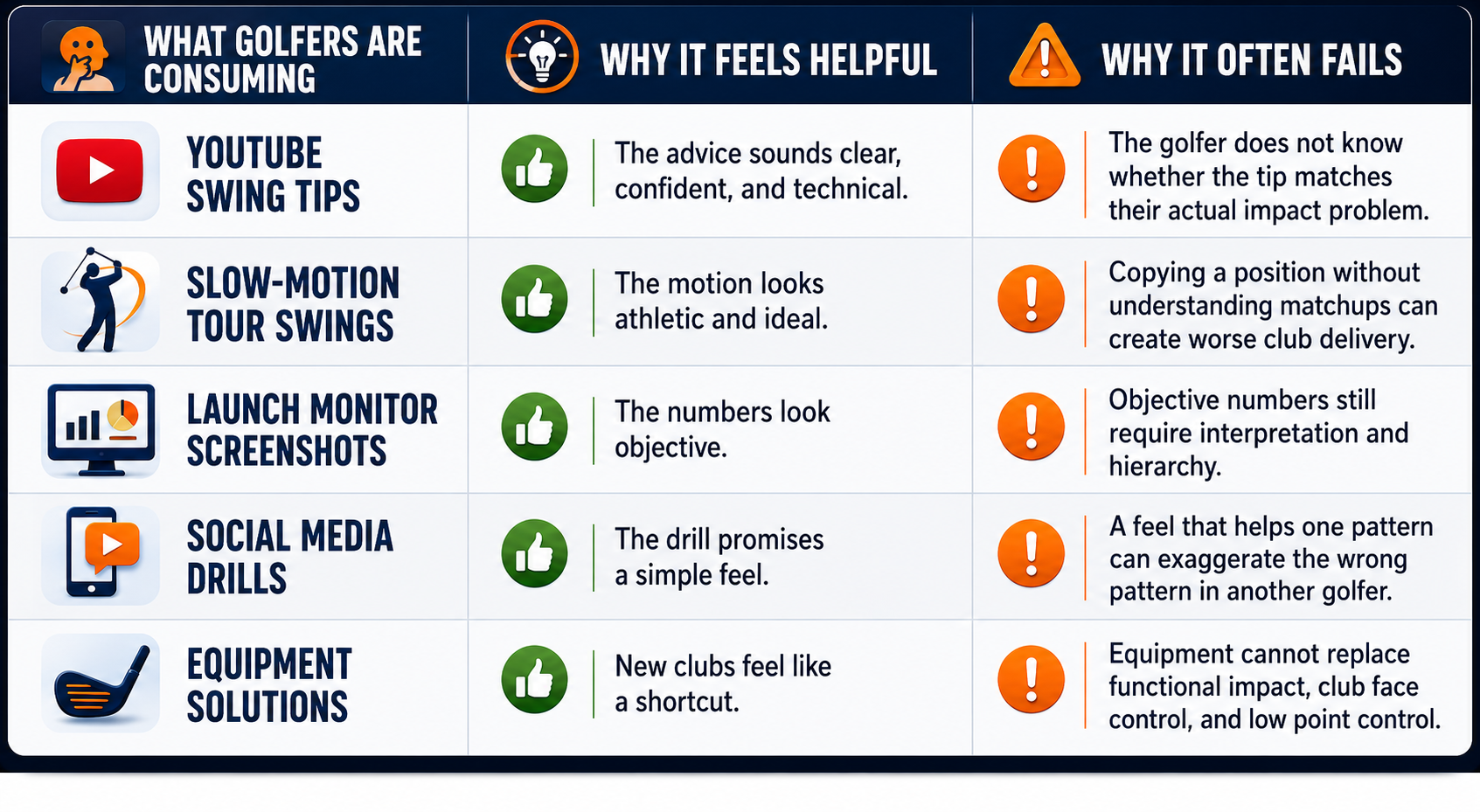
Golfers are not short on information. They have more videos, launch monitor screenshots, slow-motion swings, podcasts, social clips, training aids, and swing theories than any generation in golf history. Yet the average score-keeping golfer still lives around bogey golf. The strategy data behind this series points to a simple problem: the National Golf Foundation reports that most U.S. golfers keep score, and score-keeping golfers average about 94 for 18 holes, with no substantial recent change. At the same time, USGA data shows that golfers are measuring and posting more than ever, with more than 3.68 million U.S. golfers maintaining a Handicap Index and more than 82 million domestic scores posted in 2025.
That is not a lack-of-information problem. That is a diagnosis problem.
The online instruction market is not small. Club + Resort Business, citing National Golf Foundation reporting, stated that approximately 64% of core golfers watch some golf instruction online, and that golf instruction had become a billion-dollar business with about 21 million total lessons given in the reporting period. That means the modern golfer is surrounded by advice. The problem is not that golfers cannot find help. The problem is that most golfers cannot tell which help belongs to them.
A golf tip is only useful if it matches the problem. Most golfers do not know their problem.
That is the entire article. If you understand that sentence, you understand why so many players grind, search, copy, experiment, and still hit the same weak slice, the same fat iron, the same pull hook, the same thin wedge, or the same unpredictable two-way miss. A tip that fixes one golfer can destroy another golfer if the underlying matchup is different. Golf is not a library of universal fixes. Golf improvement is a diagnostic process.
At Coach Erik Schjolberg Golf, my coaching philosophy is The Science of Better Golf. I teach from ball flight and impact backward. I do not start with cosmetic positions. I do not force every golfer into the same swing model. I look at what the ball is doing, what that tells me about impact, what the club did to create that impact, and what body motion or matchup produced the club delivery. That is how golfers improve fast. That is why I offer a first-session improvement guarantee at EJSGolf.com/Scottsdale-golf-lessons: if I cannot help you improve in the first session, I do not want you paying for a guess.
The Data Problem: Golfers Are Consuming More, But Not Solving Impact
The uncomfortable truth is that golf improvement content has exploded while the average golfer’s impact pattern has not changed enough. The USGA’s 2025 Golf Scorecard reported record engagement in posted scores, including more than 82 million domestic scores and more than 3.68 million golfers with a Handicap Index. The USGA also noted that 94.4% of those posted rounds were recreational, which matters because we are not just talking about elite tournament players. We are talking about regular golfers trying to measure their games.
That measurement is useful. I want golfers to know their numbers. I use TrackMan, video, ball flight, and biomechanics concepts because measurement can expose the truth. But measurement alone does not create improvement. Watching more swing videos does not automatically create better low point control. Posting more scores does not automatically create a better club face. Buying another training aid does not automatically create shaft lean, compression, or centeredness of contact.
The golf industry often sells information as if information itself is the missing piece. It is not. The missing piece is an accurate diagnosis.
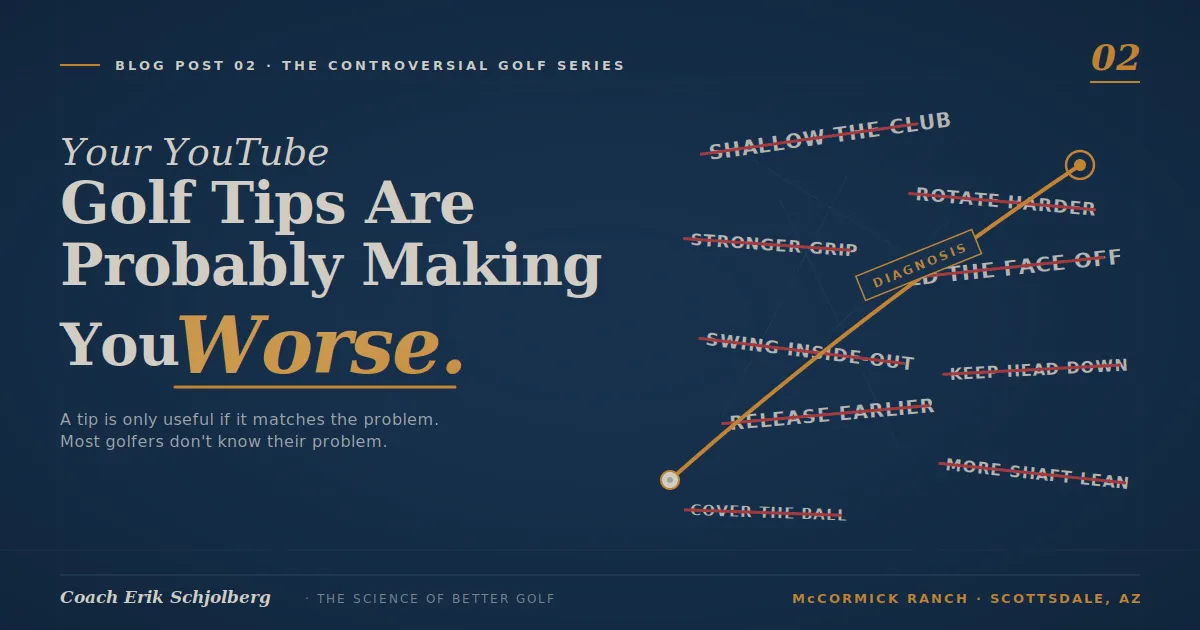
I see this constantly in lessons at McCormick Ranch Golf Club in Scottsdale. A golfer comes in with five swing thoughts from five different instructors. One video told him to shallow the club. Another told him to rotate harder. Another told him to strengthen his grip. Another told him to hold the face off. Another told him to release the club head sooner. Individually, each idea might help someone. Stacked together without diagnosis, they create a confused golfer with no reliable start line, no predictable curvature, and no understanding of why the ball is doing what it is doing.
The ball is not confused. The club delivered a message. Your job is to understand what it said.
Why Good Tips Become Bad Tips
This is the part many golfers miss: a tip can be technically true and still be wrong for you.
A stronger grip can help a golfer who chronically leaves the club face open and slices the ball. That same stronger grip can be a disaster for a golfer who already has a closed club face, flips the club head, and hits low-left hooks. A pressure shift cue can help a golfer who stays back and hits behind the ball. The same cue can hurt a golfer who already drives pressure too early, gets steep, and chops down across the ball. A release drill can help a player who holds the face open and blocks everything. The same drill can wreck a player who already over-releases and loses face stability.
That is why generic advice is dangerous. It does not account for matchups.
Golf is not about one perfect movement. It is about compatible pieces. Grip, club face, path, pressure shift, rotation, wrist conditions, release pattern, low point, and body motion must work together. The swing should fit the golfer, but impact still has to be functional. My standard is simple: ball first, then turf. If the club face is not controlled, the start line will not be predictable. If the low point is behind the ball, the contact will not be compressed. If the strike is not centered, the ball speed and curvature will not be consistent. If the pressure shift and rotation do not support the delivery, the golfer will need a compensation to find the ball.
A lot of YouTube golf instruction ignores that reality because online content has to speak to a crowd. A video cannot see your ball flight. It cannot see your divot pattern. It cannot know whether your club face is open because of your grip, your wrist conditions, your pivot, your release pattern, or your concept of impact. It cannot know whether your slice is primarily a club face problem, a path problem, a strike problem, or a sequencing problem. It cannot know whether your “over the top” move is actually the cause or just a reaction to an open face.
This is why I do not start a lesson by asking, “What position do you want your swing to look like?” I start by asking what the ball is doing.
The Correct Order: Ball Flight, Impact, Club, Body, Fix
Most golfers try to fix the swing in the wrong order. They start with the body because body motion is easy to see on video. They chase a backswing position, a takeaway look, a top-of-swing shape, or a follow-through finish. Those pieces can matter, but they are not the starting point. The starting point is the shot.
Ball flight gives you the first layer of truth. Start line tells you a lot about the club face. Curvature tells you about the relationship between face and path. Height, spin, contact, and strike pattern tell you more about dynamic loft, attack, centeredness, and low point. Turf interaction tells you where the club bottomed out. Divot direction can provide clues, but only when interpreted carefully. The sound and flight of the shot often tell a serious coach more than a pretty practice swing ever will.
Then I work backward.
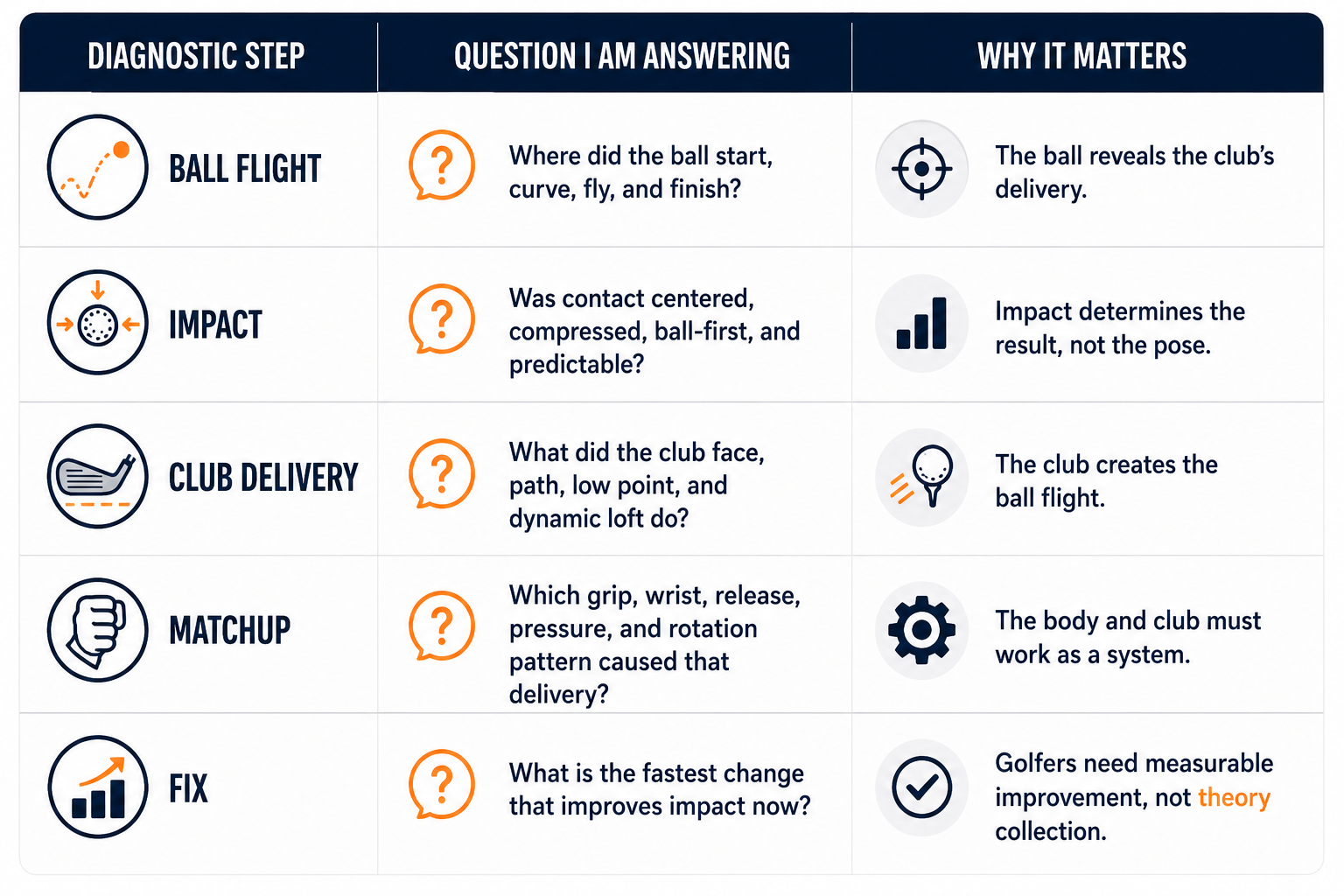
This is why one correct diagnosis beats 1,000 tips. A golfer who chunks irons does not automatically need to “keep the head down.” That cliché often freezes rotation and makes the low point worse. A golfer who slices does not automatically need to “swing more inside-out.” If the club face is wide open, swinging more to the right can create an even bigger curve. A golfer who tops the ball does not automatically need to “stay down.” The real issue may be early extension, trail arm structure, handle location, pressure, or a release pattern that changes the radius of the club.
The fix depends on the cause.
That is why serious golf coaching must be diagnostic. The PGA has long represented professional instruction, the USGA provides scoring and handicap structure, TrackMan provides ball and club data, Dr. Sasho MacKenzie has advanced the biomechanics conversation, and Golf Digest has helped bring analytics and instruction ideas to mainstream golfers. Those resources can be valuable. But the golfer still needs a coach who can connect the information to their impact.
The Most Common Way Golfers Get Worse From YouTube Tips
The most common problem is not that golfers watch one bad video. The problem is that they layer advice from different systems without understanding the conflict.
One instructor tells a golfer to rotate harder. Another tells him to feel the arms drop. Another tells him to close the club face earlier. Another tells him to hold the angles. Another tells him to release the club head. The golfer assumes improvement means adding more information. But golf swings do not improve by adding random thoughts. They improve when the correct piece is changed in the correct sequence.
Here is a common example. A golfer slices the driver. He watches videos about shallowing the club. He starts trying to drop the club behind him. But his real problem is that the club face is open early and stays open. Because the face is open, his brain knows the ball will go right unless he pulls the handle left or throws the club head. He tries to shallow, but the open club face forces a compensation. Now he hits blocks, wipey cuts, heel strikes, and occasional snap hooks when he over-corrects. The YouTube tip did not fix the problem because it never addressed the club face.
Another example: a golfer hits fat irons. He watches videos about forward shaft lean. He tries to lean the handle more. But his pressure stays on the trail side, his rotation stalls, and his arms throw the club head early. Now he adds handle drag to a body pattern that cannot support it. The result is low, weak, heavy contact. He thinks shaft lean failed. It did not fail. His matchup failed.
A third example: a golfer pulls the ball left. He watches videos about swinging more to the right. But his face is already shut. Swinging more right with a shut face can create hooks, blocks, and panic. The real priority may be club face management, grip structure, pivot, or release pattern, not path.
These are not rare exceptions. These are the normal consequences of non-diagnostic learning.
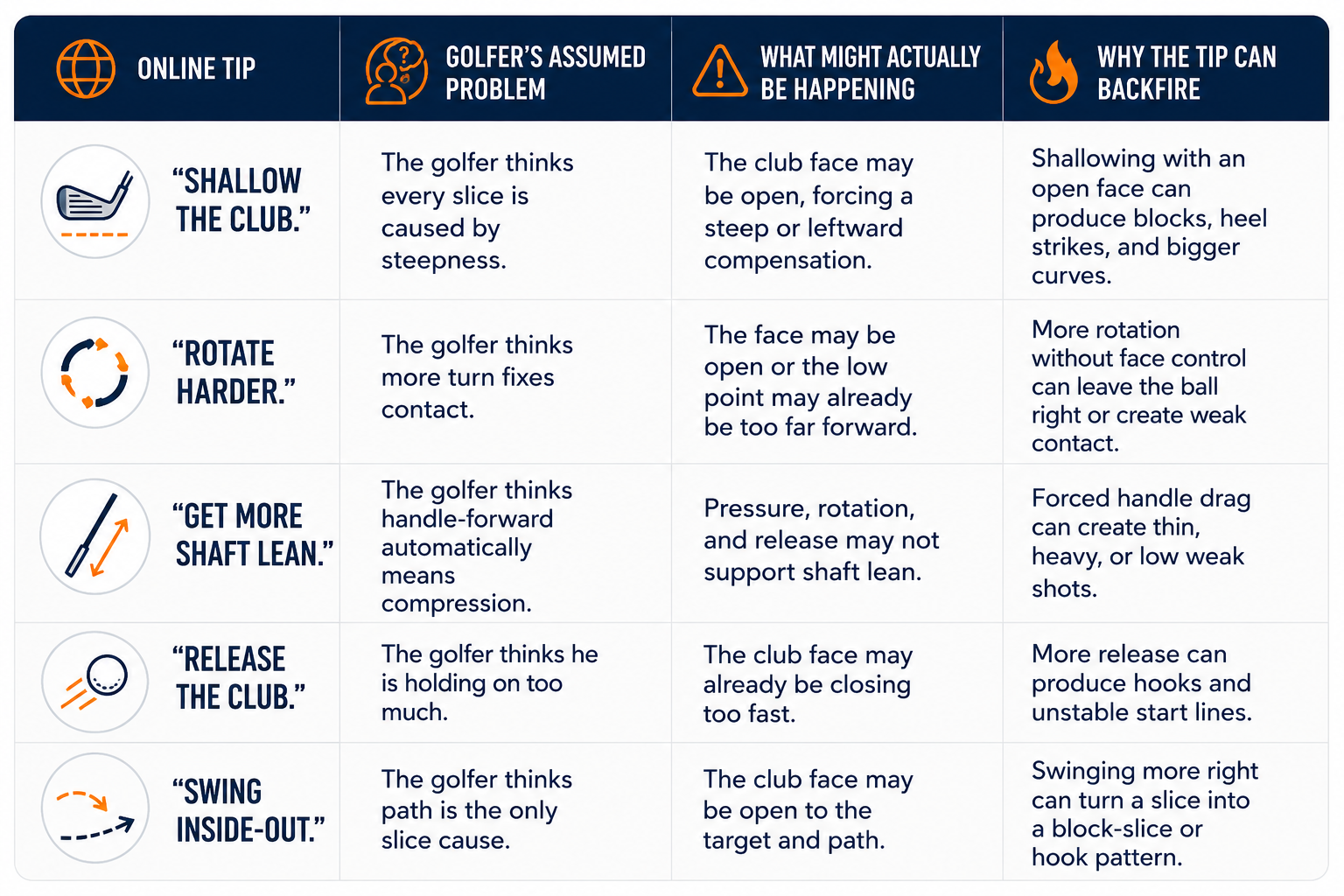
This is why I do not sell random tips at Coach Erik Schjolberg Golf. I teach golfers to understand cause and effect. The goal is not to memorize more swing theory. The goal is to become a Ball Striking Machine: better impact, better contact, predictable start line, controlled curvature, and a swing pattern that holds up under pressure.
Online Instruction Is Not the Enemy. Misapplication Is the Enemy.
I want to be fair. There are excellent instructors online. There are great explanations, useful drills, smart breakdowns, and valuable concepts. I have no issue with golfers learning. A serious golfer should be curious. I would rather coach a golfer who wants to understand cause and effect than a golfer who blindly repeats clichés.
The problem is not the existence of online instruction. The problem is that the delivery format is not personalized.
A YouTube video has to speak broadly. It cannot test your grip. It cannot watch five shots and compare start line, curvature, strike, height, divot, and speed. It cannot ask what you felt. It cannot see whether your practice swing changes when a ball is there. It cannot decide whether the first priority is club face, low point, pressure, rotation, or release. It cannot tell whether your current compensation is harmful or actually useful.
That last point matters. Not every compensation is bad. Some matchups are functional. Some unusual swings produce excellent impact because the pieces fit. The mistake is assuming every golfer needs to erase every odd-looking movement. I do not coach that way. I am not trying to make everyone swing the same. I am trying to make Impact functional.
If a golfer has a strong grip, a bowed lead wrist, and a body pattern that matches it, I may not change the grip. If a golfer has a neutral grip but poor face awareness, I may start with face control. If a golfer has good face control but poor low point, I may prioritize pressure shift and pivot. If a golfer has speed but poor centeredness of contact, I may work on strike before chasing more club head speed. The correct answer depends on the player.
That is the difference between content and coaching.
Content gives you possibilities. Coaching gives you priorities.
What a Real Diagnosis Looks Like
A real diagnosis is not a five-second opinion from one down-the-line video. It is not guessing based on what the swing “looks like.” It is not repeating what worked for the last golfer. A real diagnosis connects the shot outcome to impact, then connects impact to the golfer’s functional matchups.
If a golfer comes to me slicing the driver, I am not automatically thinking, “Fix the path.” I am asking: Where does the ball start? How much does it curve? Where is contact on the face? What does the club face look like relative to path? Is the golfer adding loft? Is the strike high, low, heel, or toe? Is pressure moving? Is the golfer stalling rotation because the face is open? Is the grip compatible with the release pattern? Is the golfer’s concept of impact wrong?
If a golfer comes to me hitting fat irons, I am not automatically thinking, “Keep the head still.” I am asking: Where is the low point? Is pressure getting forward early enough? Is the club head passing the hands too soon? Is the golfer extending early? Is the trail arm collapsing or throwing? Is the handle too far back at impact? Is the golfer afraid to rotate because the face is open? Is the ground contact before the ball or after the ball?
If a golfer comes to me with a two-way miss, I am not automatically thinking, “Simplify the swing.” I am asking: Is the start line changing because the face is unstable? Is curvature changing because the face-to-path relationship changes? Is contact moving around the face? Is the release pattern timing-dependent? Is the player using hand action to rescue a body pattern that does not support the club?
This is the kind of thinking that produces fast improvement. It is also why I guarantee improvement in the first session. I am not promising that every golfer becomes scratch in an hour. That would be nonsense. I am saying that if the diagnosis is correct, we should be able to create measurable improvement quickly. Better contact. Better start line. Better curvature. Better low point. Better understanding. The golfer should leave knowing what changed and why it changed.
That is very different from leaving with another random swing thought.
The “One Tip Away” Trap
A lot of golfers are addicted to the idea that they are one tip away. One grip secret. One takeaway move. One shallowing feel. One pressure drill. One wrist angle. One magic phrase. That belief keeps golfers searching instead of diagnosing.
The truth is usually less glamorous and more useful. You are not one tip away. You are one correct diagnosis away.
That diagnosis may lead to a simple feel. It may lead to a grip adjustment. It may lead to a release change. It may lead to a pressure shift drill. It may lead to a setup change. It may lead to a better concept of where the club face needs to be at impact. But the drill is not the point. The reason behind the drill is the point.
When a golfer only collects tips, the swing becomes a pile of disconnected instructions. “Turn more.” “Stay down.” “Shallow.” “Cover the ball.” “Release it.” “Hold it off.” “Get left.” “Swing right.” “Keep the arms connected.” “Use the ground.” Some of those ideas may be useful in the correct context. Without context, they are noise.
The golfer then starts judging improvement by whether the swing feels like the video. That is backward. The standard is not whether the swing matches the video. The standard is whether the ball flight and impact improve.
At EJSGolf.com, I want golfers to judge the work by evidence. Did the ball start closer to the intended line? Did curvature become more predictable? Did contact move toward the center of the face? Did the low point move to the correct side of the ball? Did the golfer create ball-first contact? Did the golfer understand the cause-and-effect relationship well enough to practice without guessing?
That is golf improvement. Not content consumption.
Why Scottsdale Golfers Need Diagnosis, Not More Noise
Scottsdale is full of serious golfers. Players come here for great golf courses, good weather, tournament preparation, retirement golf, junior development, business golf, and competitive amateur golf. At McCormick Ranch Golf Club, I see players who care. Many of them practice. Many of them watch the instructions. Many of them have taken lessons before. They are not lazy. They are not stupid. They are often misdirected.
A golfer can spend years working hard on the wrong priority. That is the most frustrating part of this game. Effort alone does not guarantee improvement. Range time can make a bad pattern more permanent if the golfer is rehearsing the wrong thing. A player can hit 200 balls and become better at compensating. That is not the same as becoming better at impact.
This is where The Science of Better Golf matters. Science does not mean drowning the golfer in numbers. Science means respecting cause and effect. Ball flight has causes. Impact has causes. Contact has causes. Curvature has causes. Low point has causes. A serious coach identifies those causes and chooses the highest-value intervention.
The goal is not to impress golfers with complexity. The goal is to make the solution clear.
If you are in Scottsdale, Paradise Valley, Phoenix, Tempe, Mesa, or anywhere nearby, and you are tired of random golf tips, the answer is not another saved video. The answer is a real diagnosis. Start with Scottsdale golf lessons at Coach Erik Schjolberg Golf if you want the work to be built around your ball flight, your impact, your matchups, and your measurable improvement.
How to Use Online Golf Instruction Without Letting It Wreck Your Swing
I am not telling you to stop learning. I am telling you to stop self-prescribing.
If you watch online golf instruction, use it as education, not medication. Learn the concept. Understand the language. Pay attention to the cause-and-effect explanation. But do not automatically apply the drill until you know your actual pattern. Before you copy anything, ask better questions.
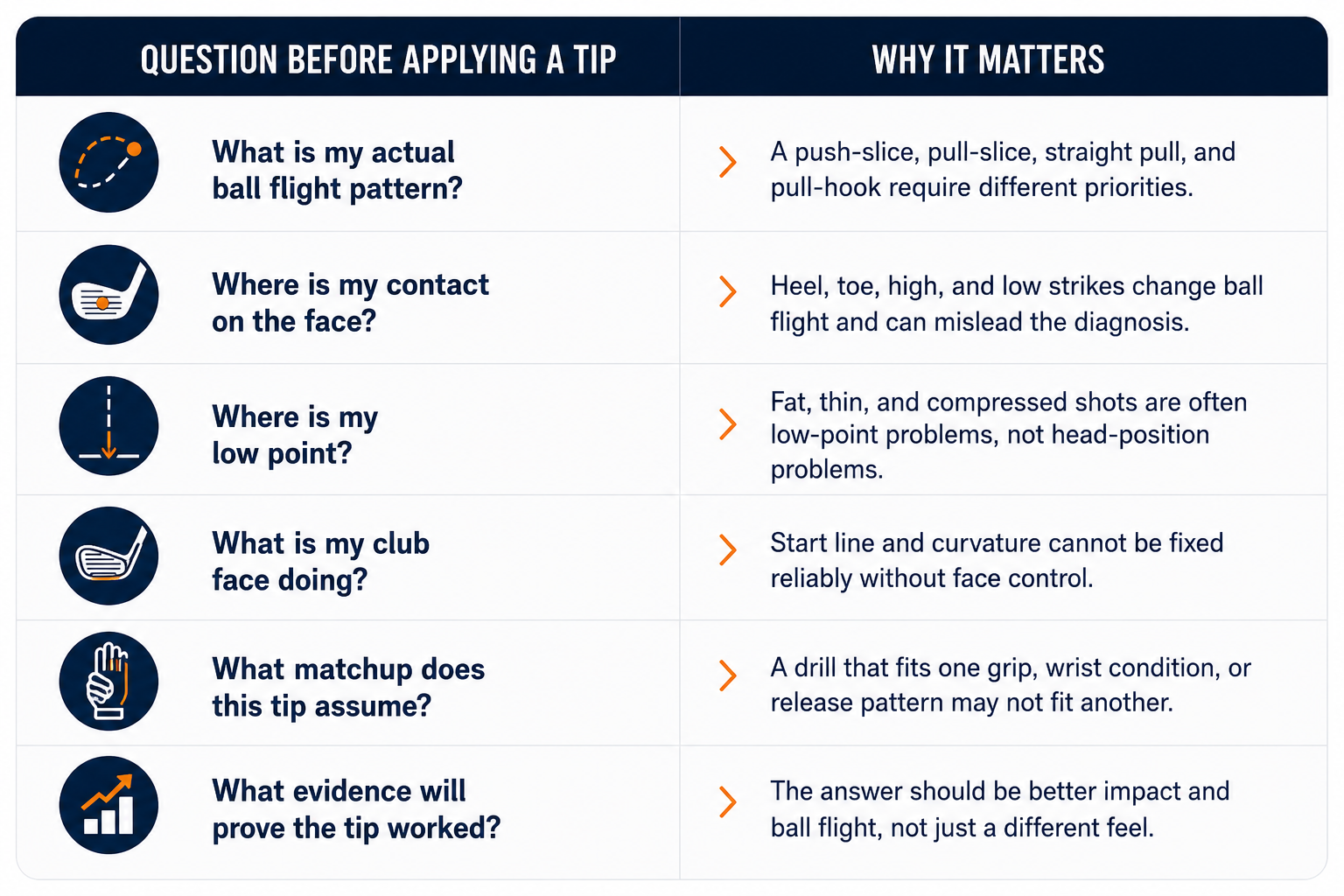
If a video does not explain who the tip is for, when it applies, when it does not apply, and what ball flight problem it is designed to solve, be careful. That does not mean the instructor is bad. It means the information is incomplete for your situation.
A better way to think is this: every tip is a tool, but not every tool belongs in your hand today. A hammer is useful. It is not useful when the job requires a wrench. Golf instruction works the same way. The right intervention depends on the job.
One Correct Diagnosis Beats 1,000 Tips
The golf ball does not care how many videos you watched. It does not care how many swing theories you can name. It does not care whether your positions look good in slow motion. The ball responds to the club: club face, path, centeredness, attack, dynamic loft, speed, and contact. The ground responds to your low point. Your score responds to whether your ball flight is predictable enough to play golf.
That is why I keep coming back to impact.
If your club face is not controlled, your start line is unstable. If your low point is wrong, your contact is unreliable. If your strike is not centered, your ball speed and spin are inconsistent. If your pressure shift does not support rotation, you will compensate with timing. If your release pattern does not match your grip and pivot, you will fight curvature all day. These are not clichés. These are cause-and-effect relationships.
A lot of golfers do not need more motivation. They need clarity. They need someone to look at the ball flight, identify the impact pattern, understand the matchup, and explain the fix in a way that transfers. That is what coaching is supposed to do.
This is also why I reject the idea that golfers must get worse before they get better. If a change is properly diagnosed, the golfer should see something improve quickly. Maybe not every shot. Maybe not the entire game immediately. But there should be a measurable signal: cleaner contact, better start line, improved strike, more functional curve, better ground contact, or a clearer understanding of the miss.
If you have been watching YouTube golf tips for years and you still do not know why the ball starts where it starts, curves how it curves, or why you hit the ground before the ball, you do not need another tip. You need a diagnosis.
Conclusion: Stop Guessing and Start Diagnosing
Online golf instruction is not going away, and it should not. Good information has value. The problem is that golfers often treat generic information like personalized instruction. That is where the damage happens.
The modern golfer is surrounded by advice, but the average golfer is still not solving the core problems that control scoring: impact, ball flight, low point control, club face control, centeredness of contact, shaft lean, pressure shift, rotation, compression, predictable start line, and controlled curvature. Those problems do not get solved by stacking contradictory tips. They get solved by diagnosis.
My approach at Coach Erik Schjolberg Golf is simple: start with the ball, work backward to impact, identify what the club did, find the matchup that caused it, and apply the fastest fix that improves the shot. That is The Science of Better Golf. That is how golfers become Ball Striking Machines.
If you are tired of guessing, stop collecting tips and get evaluated. Book a diagnostic session at EJSGolf.com/Scottsdale-golf-lessons. If I cannot help you improve in the first session, you get a refund. That is the standard because improvement should begin on day one.
Ball first. Then turf. Better impact. Better ball striking. Better golf.
FAQ: YouTube Golf Tips, Online Instruction, and Golf Swing Diagnosis
1. Are YouTube golf tips bad for your swing?
YouTube golf tips are not automatically bad. The problem is misapplication. A tip can be accurate for one golfer and wrong for another because golfers have different grips, club face tendencies, release patterns, pressure shifts, body motions, and matchups. If the tip does not match your actual ball flight and impact problem, it can make your swing worse.
2. Why do I get worse after watching golf instruction videos?
You may be adding fixes that conflict with each other or applying a drill designed for a different problem. For example, a golfer with an open club face may watch a path video and start swinging more inside-out, but the open face remains. That can create bigger slices, blocks, or hooks. The issue is not always the video. The issue is that you are trying to prescribe a fix without diagnosing the cause.
3. What is the best way to diagnose a golf swing problem?
The best diagnosis starts with ball flight and impact. Look at the start line, curvature, contact location, turf interaction, low point, and strike quality. Then identify what the club face, path, dynamic loft, attack, and centeredness of contact did. Only after that should you connect the issue to grip, pressure shift, rotation, wrist conditions, release pattern, or setup. That is the process I use in Scottsdale golf lessons at Coach Erik Schjolberg Golf.
4. Should I stop watching online golf instruction?
No. Use online golf instruction for education, not self-prescription. Learn concepts, but do not assume every drill applies to you. Before applying a tip, know your ball flight, your impact pattern, and your main priority. If you cannot explain why a drill should help your specific miss, you are probably guessing.
5. Why does Coach Erik teach from impact backward?
Impact is where the shot is created. The ball does not respond to how your backswing looks; it responds to the club at impact. Club face, path, low point, centeredness of contact, dynamic loft, shaft lean, and speed determine the shot. I work backward from impact because it gives the golfer a clear cause-and-effect path instead of a pile of disconnected swing positions.
6. What makes Coach Erik Schjolberg Golf different from generic golf lessons?
My coaching is built on diagnosis and matchups. I do not teach one universal swing model. I identify what the ball is doing, what impact created it, what the club did, and which matchup produced that delivery. Then I choose the fastest, most effective fix. The standard is measurable improvement: better contact, better start line, better curvature, better low point, and better ball striking.
7. Do launch monitors like TrackMan replace coaching?
No. A launch monitor can tell the truth about the shot, and tools like TrackMan can be extremely valuable. But data still has to be interpreted. Numbers do not automatically tell the golfer which piece to change first, which compensation is functional, or which feel will transfer to the course. Technology should serve coaching judgment, not replace it.
8. Where can I get Scottsdale golf lessons with Coach Erik Schjolberg?
Coach Erik Schjolberg Golf is located at McCormick Ranch Golf Club in Scottsdale, Arizona. You can learn more at EJSGolf.com or book Scottsdale golf lessons at EJSGolf.com/Scottsdale-golf-lessons. My first-session improvement guarantee is simple: if I cannot help you improve in the first session, you get a refund.
Get my full drill library at EJSGolf.com/my-drills
Read more at EJSGolf.com/blog
Book a session at EJSGolf.com
More from Coach Erik:
Follow me on:

What You Can Expect from Our Blog
1. Expert Insights on Swing Mechanics:
With over 25 years of experience as a PGA Professional Golf Instructor, I delve deep into the nuances of golf swing mechanics. My articles break down complex theories into understandable concepts, focusing on ground reaction forces (GRFs), biomechanics, and efficient energy transfer.
2. Advanced Technological Guidance:
Our academy is equipped with state-of-the-art tools like the Trackman 4 Launch Monitor, 3D Pressure Plates, and Hackmotion, among others. On the blog, I share how to leverage these technologies to gain precise feedback on your swing, helping you make informed adjustments and see measurable improvements.
3. Tailored Practice Routines:
My philosophy is built on the belief that improvement should be evident from the first lesson. I advocate a '15 minutes per day' practice model, designed to fit into your busy schedule while ensuring consistent progress. Each blog post aims to offer practice drills and routines that are easy to implement and effective in refining your skills.
4. Real Success Stories:
Read about the experiences of those who have trained at EJS Golf Academy. These testimonials not only inspire but also illustrate the practical application of our teaching methodologies and the real results achieved.
5. Interactive Learning:
We occasionally feature video tutorials and interactive content that allows you to visually grasp techniques and corrections. This blended approach helps reinforce learning and allows you to engage with the content actively.
How Our Blog Helps Golfers Get Better
Every post is crafted with the intent to educate. We cover everything from basic fundamentals to advanced techniques, ensuring there's something valuable for every skill level. By presenting data and evidence-backed strategies, our blog demystifies the 'why' and 'how' behind effective golf training. This analytical approach empowers you to make smarter decisions about your practice and play. We understand that generic advice does not suit everyone. Our blog posts are designed to help you identify your own needs and adapt our techniques accordingly. Whether it’s adjusting your grip, stance, or swing path, you’ll find personalized tips that resonate with your specific challenges. Beyond just reading, our blog serves as a community hub where you can interact with fellow golfers and share your experiences. This supportive environment encourages learning and improvement through collective wisdom.
Join Us on Your Path to Mastery
Whether you’re looking to refine your swing, understand the biomechanics of your body, or simply get more enjoyment out of the game, our blog at EJS Golf Academy is your go-to resource. Bookmark our page, subscribe to updates, and start transforming your game today.
Remember, at EJS Golf, we don’t just teach golf; we craft master golfers. Let’s begin this journey together. Visit us atEJSGolf.com to learn more about our programs and start your training online or at our Scottsdale location. Let’s make every swing count!
DO YOU HAVE QUESTIONS?
Fill out my contact form and I will respond to you within 24 hours.


phone: 480.861.9370 email: [email protected]

I've taken multiple private lessons with Erik and he's been by far the best swing coach I have ever worked with. He has the ability to dissect your swing and make small changes for big improvements. What I love most about his lessons is they go far beyond the 1 or 2 hours you're with him. He follows up with videos of how you can improve at home and on the range. The value he provides is absolutely worth the cost of his sessions. I would recommend any golfer at any level who truly wants to get better to go see Erik.”
- Reanol H.
Erik is the best! and that is not an exaggeration. There has not been a single lesson where I haven't walked out and felt like a far better golfer than before. What can't be praised enough is the effort and dedication that Eric puts into each of his students, as his approach to fixing and improving my golf swing was specific to me. While teaching, Erik takes the extra time to truly dive into what he is trying to convey rather than just telling you, allowing for a better understanding. Beyond the instruction at the course, Erik sends specific drills to you from an app that allows for slow motion replays, letting you break down everything and work on your game at any time. I genuinely mean it when I say that I would recommend Erik to anyone wanting to improve their golf game, as he is not only a top not instructor but also a top notch person who cares about his students.
- Brennan K.
Erik is flat out a great coach and mentor! I highly recommend him! Working from the ground up, my swing is healthier and smooth! I wanted a coach that shared the same main principles as the late Tony Manzoni and Erik hits the mark! Found Erik by listening to the Golf Smarter podcast by Fred Greene and connected with EJS Golf through the Perfect Motion app. Erik is motivated and incredibly gifted at his craft!
- Bryan B., Indiana, USA