
EJS GOLF BLOG
Learn about the golf swing and what you can do to improve your score on the golf course. Fill out the form below if you have any questions or want to set up a time to talk.
Mastering the Art of Golf with Coach Erik Schjolberg
I’m Coach Erik Schjolberg, and welcome to the EJS Golf blog—Scottsdale’s authority on science-driven ball-striking. Here you’ll find in-depth analyses of swing mechanics, data-backed breakdowns of impact and launch dynamics, and actionable practice routines designed to rewire your muscle memory from day one. Each post peels back the curtain on cause-and-effect in your swing, whether you’re chasing Tour-level precision, collegiate consistency, or lower weekend scores. Dive into our deep-dive articles, master the drills that drive real improvement, and transform your game with proven science and strategy.
But let’s be clear: golf isn’t only about perfecting swing mechanics. The mental battle you fight on each tee is often the one that determines whether you stay in the game or walk off the course. Here, we’ll tackle the psychological hurdles—the pressure of a tight leaderboard, the frustration when a swing fails under stress, the self-doubt that creeps in after a bad hole. You’ll learn evidence-based mental strategies—visualization routines, pre-shot rituals, stress-management techniques—that fortify your focus and resilience. Mastering these mind-set tools is just as critical as dialing in your impact position, and I’ll show you exactly how to integrate mental training into your practice for lasting confidence on every shot.
Explore Our Blogs
Your Launch Monitor Is a Truth Machine You're Misreading
Your Launch Monitor Is Not a Coach - It Is a Truth Machine You Are Probably Misreading
The Machine Is Not the Problem
Your launch monitor is not lying to you. That is exactly why it can be dangerous.
A good launch monitor does not care about your favorite swing thought, your handicap, your ego, your last YouTube tip, or whether you felt like you made a better move. It reports what happened. The ball launched where it launched. The club face pointed where it pointed. The club head traveled on the path it traveled. The ball spun the way impact told it to spin. In that sense, a launch monitor is one of the best truth machines in golf.
The problem is not the technology. I use TrackMan extensively in my coaching at Coach Erik Schjolberg Golf. I believe serious instruction should use evidence. I want to know what the ball did, what the club did, and what impact produced. I also respect the broader world of golf technology, including systems from FlightScope, Foresight Sports, Garmin, and other launch monitor platforms. The issue is not whether launch monitors are useful. They are useful. The issue is whether the golfer understands what the numbers mean, what caused them, and what should change first.
That is where most amateurs get lost.
Golfers are not short on data anymore. They can buy a launch monitor, set it up in a garage, pull up ball speed, club head speed, carry distance, spin rate, launch angle, face angle, path, attack angle, dynamic loft, spin axis, descent angle, dispersion, and smash factor. Then they stare at the screen and start chasing numbers without a diagnosis. They try to increase club head speed while the club face is wide open. They chase carry distance while spin loft is destroying compression. They obsess over attack angle without understanding dynamic loft. They try to fix path without knowing whether the start line is being dominated by the club face. They compare their numbers to tour averages while ignoring their own matchups.
That is not science. That is expensive confusion.
At EJSGolf.com, my philosophy is simple: ball flight tells the truth, impact explains the truth, and matchups fix the truth. A launch monitor helps reveal the truth. It does not replace the coach. The numbers serve the diagnosis. The diagnosis drives the fix. The fix must fit the golfer.

More Data Has Not Automatically Created Better Golfers
The golf world has never had more information. The average golfer has access to launch monitor data, online instruction, equipment reviews, club fitting, statistics, simulator practice, and swing analysis tools that would have been unimaginable a generation ago. That should matter. It can matter. But access to measurement is not the same thing as understanding.
The National Golf Foundation reports that 77% of U.S. golfers keep score regularly, and the roughly 20 million golfers who do keep score average about 94 for 18 holes, a number NGF says has not changed substantially in recent years.1 The USGA reported that more than 3.68 million U.S. golfers with a Handicap Index posted a record 82 million domestic scores in 2025, with Handicap Index participation up more than 46% since 2020.2 The USGA’s current handicapping statistics also show average Handicap Indexes of 14.0 for male golfers and 28.8 for female golfers, which means the game is being measured at a massive scale while many players still need better diagnosis, not more random information.3
Those facts matter because they expose the real issue. Golfers are measuring more. They are posting more. They are watching more. They are buying more technology. But the average player is still fighting the same old problems: poor contact, weak ball flight, random start lines, uncontrolled curve, fat shots, thin shots, open club face patterns, poor low point, and no clear understanding of why the ball does what it does.
The ball is not confused. The club delivered a message. Your job is to understand what it said.
A launch monitor can show the message. It cannot force you to interpret it correctly. That is why I call it a truth machine, not a coach.
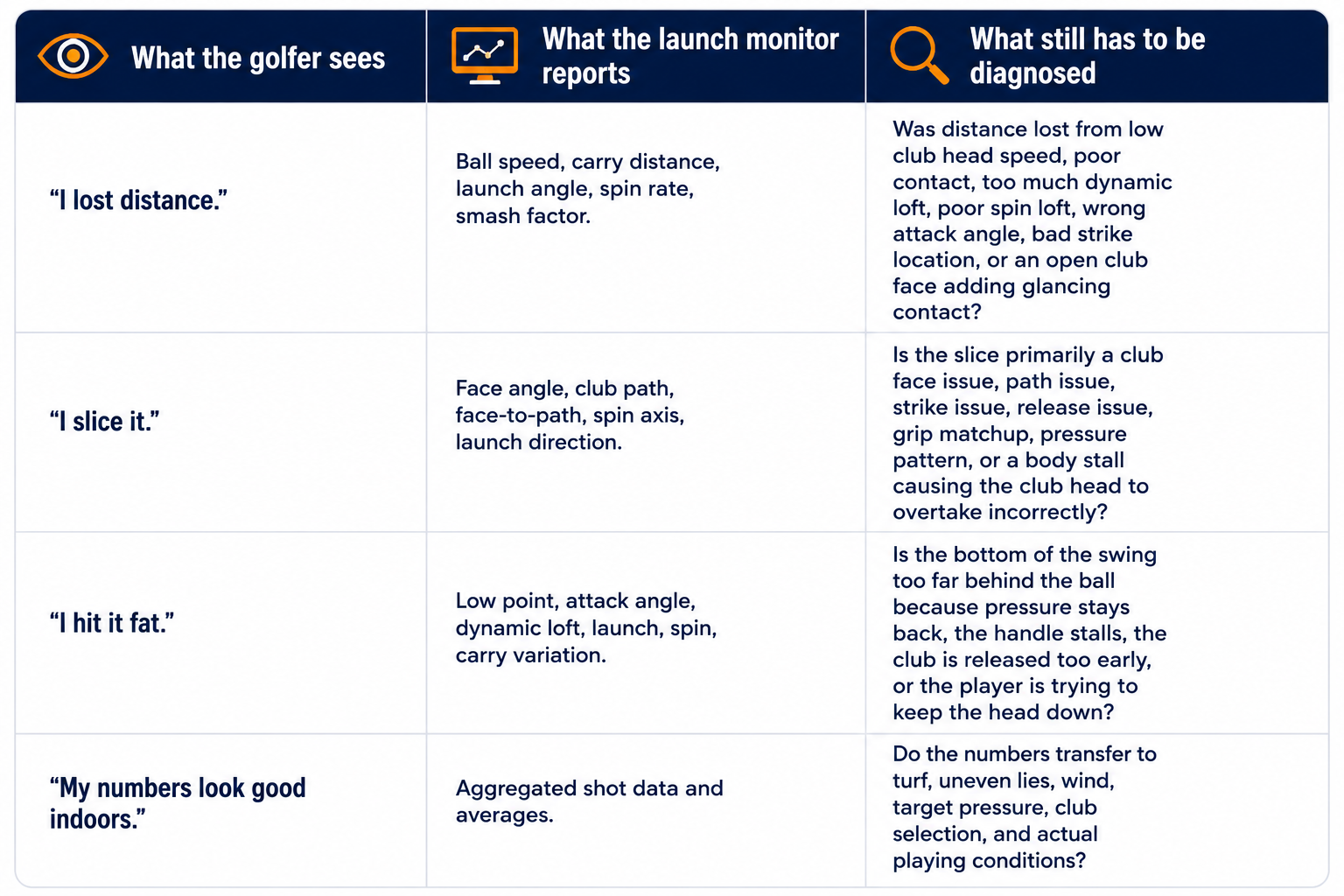
This is the missing step. Golfers collect outputs. Coaching identifies causes.
Launch Monitor Numbers Are Objective, but Your Interpretation May Be Wrong
This is where technology people sometimes get defensive. They say, “The numbers are objective.” I agree. That is the point. The problem is not the objectivity of the numbers. The problem is the golfer’s interpretation of the numbers.
TrackMan defines key parameters such as club speed, attack angle, dynamic loft, club path, face angle, spin rate, spin axis, and ball speed in precise ways.4 FlightScope explains that carry distance depends on ball speed, spin rate, spin axis, and vertical launch angle, and that club face angle has the biggest effect on horizontal launch angle.5 Foresight Sports lists important club and ball measurements such as impact point, angle of attack, club path, spin-tilt axis, impact loft, delivered lie angle, and closure rate.6 These are not vague ideas. They are measurable pieces of impact and ball flight.
But measurement is not priority. A golfer can know that the face-to-path relationship is producing a slice and still not know what to change. A golfer can know attack angle is too steep and still make the wrong fix. A golfer can know spin rate is high and still not understand whether the cause is strike location, dynamic loft, spin loft, friction, club delivery, equipment, or a matchup that breaks down under speed.
That is why launch monitor data must be read in hierarchy. Some numbers are causes. Some numbers are effects. Some numbers are summaries. Some numbers are influenced by several variables at once. If you treat every number as equal, you will chase symptoms.
For example, a golfer sees high spin with a driver. The amateur reaction is often to buy a lower-spin head, change shafts, tee it higher, swing up, or try to “hit bombs.” Maybe one of those helps. Maybe not. If the golfer is delivering too much dynamic loft with an open club face and a strike low on the face, the real fix may be face control, handle location, pressure shift, and centeredness of contact. If the golfer simply chases lower spin without fixing delivery, the result may be lower launch, worse start line, and less playable curvature.
This is why I do not coach from one isolated number. I coach from ball flight and impact backward.
The Most Common Launch Monitor Mistake: Chasing Club Head Speed First
Club head speed matters. I am not going to pretend it does not. More speed creates more potential. The PGA and modern performance world are right to value athleticism, strength, speed training, and better movement. Dr. Sasho MacKenzie’s golf biomechanics work is one of the reasons serious coaches understand that speed is created by real mechanical relationships, not by random effort.7
But speed without face control is just a faster problem.
If your club head speed goes up while your club face gets more open, your path gets more across the ball, your strike moves toward the heel, and your low point gets worse, you did not become a better golfer. You became a more powerful miss. The launch monitor may show a higher top-end ball speed once every ten shots, and that one shot will seduce you. But your dispersion, start line, curvature, and scoring pattern may be worse.
I care about speed. I also care about whether that speed arrives with functional impact. The standard is still ball first, then turf. With the driver, the standard is still predictable start line, controlled curvature, centeredness of contact, and useful launch conditions. With irons, the standard is compression, low point forward of the ball, shaft lean that matches the shot, and enough rotation to keep the handle and club face organized.
The amateur golfer often wants the one number that proves improvement. Club head speed is attractive because it is easy to understand. Higher looks better. But golf is not a long-drive contest for most players. Golf is a target sport where speed has to be delivered through the correct impact conditions.
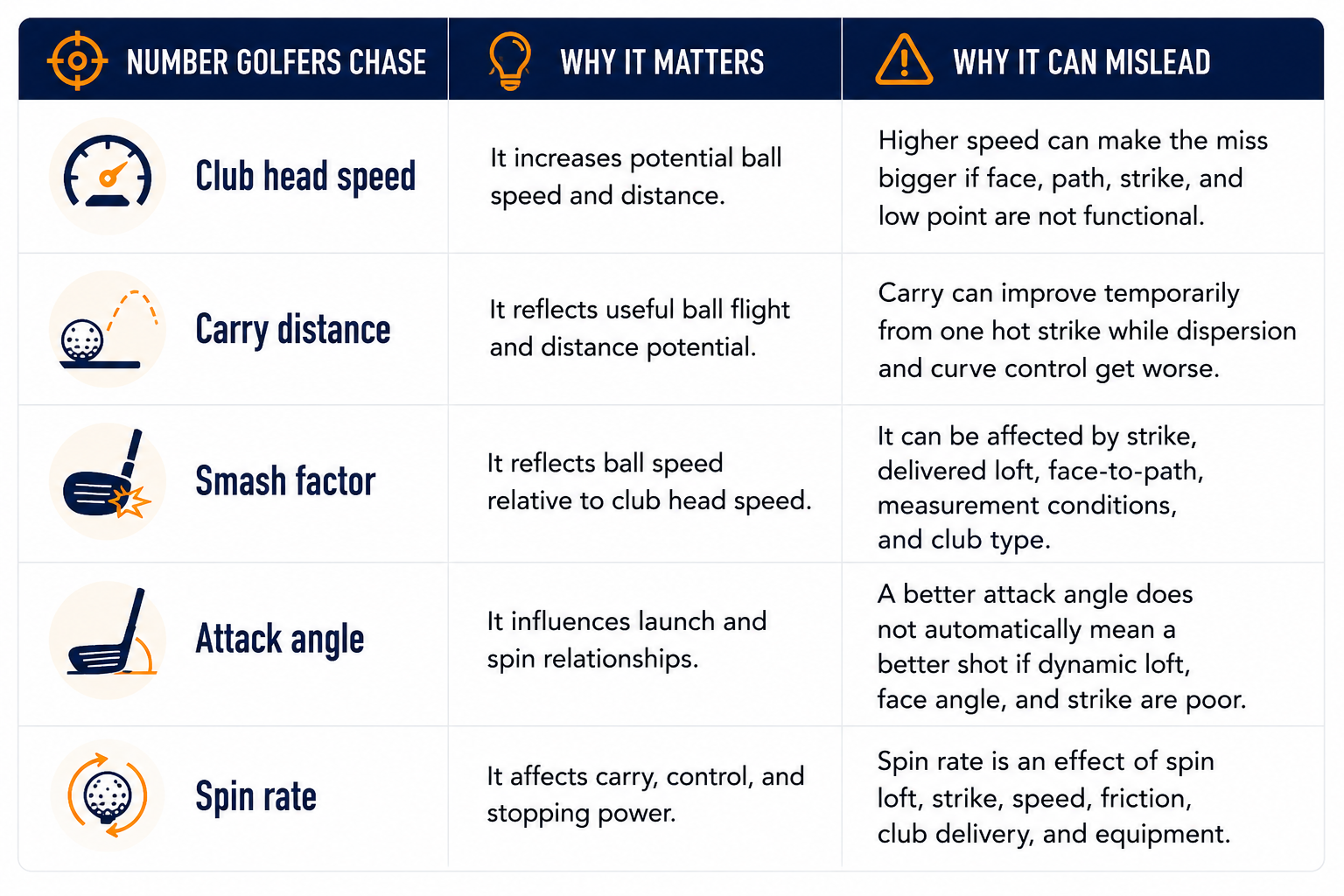
The right question is not “How do I make this number higher?” The right question is “What impact condition produced this number, and does changing it make my ball flight more functional?”
Carry Distance Is Not the Same as Ball Striking
One of the worst habits in launch monitor practice is judging every swing by carry distance. I understand why golfers do it. Distance is visible. It is easy to compare. It feels like progress. But carry distance by itself does not tell the whole truth.
FlightScope states that carry distance is determined by ball speed, spin rate, spin axis, and vertical launch angle.5 That sentence alone should stop golfers from worshiping carry distance as a single number. Carry is an outcome. It is not a diagnosis. If you hit one 7-iron five yards farther because you launched it lower with less spin but also lost stopping power and start-line control, that may not be better golf. If your driver carry goes up because you hit one high-toe knuckleball that would miss the fairway by forty yards, that is not a reliable pattern.
Better ball striking is not just longer. Better ball striking is more predictable. The ball starts closer to the intended line. The curvature is controlled. Contact is centered more often. The low point is where it needs to be. The club face is not a mystery. Distance windows tighten. Curvature windows tighten. The golfer starts to know what the ball is going to do.
That is why I teach golfers at Scottsdale golf lessons from impact backward. I want carry distance, but I want the right kind of carry distance. I want distance that comes from useful ball speed, solid strike, functional dynamic loft, appropriate spin, and a club face that matches the intended shot. I do not want distance created by a compensation that falls apart on the course.
The launch monitor should help you separate fake progress from real progress. Fake progress is one impressive number. Real progress is a tighter pattern.
Spin Loft, Dynamic Loft, and Compression Are Not Optional Details
Golfers love the word compression. Most do not understand what creates it.
TrackMan explains that spin loft is approximately the angle between dynamic loft and attack angle, while its full definition is a three-dimensional relationship between the direction the club head is moving and the orientation of the club face.8 TrackMan also states that spin loft has a major influence on spin rate, and that higher spin loft generally increases spin rate and lowers smash factor, all else equal.8
That is the technical reason a golfer can swing hard and still hit weak shots. If dynamic loft is too high, the handle is backing up, the club face is open, contact is glancing, and the low point is not controlled, the golfer is not compressing the ball efficiently. The club head may be moving fast, but the impact collision is not organized.
This is why I do not accept vague instruction like “just swing smoother” or “just hit down on it.” Those statements are incomplete. A golfer may need more shaft lean, but only if the club face, pressure shift, release pattern, and rotation can support it. Another golfer may already be too steep and need a different matchup. One golfer needs to reduce dynamic loft. Another needs to improve contact location. Another needs a grip change because the club face is never in a position to deliver compression without a last-second save.
Same number. Different cause. Different fix.
That is coaching.
Face-to-Path Is Not a Swing Tip - It Is a Ball Flight Law You Must Understand
If a golfer slices, the launch monitor will often show a face-to-path relationship that makes the curvature obvious. The ball does not curve because it hates you. It curves because the club face and path created a spin axis. That is not opinion. That is ball flight.
But here is where amateurs make the mistake. They see the face-to-path number and immediately try to “swing more inside-out.” Sometimes that helps. Sometimes it makes the shot worse. If the club face remains open and the path moves farther right for a right-handed player, the ball may start farther right and still curve right. If the golfer forces path without learning club face control, the pattern becomes a push-slice. If the player flips the club face shut with no rotation, the slice may become a hook. The number changed, but the golfer did not understand the matchup.
I want golfers to understand that club face control comes first in the hierarchy of start line and curvature. Path matters. Face-to-path matters. Strike matters. But random path manipulation without club face awareness is one of the fastest ways to get lost.
This is also why generic launch monitor advice fails. A player with an open club face because of a weak grip and poor wrist conditions needs a different solution than a player whose face opens because the body stalls and the handle raises. A player whose path is left because pressure never shifts correctly needs a different solution than a player whose path is left because the backswing and pivot create no space. A coach has to connect the number to the pattern.
At Coach Erik Schjolberg Golf, I use launch monitor data to confirm what the ball flight and video are already telling me. I do not let the screen replace my eyes. I want the golfer to learn the cause-and-effect relationship so the fix has a reason.
A Launch Monitor Cannot Tell You Which Compensation Is Useful
Every golfer has compensations. Some are destructive. Some are functional. Some are temporary training wheels. Some are part of a player’s best matchup.
This is one of the biggest reasons a launch monitor cannot be the coach. It can show that the club face was open, the path was left, the attack angle was down, or the spin axis tilted. It cannot automatically decide whether your grip should change, your pivot should change, your release should change, your setup should change, or your intent should change. It cannot know which change you can actually perform under pressure. It cannot know whether a number that looks odd is supporting a functional ball flight for your body, your mobility, your club delivery, and your shot pattern.
Golf is about matchups. I do not believe every player should swing the same. I do not teach cosmetic positions for their own sake. But impact still has to work. The swing can look different. The ball cannot be lied to.
That is why I am careful with technology. TrackMan is excellent. TrackMan University has helped raise the level of technical education in golf. Golf Digest has helped bring strokes-gained and performance conversations to mainstream golfers. The USGA and National Golf Foundation continue to publish valuable participation and handicap context. These sources matter. But none of them removes the need for a qualified coach to diagnose the golfer standing in front of him.
Technology gives information. Coaching creates prioritization.
How I Use TrackMan in a Lesson
When I use TrackMan in a lesson at McCormick Ranch Golf Club in Scottsdale, I am not looking for a perfect spreadsheet. I am looking for the truth that explains the player’s ball flight. I start with what the ball is doing. Then I work backward to impact. Then I identify what the club is doing. Then I connect that to the body motion, pressure shift, release pattern, setup, grip, or concept that created it.
My process is direct because golfers do not need another cloud of random information. They need the right priority.
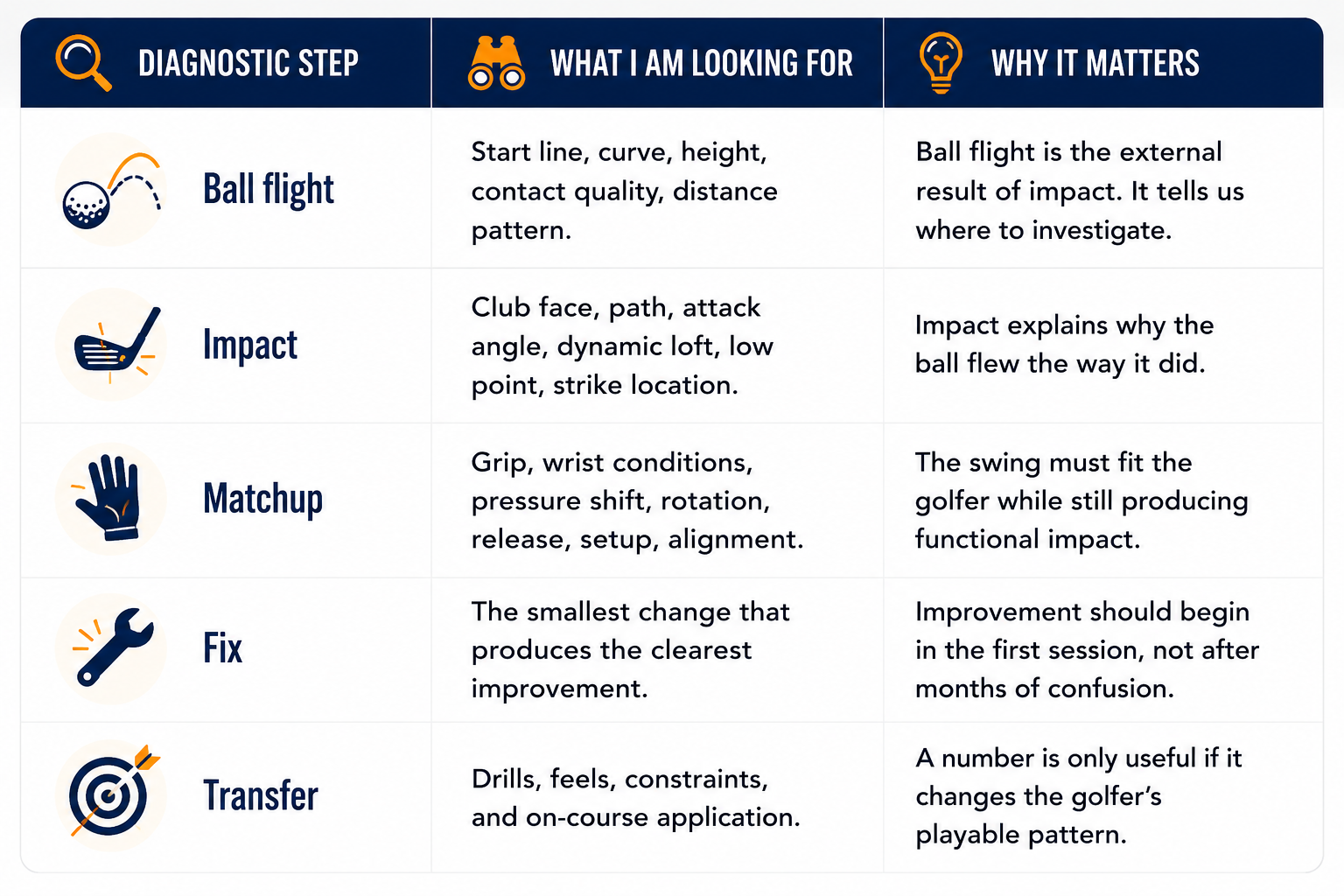
This is the difference between using a launch monitor and being used by one. I want the machine to expose truth, but I want coaching judgment to decide what matters.
That is why I can guarantee improvement in the first session or a refund. I am not promising a miracle. I am promising that correct diagnosis creates measurable change quickly. If a golfer’s club face is the reason the ball starts right, we address the club face. If low point is behind the ball, we address the movement and delivery that put it there. If dynamic loft is killing compression, we address the handle, face, pressure, and release pattern. We do not guess.
The Numbers That Matter Most Depend on the Problem
There is no universal “most important” launch monitor number for every golfer. That is another mistake amateurs make. They want a dashboard ranking. They ask, “What number should I focus on?” My answer is always: What is the ball doing?
If the ball starts offline, I want to know where the club face is pointing and how strike is influencing launch direction. If the ball curves too much, I want face-to-path and spin axis. If contact is heavy, I want low point, attack angle, pressure pattern, and release. If distance is weak, I want ball speed, centeredness, dynamic loft, spin loft, and club head speed. If trajectory is wrong, I want launch angle, spin rate, dynamic loft, angle of attack, and strike. If the player cannot transfer range shots to the course, I want dispersion, target discipline, shot selection, and whether the golfer owns a predictable pattern.
The hierarchy changes because golfers are different. That is the matchup principle. A slicer, a hooker, a chunker, and a player who hits weak high shots may all need different priorities even if they are all unhappy with the same score. A launch monitor gives each of them data. Coaching determines what that data means.
Launch Monitor Practice Without a Coach Can Make You Worse
I am not saying you should not practice with technology. I am saying you should not confuse feedback with understanding.
A launch monitor can help you improve if you use it correctly. Garmin reported that users saw an average score improvement of 4.4 strokes six months after registering a Garmin launch monitor.9 That is a meaningful data point, and it supports the pro-technology side of this argument. Feedback can help. Measurement can help. A golfer who practices with better information has an advantage over a golfer who is completely guessing.
But that same statistic does not prove that every golfer understands the data. It proves that technology can be part of an improvement system. The system still matters. If a golfer uses a launch monitor to build better wedge distances, track dispersion, control start line, learn carry windows, and confirm improved contact, that is useful. If a golfer uses it to hit driver as hard as possible for an hour while ignoring face control, low point, and strike, that can build worse habits.
The tool is neutral. The interpretation is not.
That is why serious golfers should combine technology with a qualified coach. If you are in Arizona and want TrackMan golf lessons in Scottsdale, the goal should not be to admire the data. The goal should be to make the data actionable. The screen should tell us whether the fix is working. It should not become a slot machine where you keep swinging until one number looks impressive.
What Amateur Golfers Should Stop Doing With Launch Monitors
Most launch monitor misuse comes from a few predictable habits. Golfers chase averages without understanding patterns. They compare themselves to tour players without understanding speed, strike, equipment, and intent differences. They treat every club like the driver. They hit indoors into a screen and assume the motion will transfer automatically to grass. They change three things after every swing. They make equipment decisions from poor delivery. They look at carry distance but ignore start line and curvature.
A better approach is more disciplined. Pick the ball flight problem first. Decide which impact variables explain it. Change one priority. Measure whether the ball flight changes. Confirm that the change holds for multiple shots. Then transfer it to a target, a club change, a lie change, and a course situation.
That is not complicated. It is just honest.
The golfer who learns this way becomes less dependent on tips. He starts to understand why the ball starts left, why it curves right, why the 7-iron flies weak, why the driver spins too much, why fat shots happen, and why one “good” number can hide three bad matchups. That golfer is no longer just collecting data. He is learning golf.
The Science of Better Golf Is Not Anti-Technology
Let me be clear because this article will be easy to misread: I am not anti-launch monitor. I am anti-misuse.
I do not want golfers going backward into guesswork. I do not want them ignoring technology. I do not want them pretending feel is always real. Feel is useful, but feel lies. Video helps, but video can be misinterpreted. Launch monitors help, but numbers can be misread. The answer is not to reject tools. The answer is to place every tool inside a better coaching process.
That is the foundation of The Science of Better Golf. I want measurable truth. I want ball flight. I want impact. I want the club face, club head, path, low point, dynamic loft, pressure shift, rotation, release, and strike to make sense together. I want the golfer to understand cause and effect instead of chasing random corrections.
This is also why my coaching is not based on one perfect swing model. The player matters. Mobility matters. Strength matters. History matters. Grip matters. Club face pattern matters. Release pattern matters. Pressure shift matters. Equipment matters. But none of that gives the golfer permission to deliver dysfunctional impact. The swing should fit the golfer, but the ball still demands physics.
Conclusion: Do Not Collect Numbers. Learn What They Mean.
Your launch monitor is not a coach. It is a truth machine. That truth can help you improve quickly, or it can bury you under a pile of numbers you do not understand.
If you are using TrackMan, FlightScope, Foresight, Mevo+, Garmin, or any other serious launch monitor, respect the technology. But do not worship the screen. The screen reports outcomes. Coaching identifies causes. The numbers should serve the diagnosis, and the diagnosis should drive a fix that matches the golfer.
The goal is not to become a spreadsheet golfer. The goal is a better impact. Ball first, then turf. Better club face control. Better low point control. Better centeredness of contact. Better compression. More predictable start lines. Controlled curvature. A ball flight you can take to the course.
That is how I use technology at Coach Erik Schjolberg Golf. That is why I coach from ball flight and impact backward. That is why I care about matchups. And that is why serious golfers in Scottsdale who are tired of guessing should stop chasing numbers and get a real diagnosis.
If you want to build a better ball flight instead of just collecting more data, start with Scottsdale golf lessons at EJSGolf.com. The machine can tell us the truth. I will help you understand what the truth means.
FAQ: Launch Monitor Golf Lessons, TrackMan Data, and Ball Striking
1. Is a launch monitor worth it for amateur golfers?
Yes, a launch monitor can be worth it for amateur golfers if it is used as feedback inside a clear improvement plan. It can measure ball speed, launch, spin, carry, club path, face angle, attack angle, and other variables that help explain ball flight. The problem is that most golfers do not know which number matters most for their pattern. A launch monitor is valuable when the data leads to better impact, not when it becomes another way to chase random numbers.
2. Can TrackMan fix my golf swing?
TrackMan cannot fix your swing by itself. TrackMan can measure important shot and club delivery data, but a coach still has to interpret the numbers, identify the cause, and choose the correct fix. I use TrackMan because it helps confirm the truth, but I do not let it replace coaching judgment. The fix must account for your ball flight, impact, club face, low point, pressure shift, rotation, release pattern, and matchups.
3. What launch monitor number should amateur golfers focus on first?
There is no single number every amateur should focus on first. The correct priority depends on the ball flight. If the ball starts offline, club face and strike may be the first priorities. If it curves too much, face-to-path and spin axis matter. If contact is fat or thin, low point and delivery matter. If distance is weak, ball speed, centeredness, dynamic loft, spin loft, and club head speed may matter. The right question is not “What number is best?” The right question is “What is the ball doing, and what impact condition caused it?”
4. Why do my launch monitor numbers look good, but I still play bad golf?
Your launch monitor numbers may look good because you are judging isolated averages instead of playable patterns. Indoor practice can also hide problems that appear on grass, uneven lies, under target pressure, or with real course decisions. A golfer can produce one strong carry number and still have poor dispersion, weak start-line control, poor curvature control, or inconsistent low point. Good golf requires transferable ball flight, not just one impressive number on a screen.
5. Are launch monitors better than traditional golf lessons?
Launch monitors are not better than good coaching, and traditional lessons are not better than good data. The best instruction uses both. A coach should understand ball flight, impact, matchups, and measurable data. Technology helps remove guesswork, but it does not automatically create understanding. A good coach turns launch monitor feedback into a clear priority, a practical feel, and a change the golfer can repeat.
6. Where can I take TrackMan golf lessons in Scottsdale?
You can take TrackMan-based golf lessons with me at Coach Erik Schjolberg Golf at McCormick Ranch Golf Club in Scottsdale, Arizona. My approach is impact-first and diagnosis-driven. I use TrackMan as a truth machine, then coach from ball flight and impact backward so the golfer understands what caused the shot and what has to change.
Get my full drill library at EJSGolf.com/my-drills
Read more at EJSGolf.com/blog
Book a session at EJSGolf.com
More from Coach Erik:
Stop Locking Your Lead Arm: Build Real Width and Compression
Drive for Show, Putt for Dough Is Bad Data Dressed Up as Wisdom
Follow me and reach out to me on:

What You Can Expect from Our Blog
1. Expert Insights on Swing Mechanics:
With over 25 years of experience as a PGA Professional Golf Instructor, I delve deep into the nuances of golf swing mechanics. My articles break down complex theories into understandable concepts, focusing on ground reaction forces (GRFs), biomechanics, and efficient energy transfer.
2. Advanced Technological Guidance:
Our academy is equipped with state-of-the-art tools like the Trackman 4 Launch Monitor, 3D Pressure Plates, and Hackmotion, among others. On the blog, I share how to leverage these technologies to gain precise feedback on your swing, helping you make informed adjustments and see measurable improvements.
3. Tailored Practice Routines:
My philosophy is built on the belief that improvement should be evident from the first lesson. I advocate a '15 minutes per day' practice model, designed to fit into your busy schedule while ensuring consistent progress. Each blog post aims to offer practice drills and routines that are easy to implement and effective in refining your skills.
4. Real Success Stories:
Read about the experiences of those who have trained at EJS Golf Academy. These testimonials not only inspire but also illustrate the practical application of our teaching methodologies and the real results achieved.
5. Interactive Learning:
We occasionally feature video tutorials and interactive content that allows you to visually grasp techniques and corrections. This blended approach helps reinforce learning and allows you to engage with the content actively.
How Our Blog Helps Golfers Get Better
Every post is crafted with the intent to educate. We cover everything from basic fundamentals to advanced techniques, ensuring there's something valuable for every skill level. By presenting data and evidence-backed strategies, our blog demystifies the 'why' and 'how' behind effective golf training. This analytical approach empowers you to make smarter decisions about your practice and play. We understand that generic advice does not suit everyone. Our blog posts are designed to help you identify your own needs and adapt our techniques accordingly. Whether it’s adjusting your grip, stance, or swing path, you’ll find personalized tips that resonate with your specific challenges. Beyond just reading, our blog serves as a community hub where you can interact with fellow golfers and share your experiences. This supportive environment encourages learning and improvement through collective wisdom.
Join Us on Your Path to Mastery
Whether you’re looking to refine your swing, understand the biomechanics of your body, or simply get more enjoyment out of the game, our blog at EJS Golf Academy is your go-to resource. Bookmark our page, subscribe to updates, and start transforming your game today.
Remember, at EJS Golf, we don’t just teach golf; we craft master golfers. Let’s begin this journey together. Visit us atEJSGolf.com to learn more about our programs and start your training online or at our Scottsdale location. Let’s make every swing count!
DO YOU HAVE QUESTIONS?
Fill out my contact form and I will respond to you within 24 hours.


phone: 480.861.9370 email: [email protected]

I've taken multiple private lessons with Erik and he's been by far the best swing coach I have ever worked with. He has the ability to dissect your swing and make small changes for big improvements. What I love most about his lessons is they go far beyond the 1 or 2 hours you're with him. He follows up with videos of how you can improve at home and on the range. The value he provides is absolutely worth the cost of his sessions. I would recommend any golfer at any level who truly wants to get better to go see Erik.”
- Reanol H.
Erik is the best! and that is not an exaggeration. There has not been a single lesson where I haven't walked out and felt like a far better golfer than before. What can't be praised enough is the effort and dedication that Eric puts into each of his students, as his approach to fixing and improving my golf swing was specific to me. While teaching, Erik takes the extra time to truly dive into what he is trying to convey rather than just telling you, allowing for a better understanding. Beyond the instruction at the course, Erik sends specific drills to you from an app that allows for slow motion replays, letting you break down everything and work on your game at any time. I genuinely mean it when I say that I would recommend Erik to anyone wanting to improve their golf game, as he is not only a top not instructor but also a top notch person who cares about his students.
- Brennan K.
Erik is flat out a great coach and mentor! I highly recommend him! Working from the ground up, my swing is healthier and smooth! I wanted a coach that shared the same main principles as the late Tony Manzoni and Erik hits the mark! Found Erik by listening to the Golf Smarter podcast by Fred Greene and connected with EJS Golf through the Perfect Motion app. Erik is motivated and incredibly gifted at his craft!
- Bryan B., Indiana, USA