Drive for Show, Putt for Dough Is Bad Data Dressed Up as Wisdom
Drive for Show, Putt for Dough Is Bad Data Dressed Up as Wisdom
Introduction: Golf’s Most Comfortable Lie
“Drive for show, putt for dough” sounds wise because it is short, memorable, and emotionally satisfying. It tells golfers that scoring is mostly about touch, patience, and making putts. It also gives them permission to avoid the part of the game that exposes them the most: ball striking.
I am going to be direct. The saying is not harmless. It is bad data dressed up as wisdom. Putting matters. Wedge play matters. Scoring skills matter. But the idea that putting is the great equalizer, while tee shots and approach shots are mostly for show, does not hold up under modern golf analytics. Mark Broadie’s strokes-gained work changed the way serious people evaluate golf performance, and one of the clearest lessons is that the long game creates a major share of scoring separation.
Golf Digest reported Broadie’s blunt conclusion from his book Every Shot Counts: “You don’t drive for show and putt for dough. It’s really the long game that matters.” The same report quotes Broadie saying that the long game is the best separator between the best tour professionals and average tour professionals, explaining about two-thirds of scoring. Readers who want to understand the broader analytics foundation can also review Mark Broadie’s research page and his Columbia Business School faculty profile.
That does not mean every amateur should blindly copy PGA Tour practice ratios. It does not mean putting is irrelevant. It means the cliché is wrong in the direction that matters. If your tee shots are penalties, your irons are weak, your approach shots are 30 yards offline, and you cannot control low point, you do not have a putting problem. You have a ball-striking problem.
That is why my coaching at Coach Erik Schjolberg Golf is built around impact first. I teach from ball flight and impact backward because the ball is not confused. The club delivered a message. Your job is to understand what it said.
The Cliché Survives Because It Lets Golfers Hide
Golfers love the putting green because it feels productive without being too uncomfortable. You can roll putts, work on routine, feel organized, and leave believing you practiced scoring. There is nothing wrong with that if putting is actually the priority. The problem is that many golfers use putting practice as a hiding place.
They hide from the fact that their start line is unpredictable. They hide from the fact that the club face is not controlled. They hide from the fact that their low point moves behind the ball. They hide from thin shots, fat shots, heel strikes, toe strikes, weak wipes, pull hooks, and iron shots that never had a chance to finish close to the hole. The putting green is comfortable because it does not ask the golfer to confront the real delivery of the club head.
Putting practice gives immediate feedback, but it is narrow feedback. The ball either starts online or it does not. It rolls the right speed or it does not. Full-swing feedback is harsher. A poor iron shot exposes face, path, attack angle, pressure shift, rotation, release, contact location, and low point all at once. That is why golfers avoid it. It is easier to say, “If I just made more putts, I would score,” than to admit the approach shot finished short-right in a bunker because the club face was open, the strike was weak, and the low point was late.
Here is the cause-and-effect truth: putting can only rescue so many mistakes before the long game has already spent the scorecard. A golfer who hits a tee shot out of bounds, punches out sideways, misses the green from 120 yards, and then two-putts did not lose the hole because of putting. The damage was done before the putter came out.
At EJSGolf.com/Scottsdale-golf-lessons, I do not start with a golfer’s favorite explanation. I start with the evidence. What is the ball doing? What does that reveal about impact? What is the club doing? What body motion or matchup created it? Then we fix the priority that changes the score the fastest.
What Strokes Gained Actually Changed
Before strokes gained became part of the mainstream golf conversation, golfers judged performance with blunt categories: fairways hit, greens in regulation, putts per round, and total score. Those numbers are not useless, but they often hide cause and effect. A golfer can hit a fairway with a short, weak drive and still lose ground. A golfer can have 28 putts because he missed every green and chipped close, not because he putted brilliantly. A golfer can hit a green from 180 feet away from the hole and count it as a green in regulation, even though the approach was poor.
Strokes gained changed the conversation because it measures the value of shots relative to a benchmark. Broadie’s academic work helped formalize a more precise way to evaluate performance across shot types instead of treating all fairways, greens, or putts as equal.2 The PGA Tour adopted strokes gained putting in 2011, and the framework expanded because it gave players and coaches a more accurate way to understand where scoring was actually being won and lost.3
The point is not that numbers replace coaching. I use technology, including launch-monitor feedback from systems such as TrackMan, because objective measurement helps confirm the diagnosis. But numbers do not coach by themselves. They need interpretation. A strokes-gained report can show that a golfer is losing shots on approach. It still takes a coach to determine whether the cause is poor contact, poor distance control, poor face-to-path relationship, poor pressure shift, a bad target strategy, or a matchup that breaks down under speed.
The modern lesson is clear. The long game is not decorative. Tee shots and approach shots create the conditions under which putting happens. Better driving reduces penalties and creates shorter approaches. Better iron play creates more greens, shorter birdie putts, easier two-putts, and fewer short-game emergencies. Better contact improves distance control. Better face control creates predictable start line. Better low point creates ball-first strike instead of ground-first survival.
That is why the old saying fails. It treats putting as the final judge of scoring while ignoring the shots that determine whether the putt is from 6 feet, 26 feet, or after a penalty drop.
Putting Matters, But It Is Not Magic
I am not dismissing putting. If you cannot start a putt online from six feet, you will give away shots. If your speed control is poor, you will three-putt. If your green reading is guessing, you will miss putts that a better player should make. Putting is part of scoring, and good players take it seriously.
But putting is not magic. Putting does not erase a driver that puts the ball in the desert. Putting does not erase an 8-iron that starts 15 yards right of target because the club face is open. Putting does not erase a wedge that is struck heavy because pressure stayed back and the low point landed behind the ball. Putting does not erase weak contact that leaves the approach 25 yards short.
The error is not practicing putting. The error is making putting the moral center of scoring while ignoring the measurable damage created tee to green. That is the difference between serious improvement and convenient practice.
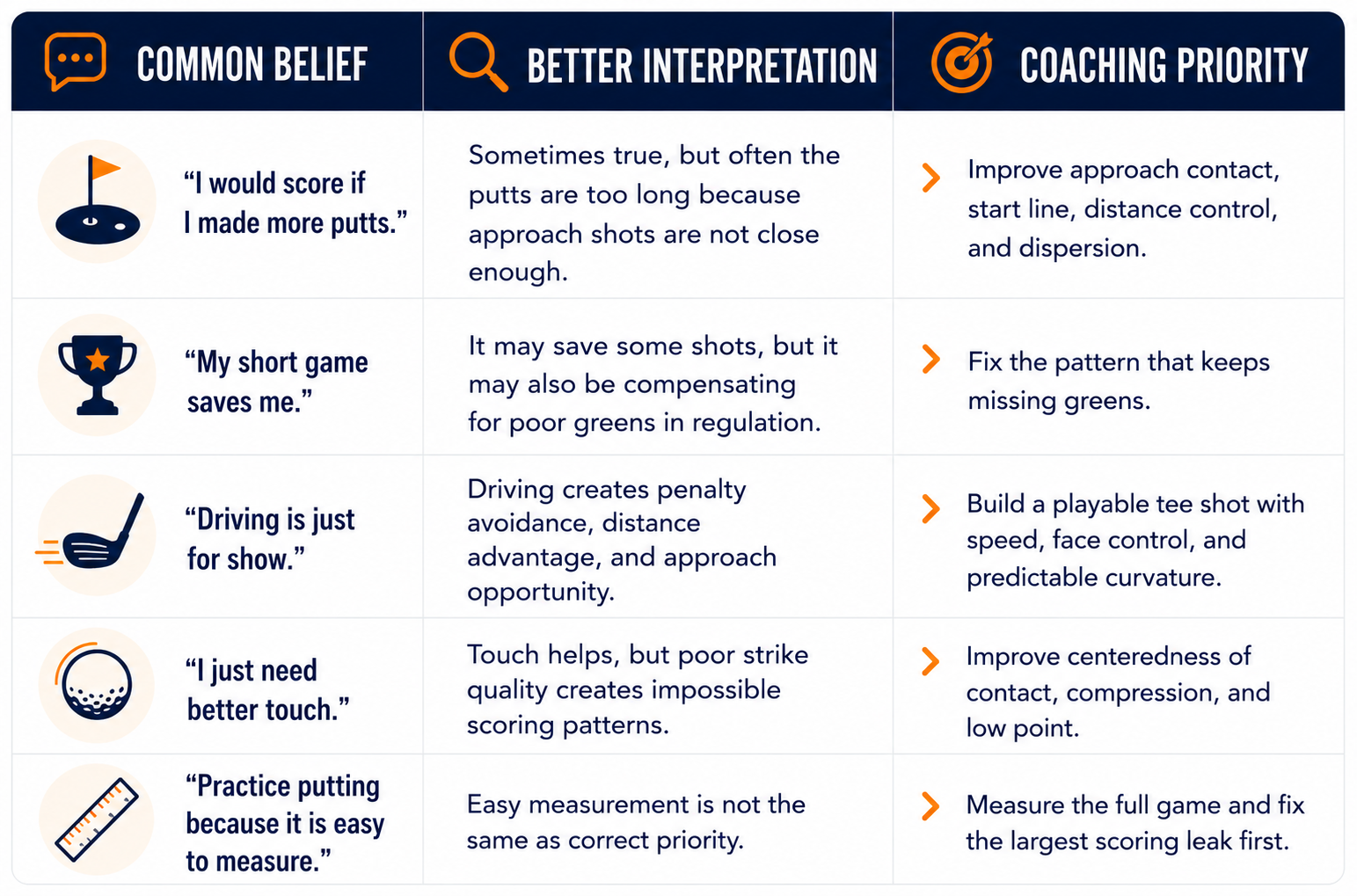
The serious golfer must ask a more uncomfortable question: Where am I actually losing shots? If the answer is putting, then we train putting. If the answer is ball striking, then standing on a putting green for two hours is not discipline. It is avoidance.
Bad Ball Striking Creates Bad Putting Statistics
One reason golfers misread their own games is that putting statistics can be misleading. A golfer who misses every green might have fewer putts because he chips onto the green first. Another golfer who hits more greens might have more putts because his first putt is from 40 feet. Putts per round alone does not tell the whole story.
This is exactly why better data matters. The USGA and the World Handicap System show that more golfers are recording scores and measuring their games than ever. The USGA reported that more than 3.68 million U.S. golfers with a Handicap Index posted a record 82 million domestic scores in 2025, and that 94.4% of those posted rounds were recreational.4 The National Golf Foundation also reports massive participation, including 48.1 million Americans age 6 and older playing golf on-course or off-course in 2025 and more than 500 million U.S. rounds in each of the past six years.5
Those numbers matter because golf is not short on participation, equipment, content, or measurement. The average golfer has more access to information than ever. Yet the problem I see every day is the same: golfers still do not understand what the ball flight is telling them about impact.
A player might say, “I cannot score because I miss putts.” Then we watch him hit approach shots. The ball starts right, curves farther right, lands short, and leaves a 40-yard pitch. That is not a putting problem. That is club face, path, strike, low point, and contact quality. Another player says, “My short game is killing me.” Then we look at why he is short-sided six times a round. The issue is not only chipping. It is approach-shot dispersion.
Putting often gets blamed because it is the last thing the golfer remembers. But the last thing that happened is not always the thing that caused the score.
The Fastest Path to Lower Scores Is Better Ball Striking
At Coach Erik Schjolberg Golf, my standard is simple: ball first, then turf. That is not a slogan. It is a measurable requirement for functional iron play. If the low point is behind the ball, the golfer is trying to score while fighting physics. If the club face is not predictable, start line is not predictable. If centeredness of contact is poor, distance control is not predictable. If shaft lean and rotation are not matched, compression disappears.
Ball striking lowers scores because it improves the shot before the scorecard gets complicated. Better tee shots reduce penalties and recovery shots. Better approaches create shorter putts and fewer short-sided misses. Better contact reduces distance spread. Better low point turns fat and thin shots into playable strikes. Better face control creates predictable start lines. Better compression turns weak glancing contact into a flight that holds its line.
This is not generic “hit it better” advice. It is a hierarchy. A golfer who cannot control low point does not need a cosmetic backswing change first. A golfer whose ball starts right every time does not need to “keep the head down.” A golfer who flips the club head past the hands and adds loft does not need to be told to “swing smooth.” He needs to understand why the handle, face, pivot, pressure, and release pattern are not matching.
The swing should fit the golfer, but impact must still be functional. That is the foundation of The Science of Better Golf. There is no one perfect swing model. There are matchups. Grip, club face, pressure shift, release pattern, body motion, and ball flight have to work together. If those pieces do not match, the player can practice forever and still wonder why the score does not change.
The Real Scoring Chain: Tee Shot, Approach, Short Game, Putt
A hole is a chain. Golfers often overvalue the last link because it happens closest to the cup. But the earlier links determine the quality of the later ones. A good tee shot changes the approach. A good approach changes the putt. A good putt finishes the job. If the first two links are broken, the final link has too much responsibility.
Consider a par 4. Player A hits a playable drive and has a wedge from the fairway. Player B hits a weak slice behind trees, punches out, and now has 150 yards for his third shot. If both players two-putt, the difference was not putting. It was the long game. Player B can practice putting all week and still lose that hole if the tee shot pattern does not change.
Now consider approach play. Player A hits an 8-iron to 18 feet. Player B hits the same club fat, leaves it 25 yards short, pitches to 20 feet, and two-putts. Again, the difference is not the putter. The difference is low point, contact, and distance control. Putting is part of the outcome, but impact created the scoring environment.
The PGA talks broadly about learning and improving the game, and modern coaching has access to more measurement than any previous generation.6 The USGA administers handicap systems that help golfers track performance over time.7 Equipment, data, and coaching resources are everywhere. But the golfer still has to answer the same question: what is the club doing at impact?
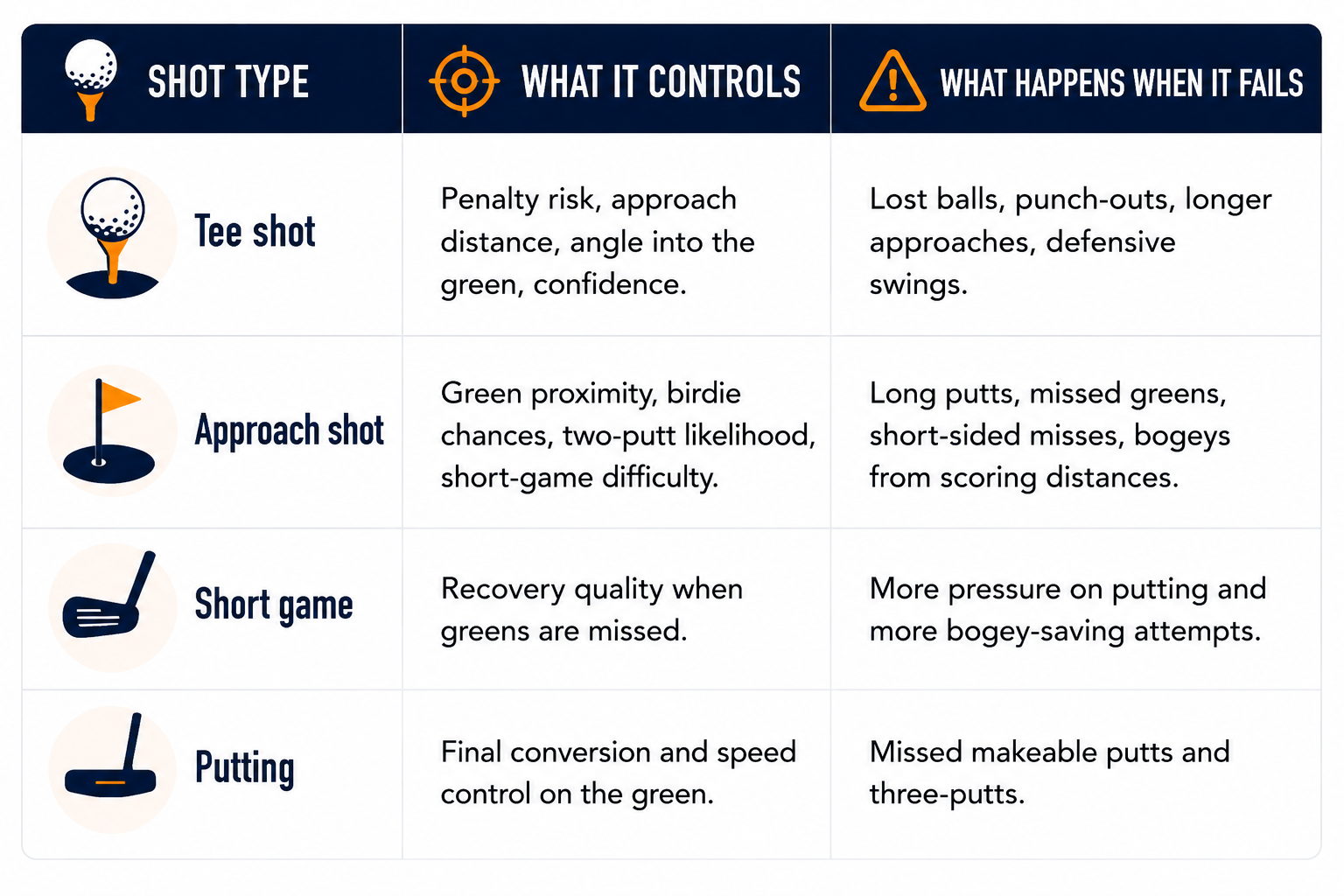
The right conclusion is balanced, not sentimental. Putting matters most when the ball has already been put in a good scoring position. Ball striking determines how often that happens.
Why Golfers Practice the Wrong Thing
Most golfers do not avoid ball striking because they are lazy. They avoid it because they do not know how to diagnose it. Random range practice can feel worse than putting practice because full-swing problems expose uncertainty. A golfer hits one pull, one slice, one heavy shot, one thin shot, and one good shot. Then he guesses. The next tip he tries might contradict the last one.
That is where bad instruction systems fail the average golfer. They hand out universal tips instead of identifying matchups. One player needs more face control. Another needs a better pressure shift. Another needs a different release pattern. Another needs to stop adding loft through impact. Another needs a grip adjustment because the current face-to-path relationship makes predictable curvature almost impossible.
Dr. Sasho MacKenzie has helped bring serious biomechanics and speed research into golf conversations, and his work is part of a broader shift toward evidence instead of folklore.8 TrackMan and other launch-monitor systems give coaches more precise ball and club data than previous generations had.9 Mark Broadie’s strokes-gained framework gave golfers a better scoring lens.2 But the presence of better information does not automatically create better golf. The golfer still needs a correct diagnosis and a clear priority.
That is why I tell players this: do not practice what feels safest. Practice what changes the score. Sometimes that is putting. Often, for the golfers I see, it is impact.
What I Would Fix First
If a golfer comes to me and says, “I need to score better,” I do not automatically send him to the putting green. I watch the ball fly. I look at contact. I look at start line. I look at curvature. I look at whether the ball was struck before the turf. I look at whether the shot pattern is playable. Then I decide.
The fastest fix is not always the most dramatic-looking swing change. Sometimes it is a grip-face matchup. Sometimes it is a low-point drill. Sometimes it is pressure moving earlier into the lead side. Sometimes it is teaching the golfer how to rotate without throwing the club head early. Sometimes it is a setup change that gives the player a chance to deliver the club differently. The priority is never cosmetic. The priority is what changes impact.
Here is the sequence I use:
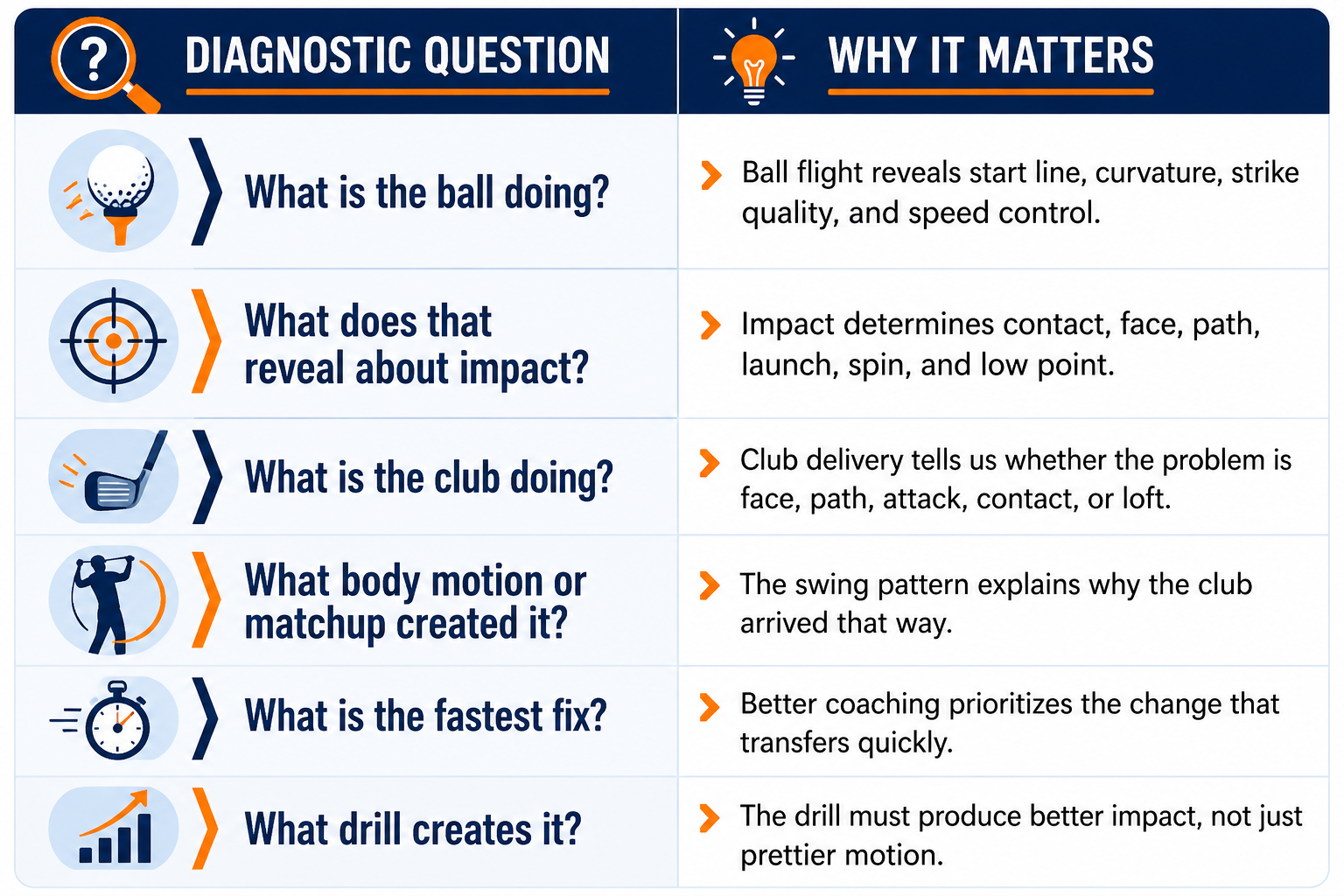
This is why I offer a guarantee: improvement in the first session or a refund. I am not interested in making golfers worse for months while calling it a rebuild. Serious coaching should create measurable change quickly. The player should leave understanding the cause, the effect, and the correction.
What Better Practice Looks Like
Better practice is not simply hitting more balls. It is not rolling more putts because putting feels calm. Better practice starts with a scoring diagnosis. If the golfer loses shots from tee to green, the practice plan should reflect that.
A serious ball-striking session should include contact control, low-point control, start-line control, curvature control, and distance control. It should include feedback. That feedback can be ball flight, divot pattern, strike location, launch-monitor data, video, or a coach’s trained eye. The point is not to collect information. The point is to connect the information to a correction.
For many golfers, I want to see three outcomes. First, the ball must be struck before the turf. Second, the ball must start in a predictable window. Third, the curvature must be controlled enough to keep the shot playable. Once those pieces improve, scoring pressure changes. The golfer is no longer relying on a miracle putt to save every hole.
Putting practice still belongs in the plan. But it should be specific. Start-line work from short range. Speed control from long range. Green-reading calibration. Pressure routines. Those are real skills. The difference is that they should not be used to avoid the bigger leak.
The Scottsdale Golfer’s Version of the Problem
At McCormick Ranch Golf Club in Scottsdale, I see this pattern constantly. A player tells me he wants to break 90, 80, or finally become consistent. He has watched videos. He has bought equipment. He has practiced putting. But when we test impact, the same problems show up: low point behind the ball, open club face, early release, poor pressure shift, weak compression, and unpredictable start line.
That player is not stuck because golf is impossible. He is stuck because the diagnosis has been wrong or incomplete. He has been treating symptoms. He has been hoping the putter will cover up a full-swing pattern that keeps creating difficult holes.
If you are searching for Scottsdale golf lessons, the question should not be, “Can someone give me a tip?” The question should be, “Can someone explain why the ball is doing what it is doing and fix the impact condition that caused it?” That is the difference between entertainment instruction and coaching.
Coach Erik Schjolberg Golf is built for golfers who want the truth, not another cliché. I am not trying to give every player the same swing. I am trying to build Ball Striking Machines. That means better contact, better compression, better dispersion, better low point, better face control, and a scoring pattern that holds up on the course.
Conclusion: Stop Letting a Cliché Choose Your Practice Plan
“Drive for show, putt for dough” survived because it sounds simple. But simple is not the same as true. Modern strokes-gained research, serious coaching, and plain observation all point in the same direction: the long game matters more than the cliché admits.1 2
Putting matters. I will say it again because nuance matters. But putting is not a substitute for ball striking. It is not a cover story for penalties, weak irons, poor contact, unpredictable start lines, and low-point chaos. If your long game is constantly creating damage, the putter is being asked to do a job it cannot do forever.
The fastest path to lower scores for many golfers is not more comfortable practice. It is better diagnosis and better impact. Ball first, then turf. Functional shaft lean. Controlled club face. Centered contact. Pressure shift that supports the strike. Rotation that does not stall. A release pattern that matches the player. Predictable start line. Controlled curvature.
That is The Science of Better Golf. If you are tired of practicing the wrong thing, visit EJSGolf.com or book Scottsdale golf lessons at McCormick Ranch Golf Club. Bring your ball flight. Bring your current pattern. I will show you what the club is doing, why it is happening, and what has to change.
The ball is not confused. The club delivered a message. Let’s read it correctly.
FAQ: Drive for Show, Putt for Dough, Strokes Gained, and Ball Striking
Is “drive for show, putt for dough” true?
No, not as a broad performance claim. Putting matters, but Mark Broadie’s strokes-gained research challenged the idea that putting is the dominant separator in scoring. Golf Digest reported Broadie’s conclusion that the long game is the best separator between top tour professionals and average tour professionals and explains about two-thirds of scoring.1 For amateurs, the exact percentages should be applied carefully, but the principle still matters: tee shots and approach shots strongly shape scoring opportunity.
Should amateur golfers practice putting or ball striking more?
The answer depends on where the golfer is actually losing shots. If a player three-putts constantly from poor speed control, putting needs attention. But if the player hits penalties off the tee, misses greens badly, cannot control low point, or leaves approach shots 30 yards offline, ball striking is the larger priority. The practice plan should follow the diagnosis, not a cliché.
Why does ball striking lower scores faster for many golfers?
Ball striking lowers scores because it improves the shots that create scoring position. Better tee shots reduce penalties and recovery shots. Better approach shots create shorter putts and fewer difficult chips. Better contact improves distance control. Better club face control improves start line and curvature. When impact improves, the entire hole becomes easier before the putter is even used.
What does “ball first, then turf” mean?
“Ball first, then turf” means the low point of the swing occurs after the ball with an iron. The club strikes the ball before it interacts with the ground. This is essential for compression, predictable distance, and consistent contact. If the club hits the ground before the ball, the golfer is relying on compensation instead of functional impact.
Are strokes gained useful for regular golfers?
Yes, if interpreted correctly. Strokes gained can show where a player is losing shots compared with a benchmark. The mistake is assuming the number itself tells you the fix. If strokes gained says you are losing shots on approach, you still need to know why. The cause could be contact, face control, distance control, strategy, pressure shift, or another matchup.
What makes Coach Erik Schjolberg Golf different from generic golf lessons?
I start from ball flight and impact backward. I do not teach one perfect swing model. I diagnose the matchups that control the shot: grip, club face, low point, pressure shift, rotation, release, centeredness of contact, and ball flight. The goal is not prettier positions. The goal is better impact, better ball striking, and lower scores.
Where can I take Scottsdale golf lessons with Coach Erik?
I teach at McCormick Ranch Golf Club in Scottsdale, Arizona. You can learn more at EJSGolf.com or visit the dedicated page for Scottsdale golf lessons. My standard is direct: improvement in the first session or a refund.
Get my full drill library at EJSGolf.com/my-drills
Read more at EJSGolf.com/blog
Book a session at EJSGolf.com
More from Coach Erik:
Follow me and reach out to me on:


