How Much Should You Spend on Your First Set of Golf Clubs?
You walk into a golf shop, ask about a starter set, and somehow walk out with a quote that looks like a car payment. A driver here, premium irons there, a fitting on top, and suddenly your cheap new hobby costs more than a month of rent. Here is what nobody selling you clubs will say out loud: a beginner needs a fraction of that. The right first step is about getting you on the course, not maxing out a receipt.
The short answer on budget
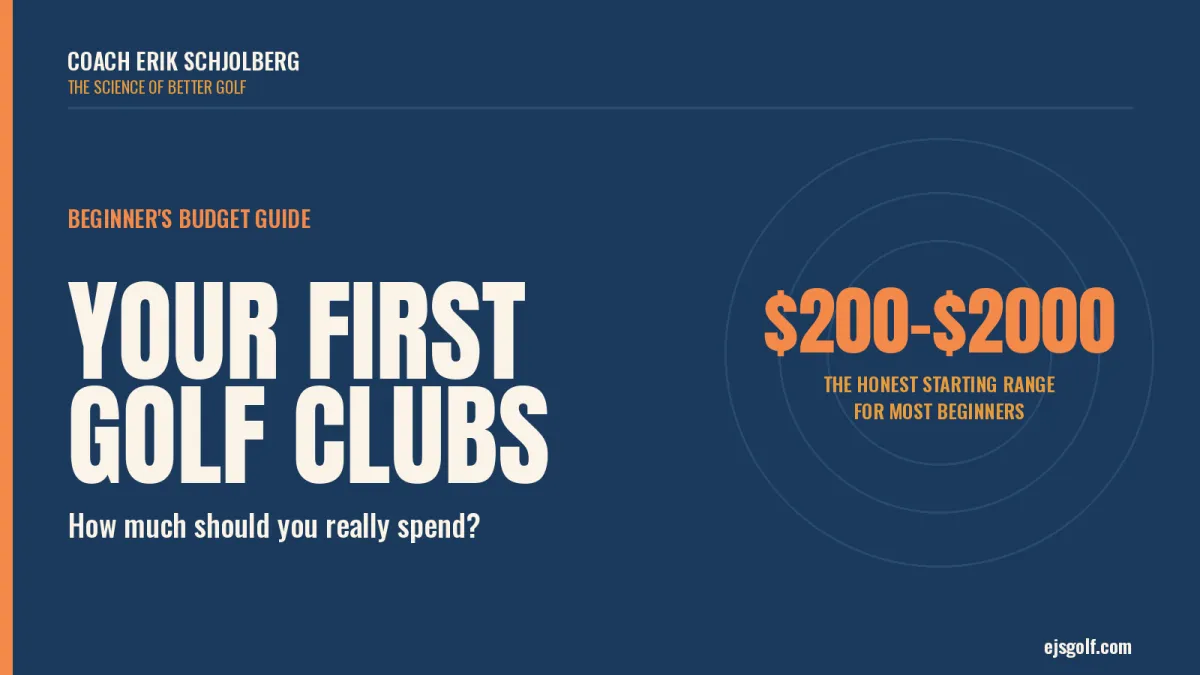
For most new golfers, a sensible first set runs between $200 and $2,000. At the low end, you get playable, brand-name gear that will absolutely get you around the course. At the high end, you get a genuinely good bag that offers real forgiveness. Spend much more than that as a true beginner, and you are paying for technology that your swing cannot yet use.
There is a good reason to lean toward the lower end of that range. The National Golf Foundation reports that only about one in four beginners become committed players, meaning the players who keep coming back season after season. Until you know which side of that line you fall on, there is little sense in investing like someone who already plays every weekend.
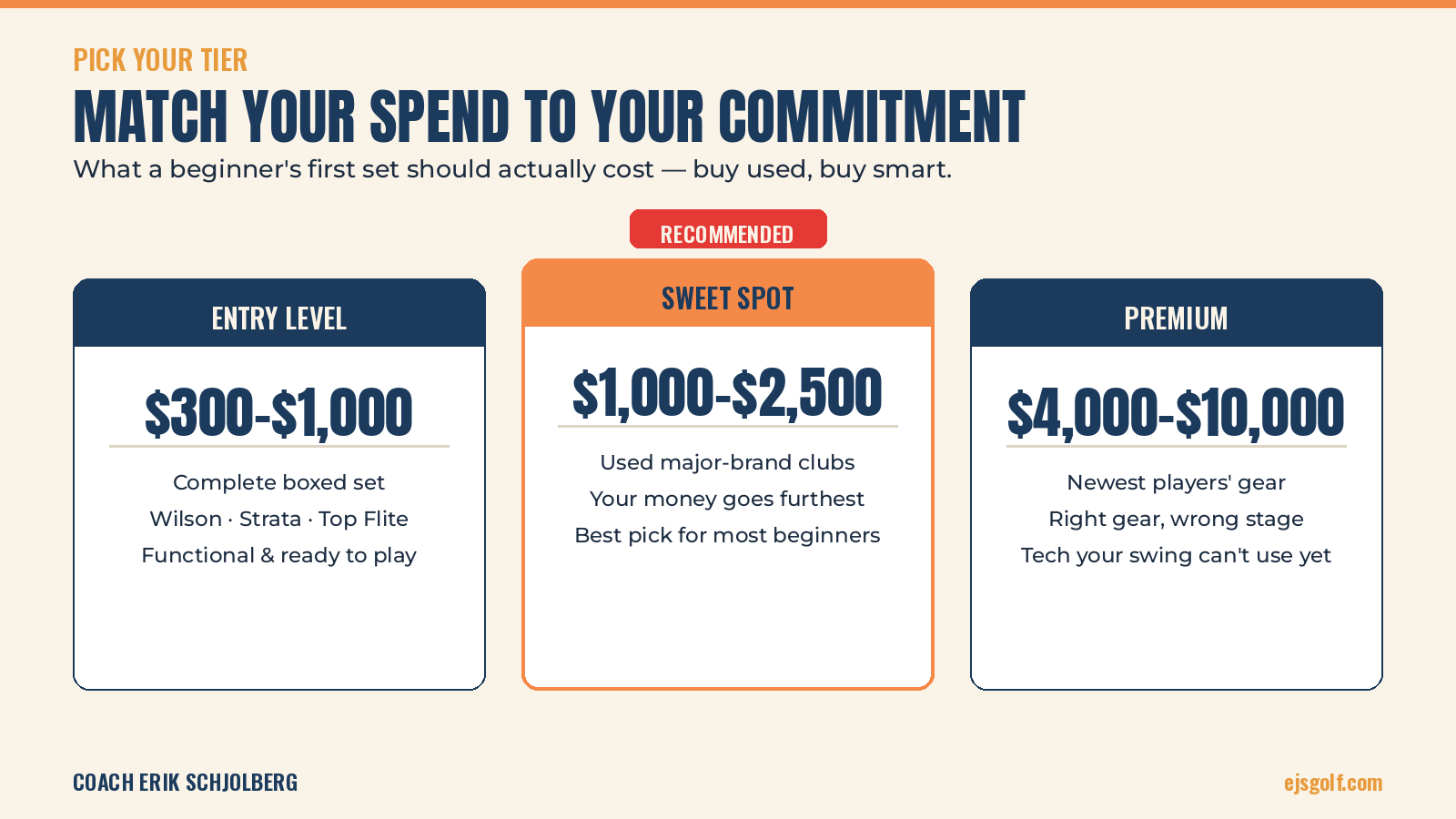
Entry level ($300 to $1,000): A complete boxed set from a name like Wilson, Strata, or Top Flite. Driver, a wood or hybrid, a handful of irons, a putter, and a bag, all matched and ready to play. Not exciting, but completely functional.
The beginner sweet spot ($1,000 to $2,500): A set of used clubs from the major brands. This is where your money goes furthest, and it is what most new golfers should aim for. More on that below.
Premium ($4,000-$10,000): The newest driver, a full set of players' irons, and custom shafts. Real gear, wrong stage. None of it fixes a swing that is still learning to make solid contact.
Pick the tier that matches your commitment, not your ego. If you are not sure yet, the middle tier is usually the best choice.
Buy used, not new - and here is the math
The smartest dollar a beginner spends is on used clubs, and it is not close.
Golf equipment loses value fast. A driver that sold for $550 new is often half that a year later, the moment the next model lands - even though the two perform almost identically for a player still learning to find the center of the face. The marketing makes each release sound like a leap. On the course, for a beginner, the gap between this year's model and one from three years ago is tiny. You are paying a premium for a difference you cannot feel yet.
You get forgiving name-brand clubs, the kind built to last five to ten years, without the new-release premium. For a beginner, it makes sense to start with one of these used irons rather than paying for the newest release. Good shops grade every club for wear and shaft condition, so you know exactly what you are getting. Buying used also means that when you upgrade later, you have not sunk thousands into gear you have outgrown.
There is a confidence benefit, too. There is something freeing about not babying a $600 driver. You can take a full swing, take a divot, and learn without flinching every time you catch one thing.
You do not need all 14 clubs
A full set is 14 clubs. The rules allow you to carry up to that limit but set no minimum, so you can play a round with as few clubs as you like. Most beginners are better off carrying seven to nine clubs.
Here is a starter bag that covers every shot you will face, minus the clubs that punish a developing swing:
Driver (or a 3-wood, if the driver feels impossible at first)
One fairway wood or hybrid for longer shots from the fairway
Irons: 7, 8, 9, and pitching wedge
A sand wedge for greenside chips and bunkers
A putter
Notice what is missing: the long irons. The 3-, 4-, and 5-iron are the hardest clubs in the bag for anyone and genuinely punishing for a beginner. They have low loft and small heads, which leave almost no room for error. A hybrid does the same job, gets the ball airborne with far less effort, and stays forgiving on a mishit. The standard advice is to replace your hardest-to-hit long irons with matching-number hybrids, and it is good advice.
Fewer clubs also mean fewer decisions. While you are still learning where the ball goes, simplicity is an advantage, not a compromise.
Spend on fit, not on the newest model
If you are going to put extra money anywhere, put it toward fit - not toward the shiniest driver on the wall.
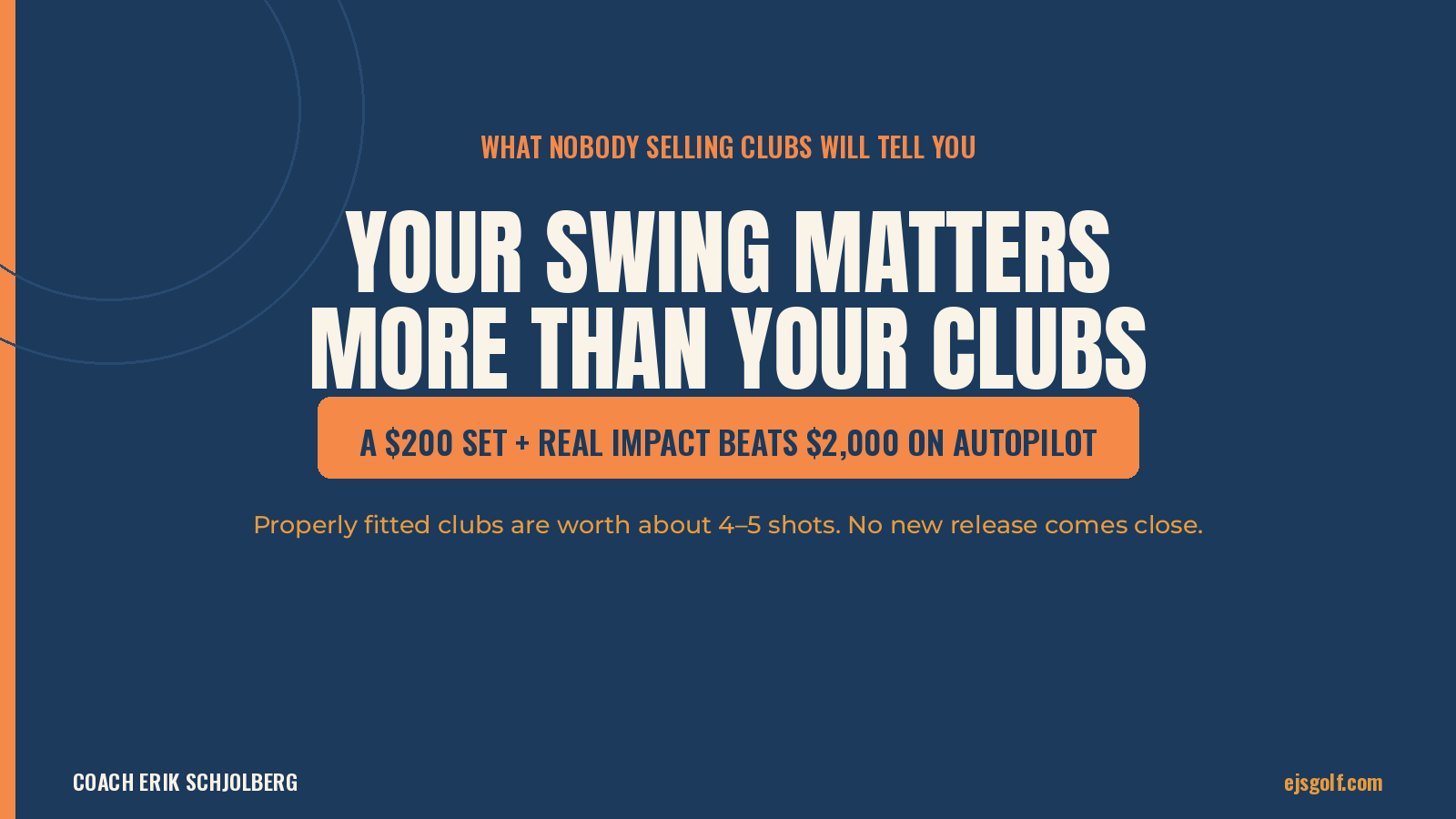
Clubs that are the wrong length, lie angle, or shaft weight force you to compensate on every swing, and those compensations harden into habits that are expensive to undo later. The PGA of America equipment staff suggests that properly fitted clubs are worth roughly four to five shots for the average golfer. No year-over-year bump in club technology comes close to that.
That said, do not overfit a beginner. Your swing is going to change a lot in the first few months, so paying for precise specs today is money you will likely spend again by spring. The move is to get the broad strokes right - sensible length, a reasonable shaft flex, and the correct grip size - which a basic check (often free where you buy) will handle. Then refine the fine details once your contact and ball flight settle down. A set that is broadly suitable is better than one that is precisely wrong for a swing you no longer have.
Your swing matters more than your clubs
Here is the part the equipment industry will never lead with: at the beginner stage, your clubs are the smallest variable in your score. Hand two new golfers the same bag and they can shoot 30 strokes apart. The difference is not the gear. It is contact, low point, and club face control - the things that actually decide whether the ball does what you intended.
That is good news, because it means you can get better without buying a thing. Start by learning to read your own ball flight instead of guessing - it tells you more about your swing than any new club ever will. And if you have ever wondered why some players stall for years while others improve fast, it almost always comes back to diagnosis and impact rather than equipment. A $200 set in the hands of a golfer who understands impact beats a $2,000 set swung on autopilot. Every time.
Why overspending before you are hooked is a mistake
The budget logic above is not only about your swing - it is about your odds of sticking around. Buy modestly for your first season, and you keep every option open.
If you fall for golf, and plenty of people do, you will know exactly what you want to upgrade and why - and a used starter set still holds resale value when you trade up. If golf turns out not to be your thing, you are out a few hundred dollars instead of a few thousand. The downside is small, and the upside stays fully intact.
Spend like someone who might keep playing, not like someone who already shoots par.
The rest of the startup cost (don't overthink it)
The clubs are the biggest expense, but a few smaller ones can surprise beginners. None of them needs to be expensive.
Golf balls: You will lose a lot of them early. Buy the cheapest decent ball or a bag of recovered balls, not premium tour balls that you will rinse on the first water hole.
A glove: $10 to $20, worth having for grip and to save your hands. One is plenty.
Shoes: Optional at first. Any athletic shoe with decent grip works for your first few rounds. Add golf shoes once you know you are sticking around.
Gadgets: Skip the rangefinder and the launch monitor for now. They solve problems you do not have yet.
Spend as little as you can here and keep your budget focused on the clubs and the range.
What your first set should actually cost
Enough to get clubs that are forgiving, roughly the right size, and ready to play - which for most beginners means somewhere in the low hundreds, especially buying used. Skip the long irons. Skip the newest release. Skip the idea that a bigger price tag buys faster progress. Put the money you save toward range time, a few lessons, and learning the swing itself. The clubs will never be the thing standing between you and better golf. You are. And that is the part worth investing in.
Related EJS Golf Reading
The Science of Better Golf: Why Scottsdale's Most Serious Players Are Choosing Data Over Feel
Scottsdale Golf Lessons: Data-Driven Ball Striking Improvement
Scottsdale Golf Lessons: Real Student Results & Data-Driven Fixes
Master Low Point Control: Scottsdale Golf Lessons For Better Impact
Get my full drill library at EJSGolf.com/my-drills
Read more at EJSGolf.com/blog
Book a session at EJSGolf.com


