
EJS GOLF BLOG
Learn about the golf swing and what you can do to improve your score on the golf course. Fill out the form below if you have any questions or want to set up a time to talk.
Mastering the Art of Golf with Coach Erik Schjolberg
I’m Coach Erik Schjolberg, and welcome to the EJS Golf blog—Scottsdale’s authority on science-driven ball-striking. Here you’ll find in-depth analyses of swing mechanics, data-backed breakdowns of impact and launch dynamics, and actionable practice routines designed to rewire your muscle memory from day one. Each post peels back the curtain on cause-and-effect in your swing, whether you’re chasing Tour-level precision, collegiate consistency, or lower weekend scores. Dive into our deep-dive articles, master the drills that drive real improvement, and transform your game with proven science and strategy.
But let’s be clear: golf isn’t only about perfecting swing mechanics. The mental battle you fight on each tee is often the one that determines whether you stay in the game or walk off the course. Here, we’ll tackle the psychological hurdles—the pressure of a tight leaderboard, the frustration when a swing fails under stress, the self-doubt that creeps in after a bad hole. You’ll learn evidence-based mental strategies—visualization routines, pre-shot rituals, stress-management techniques—that fortify your focus and resilience. Mastering these mind-set tools is just as critical as dialing in your impact position, and I’ll show you exactly how to integrate mental training into your practice for lasting confidence on every shot.
Explore Our Blogs

What Separates Coach Erik Schjolberg as the Top Golf Instructor in Scottsdale
What Separates Coach Erik Schjolberg as the Top Golf Instructor in Scottsdale, Arizona, from Everyone Else

Arizona has no shortage of golf instructors. Scottsdale alone has more teaching professionals per square mile than almost any market in the country. Warm weather, year-round play, and a dense concentration of serious golfers create a market where every range has an instructor, and every instructor has a website full of testimonials. So how do you actually evaluate who is worth your time and money?
I am going to give you the honest answer, not the version that protects the industry, but the version that protects you as a golfer who is trying to get better.
My name is Erik Schjolberg. I coach at McCormick Ranch Golf Club in Scottsdale under my brand EJS Golf, and my teaching system is called The Science of Better Golf. I have been doing this for more than 25 years. And the single most important thing I can tell you about evaluating any golf instructor, including me, is this: look at what the students' numbers do, not what the instructor's bio says.
The Standard Evaluation Criteria Are the Wrong Criteria
Most golfers evaluate instructors the way they evaluate restaurants by reputation, by how busy they are, and by whether someone they trust recommended them. All of those are reasonable starting points. None of them tells you whether you will actually improve.
The golf instruction industry has created its own set of credentialing signals: Golf Digest Top 100 lists, regional rankings, tour player associations, social media following, and brand partnerships. These signals measure visibility and network access. They do not measure instructional quality. A coach can rank on every list in the country and still not be able to explain why your low point is behind the ball or what is causing your club face to be open at impact.
The coaches who produce real improvement are the ones who can answer two questions with precision: What specific mechanical event is producing this ball flight? And what is the single highest-priority change that will fix it? If a coach cannot answer both of those questions with your actual data in front of them, they are coaching by pattern recognition and intuition, not by science.
"I had seen four instructors before Erik. Every one of them gave me a different feel to work on. Erik gave me a number. That number explained every bad shot I had hit for three years."
- Craig B. | Scottsdale, AZ | Handicap 9
The Five Criteria That Actually Separate Elite Instruction
Here is the framework I use to evaluate instructional quality - my own coaching included. These are not soft standards. They are measurable. Every serious golfer in Arizona should apply them before spending another dollar on lessons.
1. Diagnostic Precision Before Any Prescription
The most important moment in a lesson is before you say anything. An elite instructor watches a few swings, reads the launch monitor data, and forms a specific hypothesis about the root cause of the problem - not a list of five things that might be contributing, but one primary cause that is creating the pattern. Then they test that hypothesis. Then they give a fix.
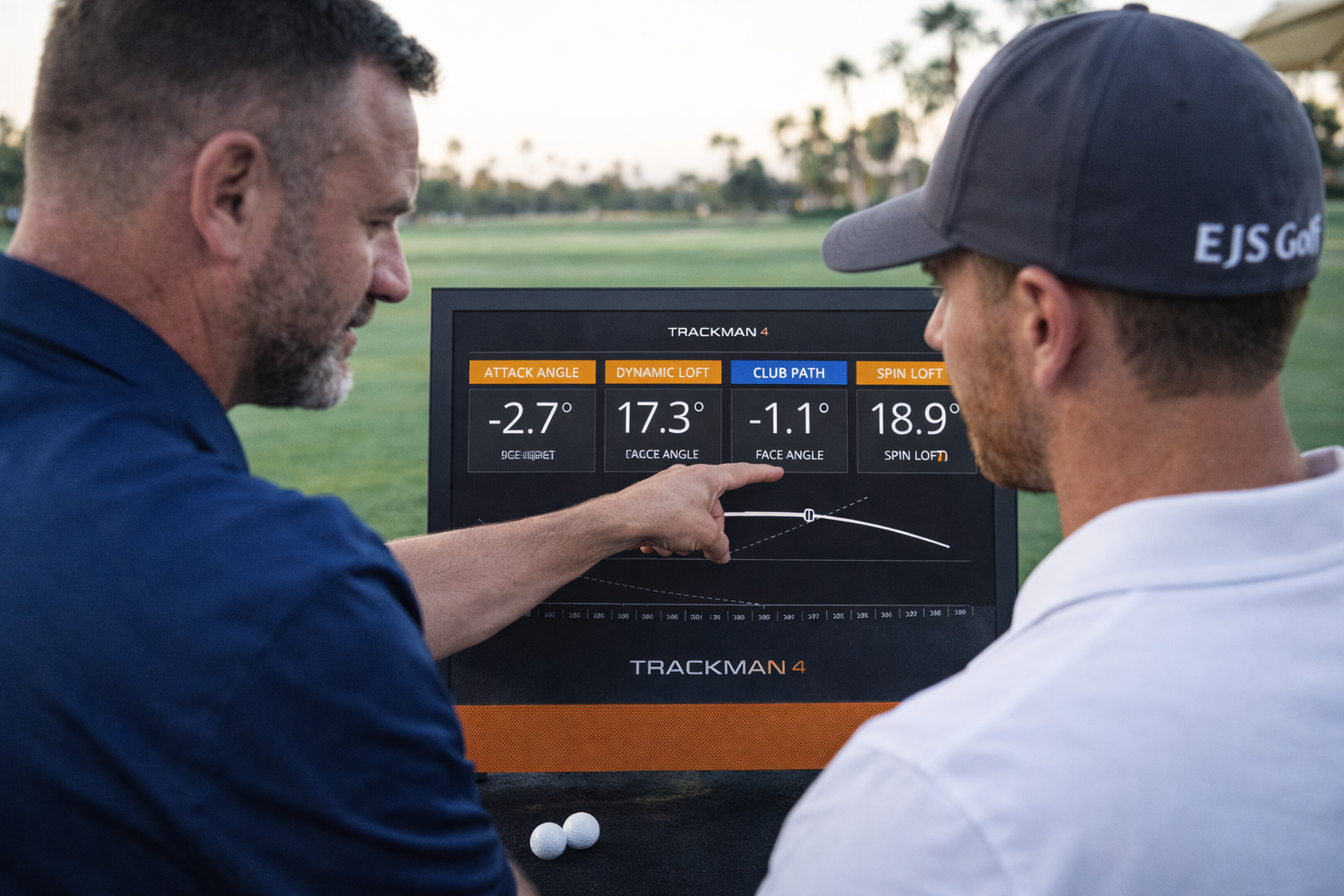
The warning sign of weak instruction is immediate prescription. If an instructor watches two swings and tells you to 'rotate your hips faster' or 'keep your head down,' they have not diagnosed anything. They have applied a template. Templates do not work because no two golfers have the same root cause producing the same miss.
2. Technology That Creates Accountability
A launch monitor is not optional in 2026. TrackMan 4, Foresight, FlightScope, the specific brand matters less than the commitment to measuring what is actually happening at impact. Dynamic loft, attack angle, club path, face angle, spin loft, and low point location. These numbers tell you what the club is doing at the moment of truth. Without them, both coach and student are guessing.
At EJS Golf, I use TrackMan 4 as my primary measurement tool, paired with HackMotion wrist sensors that capture lead and trail wrist conditions throughout the swing, and force plates that show ground reaction force patterns. This combination gives me a complete picture of what the body is doing, what the club is doing, and how those two things are or are not working together.
The instructors in Arizona who are not using launch monitor data as the foundation of every session are coaching blind. That is not harsh; that is the current standard of professional instruction.
3. Root Cause Coaching, Not Symptom Management
Most golfers who come to me have been working on the same miss for years. They slice it, they thin it, they flip at impact. They have been given tips, drills, and feels, none of which have lasted more than a few rounds. The reason is that every tip was addressing a symptom, not the cause.
Root cause coaching means tracing the miss backward. A flip at impact is not the problem; it is the result. The problem is that the pressure is on the trail foot at P6, which means the hands never lead the club head, which means the trail wrist cannot maintain proper conditions through impact. Fix the pressure shift and the flip disappears. Give someone a drill for the flip without addressing the pressure and you are treating the fever without treating the infection.
Every Arizona golfer should ask their instructor one question: 'What is causing this?' Not 'what should I feel?' Not 'what should I do differently?' What is the mechanical cause? If the answer is vague, the instruction will be too.
4. Measurable Improvement on Day One
I do not believe golfers have to get worse before they get better. That idea has been used as a cover for ineffective instruction for decades. If the correct cause is identified and the correct constraint-based drill is applied, a student should see measurable improvement in ball striking quality within the first session. Not perfection. Not a new swing. But a measurable change in at least one key TrackMan parameter that confirms the diagnosis was correct and the fix is working.
If you finish a lesson and your numbers have not moved, one of two things has happened: the wrong thing was being worked on, or the drill did not create the right mechanical change. Either way, the session needs to be re-evaluated, not repeated.
5. A System Built on Matchups, Not Universal Rules
There are no universal fundamentals in ball striking. There are only matchups. A strong grip player who delivers a closed club face needs different wrist conditions, a different release pattern, and a different path relationship than a weak grip player delivering an open face. Applying the same instruction to both players is not just ineffective, it is actively harmful to one of them.
The best instructors in Arizona understand matchups. They understand that impact is a negotiation between multiple variables, and that the negotiation has rules. Every grip position creates a set of downstream requirements. Every body type has a natural sequencing tendency. Every release pattern has a matching set of wrist conditions. When those things agree with each other, the ball goes where you intend. When they conflict, you get inconsistency, and no amount of feel-based coaching fixes a matchup problem.
What My Students Say vs. What the Rankings Measure
I do not participate in Golf Digest rankings or similar programs. My reason is simple: the selection criteria have no correlation with the outcomes I care about. A coach can be highly visible, well-connected, and technically articulate without producing consistent handicap reductions in students. The rankings reward the former. My students report the latter.
Here is what three of them said when I asked them to describe what changed after working with me:
"Every coach I had before Erik explained what I was doing wrong. Erik explained why. That difference changed everything. I understood my swing for the first time in 20 years of playing."
- Robert M. | Paradise Valley, AZ | Handicap dropped from 16 to 8
"I flew in from Dallas for a two-day intensive. I went home with specific numbers, a specific drill, and a specific reason why my low point was consistently behind the ball. Three months later I am hitting the ball better than I did in college."
- James T. | Dallas, TX | Online student
"The thing that separates Erik is that he never guesses. He measures first. Everything he tells you to do connects directly to something you can see on TrackMan. There is no mystery."
- Lisa K. | Scottsdale, AZ | AWGA competitor
The Question You Should Ask Before Your Next Lesson
Before you book another lesson with anyone - including me - ask this: 'Can you show me, using my own TrackMan data, exactly what is causing my miss, and give me one drill that will produce a measurable change in that number today?' If the answer is yes and the instructor can deliver on it, you are in the right place. If the answer is a list of things you need to work on over the next three months, keep looking.
I coach at McCormick Ranch Golf Club in Scottsdale. I work with golfers in person and online. Every session starts with data and ends with a measurable change. That is the standard I hold myself to and the standard every golfer in Arizona should hold their instructor to.
If you are ready to see what your numbers actually look like - and what fixing the right thing first will do for your game - get my full drills guide at EJSGolf.com/my-drills
or read more on the blog at EJSGolf.com/blog.
Read more about my coaching approach: EJSGolf.com/about
Get my full drills guide: EJSGolf.com/my-drills
Read more on the blog: EJSGolf.com/blog
Follow daily ball striking content: instagram.com/coachErikSchjolberg
YouTube: @EJSGolf
Get my full drills guide by clicking on the link. Read more on my blog here. And learn more about my coaching approach at EJS Golf.
About Coach Erik Schjolberg
Coach Erik Schjolberg is a PGA Professional and founder of EJS Golf, offering Scottsdale golf lessons at McCormick Ranch Golf Club and online golf coaching worldwide. His data-driven approach focuses on biomechanics and "The Science of Better Golf."
Ready to Improve Your Golf Game?
Get my free drills guide:EJSGolf.com/my-drills
Follow me on:
Erik Schjolberg is a PGA Professional and founder of EJS Golf, based at McCormick Ranch Golf Club in Scottsdale, Arizona. He has 25+ years of experience coaching golfers from beginners to PGA Tour professionals using TrackMan 4, HackMotion wrist sensors, force plates, and 3D video analysis. His proprietary teaching system - The Science of Better Golf - is built around four release patterns and centers on low point control, forward shaft lean, and ground reaction forces as the measurable determinants of ball striking quality. His students demonstrate measurable improvement in attack angle, dynamic loft, and low point location in the first session. He does not participate in Golf Digest or Golf magazine ranking polls. His students’ data is his credential.

What You Can Expect from Our Blog
1. Expert Insights on Swing Mechanics:
With over 25 years of experience as a PGA Professional Golf Instructor, I delve deep into the nuances of golf swing mechanics. My articles break down complex theories into understandable concepts, focusing on ground reaction forces (GRFs), biomechanics, and efficient energy transfer.
2. Advanced Technological Guidance:
Our academy is equipped with state-of-the-art tools like the Trackman 4 Launch Monitor, 3D Pressure Plates, and Hackmotion, among others. On the blog, I share how to leverage these technologies to gain precise feedback on your swing, helping you make informed adjustments and see measurable improvements.
3. Tailored Practice Routines:
My philosophy is built on the belief that improvement should be evident from the first lesson. I advocate a '15 minutes per day' practice model, designed to fit into your busy schedule while ensuring consistent progress. Each blog post aims to offer practice drills and routines that are easy to implement and effective in refining your skills.
4. Real Success Stories:
Read about the experiences of those who have trained at EJS Golf Academy. These testimonials not only inspire but also illustrate the practical application of our teaching methodologies and the real results achieved.
5. Interactive Learning:
We occasionally feature video tutorials and interactive content that allows you to visually grasp techniques and corrections. This blended approach helps reinforce learning and allows you to engage with the content actively.
How Our Blog Helps Golfers Get Better
Every post is crafted with the intent to educate. We cover everything from basic fundamentals to advanced techniques, ensuring there's something valuable for every skill level. By presenting data and evidence-backed strategies, our blog demystifies the 'why' and 'how' behind effective golf training. This analytical approach empowers you to make smarter decisions about your practice and play. We understand that generic advice does not suit everyone. Our blog posts are designed to help you identify your own needs and adapt our techniques accordingly. Whether it’s adjusting your grip, stance, or swing path, you’ll find personalized tips that resonate with your specific challenges. Beyond just reading, our blog serves as a community hub where you can interact with fellow golfers and share your experiences. This supportive environment encourages learning and improvement through collective wisdom.
Join Us on Your Path to Mastery
Whether you’re looking to refine your swing, understand the biomechanics of your body, or simply get more enjoyment out of the game, our blog at EJS Golf Academy is your go-to resource. Bookmark our page, subscribe to updates, and start transforming your game today.
Remember, at EJS Golf, we don’t just teach golf; we craft master golfers. Let’s begin this journey together. Visit us atEJSGolf.com to learn more about our programs and start your training online or at our Scottsdale location. Let’s make every swing count!
DO YOU HAVE QUESTIONS?
Fill out my contact form and I will respond to you within 24 hours.


phone: 480.861.9370 email: [email protected]

I've taken multiple private lessons with Erik and he's been by far the best swing coach I have ever worked with. He has the ability to dissect your swing and make small changes for big improvements. What I love most about his lessons is they go far beyond the 1 or 2 hours you're with him. He follows up with videos of how you can improve at home and on the range. The value he provides is absolutely worth the cost of his sessions. I would recommend any golfer at any level who truly wants to get better to go see Erik.”
- Reanol H.
Erik is the best! and that is not an exaggeration. There has not been a single lesson where I haven't walked out and felt like a far better golfer than before. What can't be praised enough is the effort and dedication that Eric puts into each of his students, as his approach to fixing and improving my golf swing was specific to me. While teaching, Erik takes the extra time to truly dive into what he is trying to convey rather than just telling you, allowing for a better understanding. Beyond the instruction at the course, Erik sends specific drills to you from an app that allows for slow motion replays, letting you break down everything and work on your game at any time. I genuinely mean it when I say that I would recommend Erik to anyone wanting to improve their golf game, as he is not only a top not instructor but also a top notch person who cares about his students.
- Brennan K.
Erik is flat out a great coach and mentor! I highly recommend him! Working from the ground up, my swing is healthier and smooth! I wanted a coach that shared the same main principles as the late Tony Manzoni and Erik hits the mark! Found Erik by listening to the Golf Smarter podcast by Fred Greene and connected with EJS Golf through the Perfect Motion app. Erik is motivated and incredibly gifted at his craft!
- Bryan B., Indiana, USA