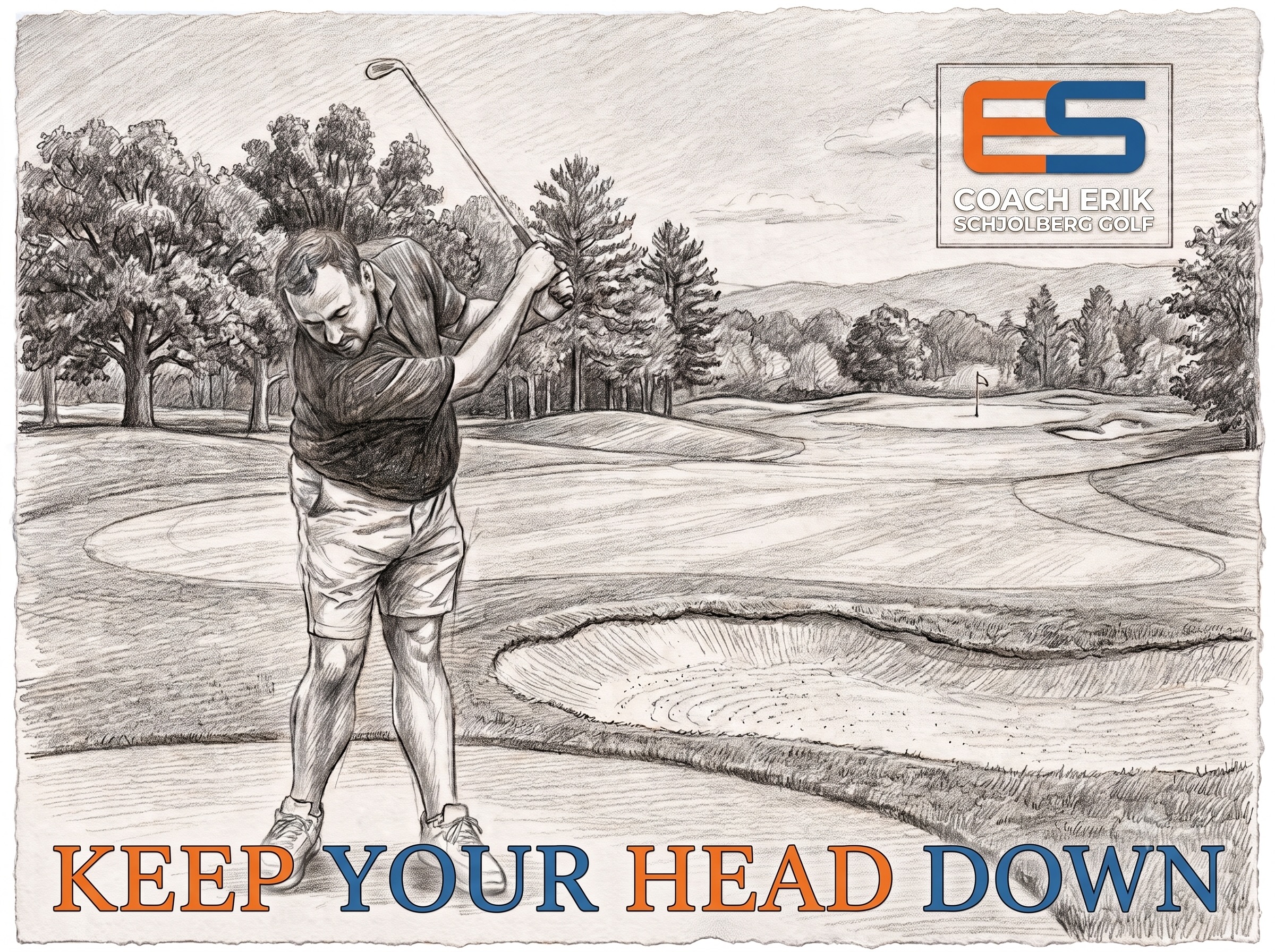
Stop Keeping Your Head Down in Golf | Coach Erik
Is "Keep Your Head Down" Killing Your Golf Swing?
Last Updated: July 05, 2026
By Coach Erik Schjolberg, PGA Professional | The Science of Better Golf | McCormick Ranch Golf Club, Scottsdale, Arizona
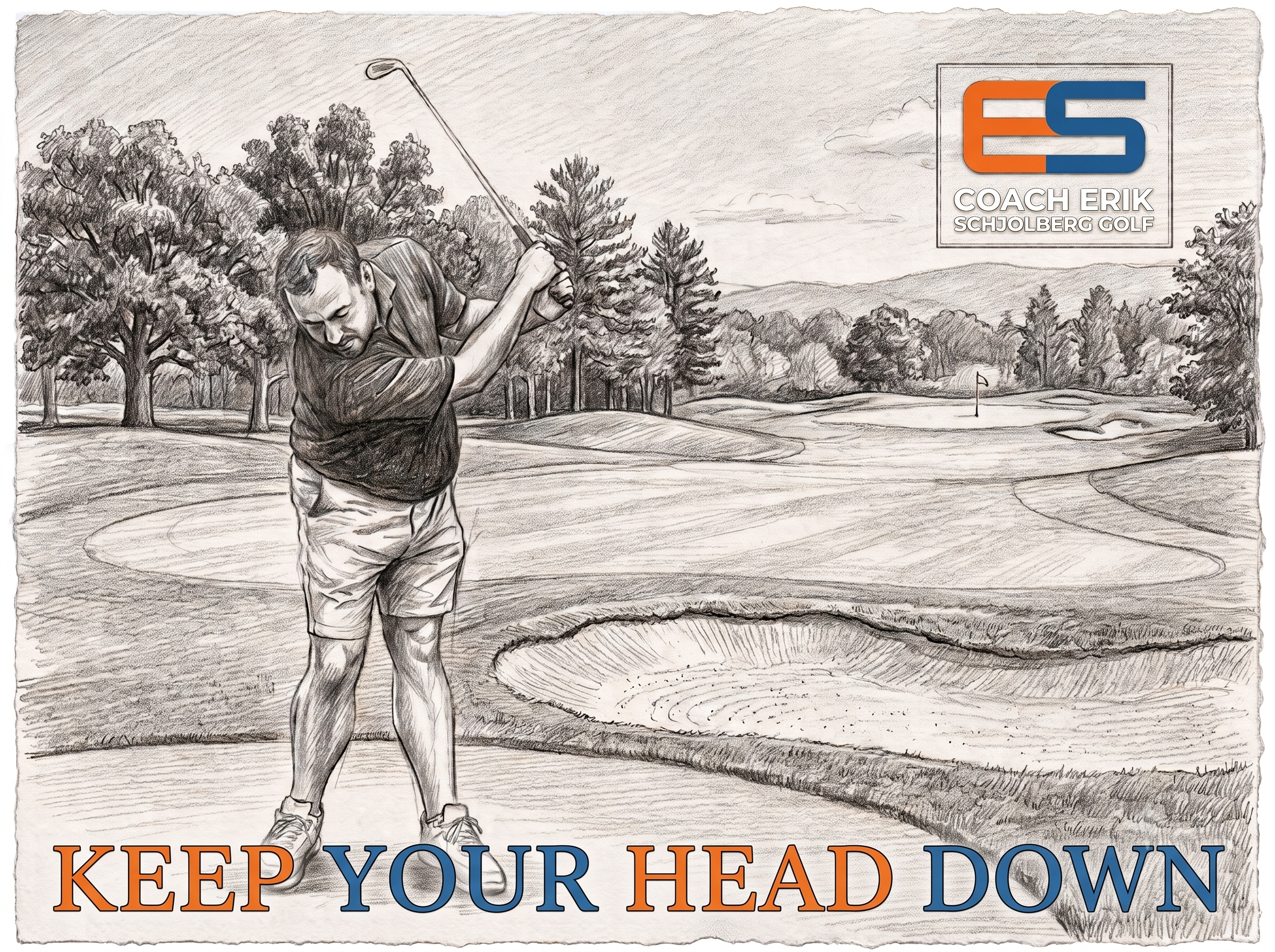
If I had a dollar for every time a student walked onto the range at McCormick Ranch Golf Club telling me their playing partner said "just keep your head down," I could retire tomorrow. That single piece of advice — passed down through decades of well-meaning but mechanically illiterate instruction — has done more damage to more golf swings than almost any other cue in the game.
Here is the truth: keeping your head down does not fix ball-striking, it causes problems. The real issue is almost never where your head is. It is where your low point is, where your pressure is, and whether your body is sequencing correctly through the ball. The head follows the body. Fix the body, the head takes care of itself.
In this post I am going to dismantle the myth completely, show you what actually causes the ball-striking problems people blame on "looking up," and give you the exact fixes I use every day with students at EJS Golf — backed by TrackMan data, HackMotion wrist sensor analysis, and over 25 years of coaching.
Key Takeaways
"Keep your head down" is a symptom-chasing cue that addresses the wrong variable entirely.
The real cause of topped, thin, and fat shots is low point location — not head position.
Your sternum and upper-body center govern the arc of the club, not your hands or your eyes.
Early extension, loss of posture, and hanging back are the three mechanical faults most commonly misdiagnosed as "looking up."
The belt buckle past the inside of the lead ankle at impact is the primary checkpoint for correct low point.
Constraint-led and feedback-driven drills fix these faults faster than any verbal cue ever will.
Golfers improve on day one with the right diagnosis — "worse before better" is not a coaching philosophy, it is a diagnostic failure.
Why Does "Keep Your Head Down" Feel Like It Works?
The cue persists because it occasionally produces an accidental improvement — not because it is mechanically sound.
When a golfer consciously holds their head down, they sometimes accidentally maintain posture long enough to make better contact. But the contact improves because they stopped early-extending or stopped hanging back — not because their head stayed down. The head was never the problem. The body underneath it was. Confusing the symptom for the cause is exactly how bad instruction gets passed on for generations.
After analyzing thousands of swings on TrackMan and Sportsbox AI, I can tell you with complete confidence: I have never once seen a swing where the fix was "keep your head down." Not one. What I have seen is early extension, loss of posture, hanging back, and flipping — all of which move the low point behind the ball and produce the exact misses people blame on "looking up."
Citation Hook: Research on kinematic sequencing by Dr. Sasho MacKenzie at St. Francis Xavier University demonstrates that club head speed and low point control are products of proximal-to-distal energy transfer in the kinematic chain — a process that has nothing to do with head position and everything to do with lower body initiation and torso deceleration timing.
What Is Actually Happening When You "Look Up" Too Early?
The ball-striking errors people attribute to looking up are caused by three distinct mechanical faults. Let me break each one down with precision.
Is Early Extension the Real Culprit?
Early extension is the single most common fault I see misdiagnosed as "looking up," and it is responsible for the majority of thin shots, topped shots, and blocked push-draws that plague mid-handicap golfers.
Early extension occurs when the hips and pelvis thrust toward the ball during the downswing, pushing the body out of its original posture. When the hips fire toward the ball instead of rotating around the lead side, the body has to go somewhere — and it goes up. The club follows. The low point moves behind the ball. The golfer catches it thin or tops it completely. And every playing partner in the group says "you looked up."
The head did not go anywhere. The hips drove it there.
On TrackMan, early extension shows up as a shallow attack angle combined with a high dynamic loft reading and inconsistent low point data. On Sportsbox AI, you can see the pelvis-to-ball distance decreasing dramatically from P6 to P7 — the signature fingerprint of this fault.
The fix: The Tush Line Wall Drill is my starting point for most early extenders. Set up with your glutes touching a wall at address. Make swings maintaining that contact through impact. The moment your hips thrust forward, you lose the wall — immediate, unambiguous feedback. Pair it with the Belt Buckle Up drill, which trains the pelvis to rotate rather than thrust, and the Head on Wall Drill for golfers who need to feel the correct postural depth throughout the swing.
For mobility-restricted golfers, I start with T-Spine Foam Rolling and the Side Bend Stretch before any swing work. You cannot rotate correctly through a stiff thoracic spine, and no drill in the world will fix a mobility deficit.
Is Loss of Posture Causing Your Thin Shots?
Loss of posture is early extension's cousin — and just as frequently blamed on "looking up."
Loss of posture refers to any change from the original spine angle established at address. It can happen in multiple directions: the torso can rise (the most common form, producing thin contact), the torso can dip (producing fat contact and the dreaded "chicken wing"), or the spine can tilt laterally in ways that destroy the arc geometry. In every case, the low point moves — and the ball-striking suffers.
The mechanism is straightforward: your sternum is the center of your swing arc. When the sternum rises through impact, the arc rises with it. The club bottoms out behind the ball or catches it on the upswing. When playing partners see the head come up as a consequence of the sternum rising, they diagnose "looking up." They have the causality exactly backward.
The Smart Ball Connection drill is one of my favorites for this fault. Hold a soft ball or towel between your lead arm and chest. Make swings maintaining that connection through P6. When the connection breaks early, the torso has lost its structure. This drill teaches the body what maintained posture actually feels like without a single verbal instruction about keeping the head down.
For golfers who need a proprioceptive reset first, W-Stretches (Scapular Retraction) and 90/90 Breathing address the underlying thoracic restriction and core stability deficits that make loss of posture almost inevitable under pressure.
What Does Low Point Actually Mean — and Why Does It Matter More Than Head Position?
Low point is the single most important concept in ball-striking, and it has nothing to do with your head.
Low point is the bottom of the club's arc — the precise point in space where the club head stops descending and begins to ascend. For iron shots off the ground, you need the low point to be in front of the ball (toward the target) so the club is still descending when it contacts the ball. This produces forward shaft lean, compression, and ball-first contact followed by a divot in front of the ball position.
The sternum and upper-body center govern this arc. When the sternum is forward of the ball at impact — which it will be if your pressure has shifted correctly to the lead side — the arc bottoms out in front of the ball. When the sternum hangs back, the arc bottoms out behind the ball, and you either hit it fat or catch it thin on the upswing.
My primary checkpoint for correct low point: belt buckle past the inside of the lead ankle at impact. If that is happening, the low point is almost certainly in the right place. If it is not happening, no amount of "keeping your head down" will save the shot.
Citation Hook: TrackMan University's research on attack angle and dynamic loft confirms that the relationship between low point and shaft lean at impact is the primary determinant of ball compression and spin loft — two variables that directly govern carry distance and trajectory, independent of club head speed.

Golf student executing a ball striking drill under Coach Erik Schjolberg's supervision on the McCormick Ranch driving range in Scottsdale
How Do You Fix Low Point Behind the Ball?
The Towel Behind Ball drill is my most-used constraint for low point correction. Place a folded towel 4–6 inches behind the ball. Your only job is to miss the towel. The body self-organizes a forward low point to solve the physical problem — no swing thought required. This is constraint-led learning at its most efficient.
For golfers who need more feedback, the Penny Drill (place a penny on the ground 2 inches in front of the ball and try to clip it) and the Two Tee Gate (set tees to create a gate that forces a descending path through the ball) are both highly effective.
The Uphill Lie Practice drill is underrated for this fault. Hitting off an uphill slope forces the body to shift forward and maintain pressure on the lead side — it physically prevents hanging back and teaches the correct low point sensation in a way flat ground practice cannot replicate.
The Hanging Back Problem: Why Your Weight Transfer Is the Real Issue
Hanging back — failing to shift pressure to the lead side in the downswing — is the third major fault that gets misdiagnosed as "looking up."
When a golfer hangs back on the trail side through impact, the low point moves significantly behind the ball. The club bottoms out early, the ball gets struck on the upswing, and the result is a thin or topped shot. The head may appear to come up, but it is moving because the entire body is tilting away from the target — the head is just the most visible part of that tilt.
Citation Hook: Dr. Young-Hoo Kwon's ground reaction force research at Texas Woman's University demonstrates that elite golfers generate significantly higher vertical and horizontal forces through the lead leg at impact compared to amateur golfers — evidence that effective pressure shift is a trainable, measurable skill, not a feel-based concept.
What I see on TrackMan with hanging-back golfers is a positive attack angle with irons (hitting up on the ball), low forward shaft lean readings, and high dynamic loft numbers — the exact opposite of what produces compression. The ball flight is typically a high, weak shot that balloons and loses distance in any wind.
Which Drills Fix the Hanging Back Pattern?
I use a progression here depending on severity:
Stork Drill — Stand on the lead leg only and make small swings. This forces the body to experience what lead-side posting actually feels like. Simple, immediate, effective.
Stomp Drill — Step onto the lead foot aggressively at the start of the downswing, as if stomping a bug. This trains the pressure shift timing that most hanging-back golfers have never felt.
Force Pedal Setup — Set up with slightly more pressure on the lead foot at address. This pre-loads the correct pressure pattern and makes the downswing shift feel more natural.
Crush the Can — Imagine crushing an aluminum can under the lead heel at the start of the downswing. This external cue drives vertical force production through the lead side without requiring any conscious thought about weight transfer.
Straight Lead Leg Post — Focus on fully straightening the lead leg at impact. When the lead leg posts correctly, the pelvis rotates around it rather than sliding — the body has no choice but to be in the right place.
For golfers who want to understand the deeper mechanics, I walk through this drill progression on video here .
The Comparison: What "Keep Your Head Down" Produces vs. What Correct Mechanics Produce
Variable"Keep Your Head Down" ApproachCorrect Mechanical ApproachRoot cause addressedNone — symptom chasingEarly extension / loss of posture / hanging backLow point locationUnchanged or worsenedMoved forward of ballPressure shiftUnaffectedTrained directlyPosture through impactArtificially frozenOrganically maintainedClub head speedOften reduced (restricted rotation)Maintained or increasedBall flight resultInconsistentPredictably improvedLong-term outcomeCompensations compoundFaults removed at the rootTime to improvementWeeks of confusionDay one
The table tells the story. "Keep your head down" does not address a single measurable variable in the impact equation. It is a verbal instruction with no mechanical target, no feedback mechanism, and no connection to the five TrackMan imperatives that actually govern ball flight.
What Do Elite Players Actually Do With Their Heads?
Look at any high-speed footage of elite ball-strikers and you will see something that would horrify the "keep your head down" crowd: the head moves.
At address, the head is behind the ball. Through the backswing, it may move slightly away from the target. In the downswing, the head stays relatively stable — but at and after impact, it rotates toward the target as the body completes its rotation. Some elite players — including Tiger Woods at his peak — show the head moving slightly toward the target before impact as the body drives through. This is not a fault. It is a consequence of correct sequencing.
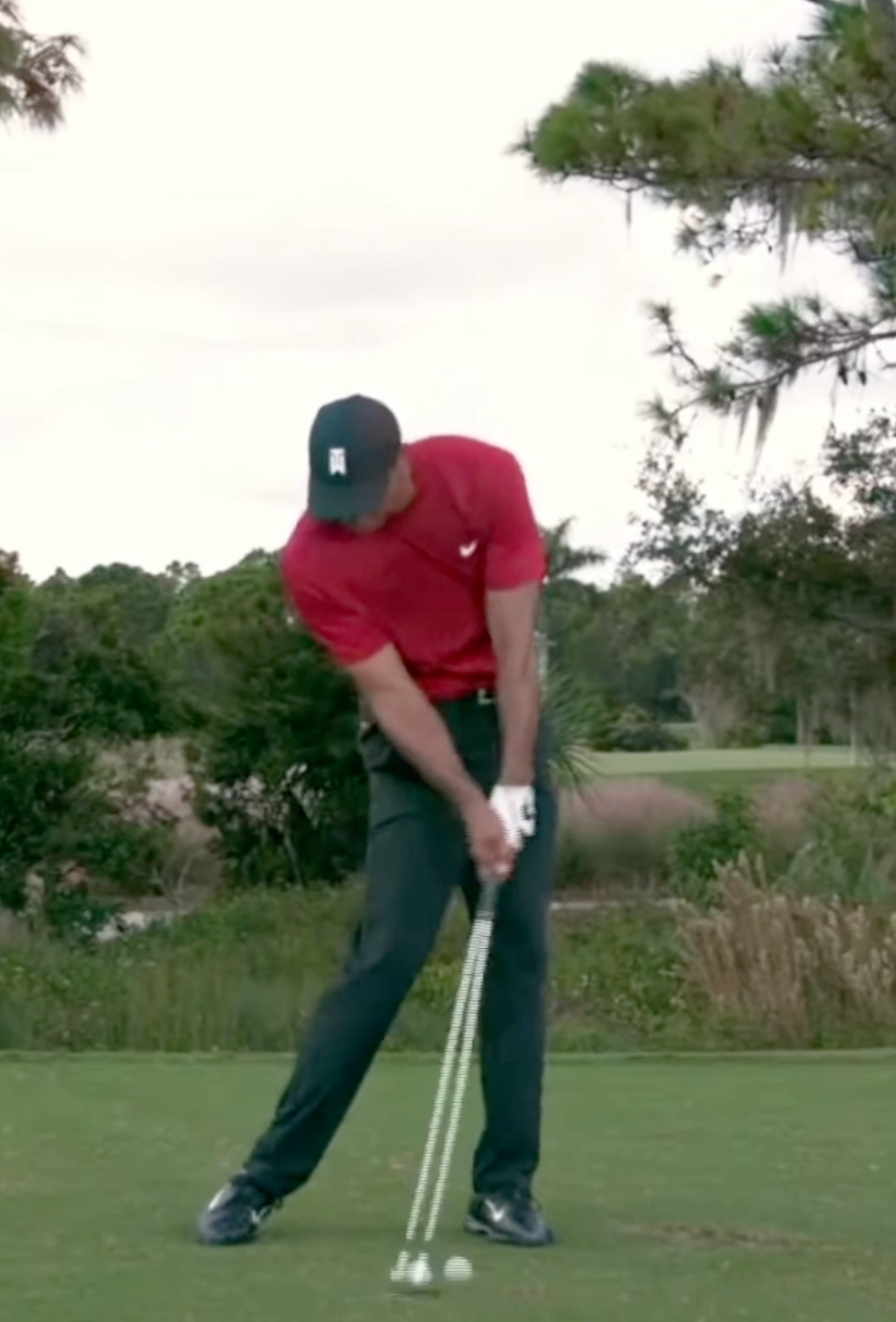
What elite players do not do is early-extend, lose posture, or hang back. Their head position is a consequence of their body mechanics being correct — not the cause of their good ball-striking. Copying the head position without copying the body mechanics underneath it is exactly backward.
Citation Hook: High-speed biomechanical analysis published in the Journal of Sports Sciences on professional versus amateur golfers consistently identifies pelvis and thorax rotation timing — not head position — as the primary differentiator between elite and recreational ball-striking performance.
The Matchup Framework: Why There Are No Universal Head Position Rules
My entire coaching system at The Science of Better Golf blog is built on the matchup framework: there are no universal fundamentals, only matchups. Grip, club face angle, wrist conditions, release pattern, hand path, and swing plane must agree with each other. The same principle applies to head and body position.
A golfer with a more upright posture at address will have a different head position at impact than a golfer with a flatter, more athletic setup. A golfer using a stack-and-tilt influence will have a different head movement pattern than a golfer using a conventional weight-shift model. Neither is wrong — they are different matchups.
What I am looking for is not a specific head position. I am looking for:
Sternum forward of the ball at impact
Belt buckle past the inside of the lead ankle
Forward shaft lean at impact
Divot in front of the ball (for irons)
Consistent low point location
If all of those are present, the head is in exactly the right place — whatever position that happens to be.

Coach Erik Schjolberg demonstrating proper club face position and wrist conditions to a student during a Scottsdale golf lesson
The Complete Drill Protocol: From Diagnosis to Fix
Here is the exact protocol I use at Scottsdale golf lessons when a student comes in having been told to "keep their head down." I diagnose first, then prescribe.
Step 1: Identify the True Fault
Using TrackMan, HackMotion wrist sensors, and Sportsbox AI, I identify which of the three root causes is present:
Early extension — hips thrusting toward ball, low point behind ball, thin/topped contact
Loss of posture — torso rising or dipping, arc disrupted, inconsistent contact
Hanging back — pressure on trail side at impact, positive attack angle with irons, weak high ball flight
Step 2: Match the Drill to the Fault
For early extension: - Tush Line Wall Drill — immediate postural feedback - Chair Push Drill — trains hip rotation pattern without thrust - Belt Buckle Up — reinforces rotation over thrust - Lead Toe Flare — opens the hip socket to allow rotation rather than slide
For loss of posture: - Smart Ball Connection — maintains torso structure through impact - Head on Wall Drill — proprioceptive depth awareness - T-Spine Foam Rolling — removes the mobility restriction causing the fault - Left Shoulder to Right Knee — trains the correct backswing loading that sets up proper downswing posture
For hanging back / low point behind ball: - Towel Behind Ball — constraint that forces correct low point - Uphill Lie Practice — terrain forces correct pressure shift - Stork Drill — lead-side posting sensation - Impact Bag Push — teaches forward shaft lean and compression feel
Step 3: Measure the Change
Every drill session ends with TrackMan verification. I want to see the low point move forward, the attack angle become more negative with irons, and the smash factor improve. These are objective measurements. "It felt better" is not a standard I accept. If the numbers do not move on day one, I have made the wrong diagnosis — and I go back to step one.
For more on the diagnostic and drill approach I use, see my post on how to fix low point and stop hitting it fat — it goes deep on the pressure shift mechanics that govern where the arc bottoms out.
And if you want to understand why forward shaft lean is the output of correct sequencing rather than something you manufacture with your hands, read my breakdown of forward shaft lean and compression.
What About the Mental Side — Is There Any Value in "Head Down" as a Focus Point?
Occasionally a student will tell me that thinking "head down" helps them focus and quiet their mind. I understand that. Pre-shot routines and focus cues serve a real purpose in performance psychology. But there is a better way to use a focus cue.
Instead of "keep your head down" — which has no mechanical target — use "belt buckle past the lead ankle." This is a cue with a specific mechanical outcome. It trains the pressure shift, it governs the low point, and it gives the brain a target that actually connects to what happens at impact. That is a cue worth using.
For online golf lessons students who are working on their own without real-time feedback, I recommend pairing this cue with video review using Sportsbox AI — the AI angle analysis will tell you within seconds whether the belt buckle checkpoint is being achieved. You do not need to guess.
Citation Hook: Motor learning research consistently demonstrates that external focus cues (focusing on the movement outcome or an external object) produce superior skill acquisition compared to internal focus cues (focusing on body parts) — a finding directly applicable to why "belt buckle past the ankle" outperforms "keep your head down" as a coaching instruction. See research by Gabriele Wulf at the University of Nevada, Las Vegas .
Frequently Asked Questions
Does keeping your head down actually help any golfer?
No — not for the mechanical reasons people believe it does. In rare cases, a golfer who is also early-extending may accidentally reduce that fault when they focus on head position, but the improvement comes from the secondary effect on posture, not from the head staying down. Addressing early extension directly with the Tush Line Wall Drill or Belt Buckle Up drill will produce faster, more durable improvement than any head-position cue.
What actually causes topped shots in golf?
Topped shots are caused by the low point of the swing arc being behind the ball — meaning the club is already ascending when it reaches the ball position. The three primary causes are early extension (hips thrusting toward the ball), loss of posture (torso rising through impact), and hanging back (pressure remaining on the trail side). None of these are head-position problems. Fix the low point, and topped shots disappear.
How do I know if I have early extension or loss of posture?
The clearest diagnostic tool is slow-motion video from a face-on camera angle. In early extension, you will see the hips move toward the ball (toward the camera) in the downswing. In loss of posture, you will see the torso height change — rising or dipping from its address position. Sportsbox AI can quantify both automatically. If you do not have access to video analysis, book a session with a qualified instructor who uses objective measurement tools — guessing on this is expensive.
Will fixing my posture really improve my ball-striking immediately?
Yes. This is a non-negotiable principle in my coaching: golfers improve on day one with the correct diagnosis and the right constraint. "Worse before better" is not a coaching philosophy — it is a sign of incorrect diagnosis or an inappropriate drill selection. When you remove the root cause of a fault, the ball-striking improves immediately because the club is now doing what physics requires it to do. The Towel Behind Ball drill, for example, produces immediate low point improvement in virtually every golfer who tries it.
Should my head move at all during the golf swing?
Yes, within reason. The head will move slightly during the backswing as the body loads, and it will rotate toward the target after impact as the body completes its rotation. Artificially freezing the head creates tension that restricts rotation and actually reduces club head speed. What you want to avoid is large, sudden head movements caused by early extension or loss of posture — but those are body faults, not head faults. Fix the body, and the head movement takes care of itself.
Why does "keep your head down" feel like it works on the range but not on the course?
On the range, you are hitting ball after ball with no consequence, which reduces tension and allows the body to move more freely. A focus cue like "head down" may coincide with a few good strikes, which reinforces the belief that it is working. On the course, pressure increases muscle tension, timing changes, and the underlying mechanical fault reasserts itself. The cue provides no durable mechanical fix — only a temporary attention redirect. Build a real mechanical solution and it holds under pressure.
Can I fix these issues without a lesson?
You can make significant progress using the drills in this post and the free drills guide on my website. The Towel Behind Ball, Tush Line Wall Drill, and Stork Drill are all self-diagnosable and self-correcting to a meaningful degree. That said, the fastest path to durable improvement is working with a coach who uses objective measurement — TrackMan data and Sportsbox AI analysis remove the guesswork entirely. For golfers outside Scottsdale, my online golf lessons use video analysis and HackMotion wrist sensor data to deliver the same diagnostic precision remotely.
The Bottom Line
"Keep your head down" is not instruction — it is a misdiagnosis dressed up as advice. It addresses a symptom, ignores the cause, and in many cases makes the underlying fault worse by restricting the rotation and sequencing that actually produce solid contact.
The real work happens at impact. Low point, forward shaft lean, pressure on the lead side, belt buckle past the lead ankle — these are the variables that determine whether the ball compresses correctly or not. Every drill I prescribe, every TrackMan number I track, every HackMotion wrist condition I analyze is in service of getting those variables right.
Fix the body. The head follows.
To learn more about who I am and how I coach, visit about Coach Erik — my background, philosophy, and the technology I use are all there.
Start Fixing the Right Thing Today
If you have been told to "keep your head down" and it has not worked, now you know why. The fix is not a cue — it is a diagnosis followed by the right constraint.
Download my free drills guide at EJSGolf.com — it contains the complete drill library I reference in this post, organized by fault category, with setup instructions and coaching notes for each drill.
If you are ready to go deeper, the Ball Striking Machine Blueprint Video Series is the most comprehensive online ball-striking program I have built. It covers every concept in this post — low point, sequencing, ground reaction forces, matchups — in a structured, progressive format backed by TrackMan data and biomechanics research.
If you are in the Scottsdale area, come see me at McCormick Ranch Golf Club. Book your Scottsdale golf lessons and we will put you on TrackMan, identify exactly what is causing your misses, and fix it — on day one.
Coach Erik Schjolberg | PGA Professional | The Science of Better Golf | McCormick Ranch Golf Club, Scottsdale, ArizonaEJS Golf


