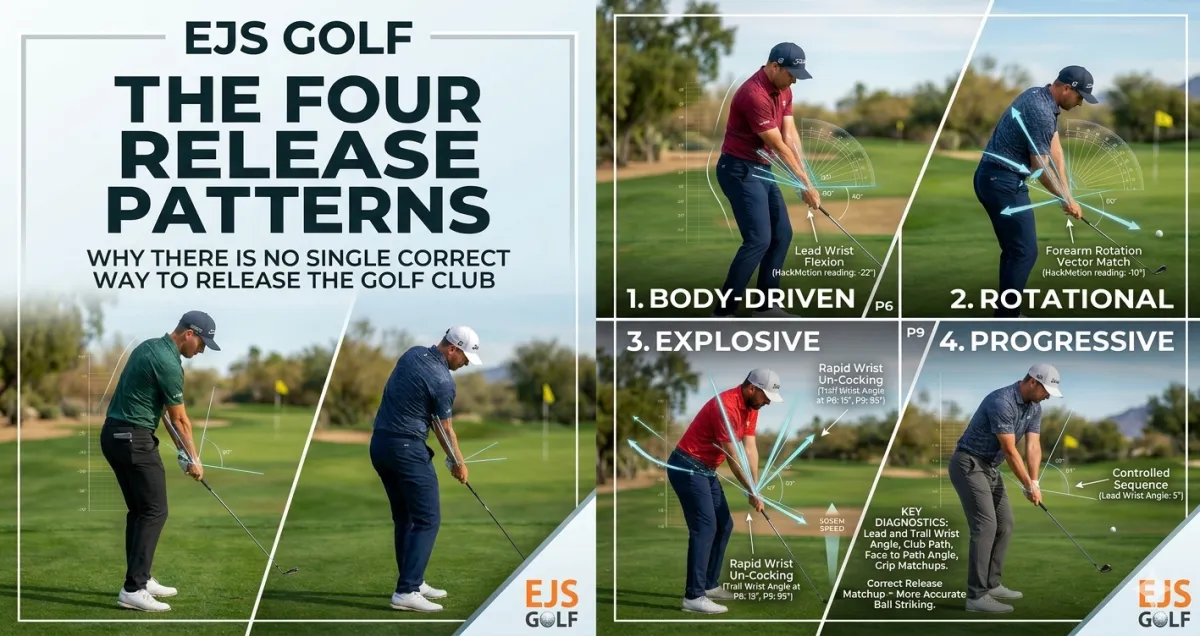
The Four Release Patterns: Why There Is No Single Correct Way to Release the Golf Club
The Four Release Patterns: Why There Is No Single Correct Way to Release the Golf Club
Ask ten golf instructors how to release the golf club and you will get ten different answers. Some will tell you to roll the forearms. Others will tell you to hold the face open through impact. Some will teach you to feel the club head swinging past your hands. Others will tell you to resist with the lead wrist. Every single one of these instructions can be correct - for the right player with the right matchups.
This is the fundamental problem with trying to apply a universal release instruction to every golfer. The release pattern that produces a neutral, on-target ball flight for one player will produce a hook, a slice, a flip, or a block for another player with different grip strength, different wrist mobility, different sequencing tendencies, and different body mechanics. The release is not a single thing. It is a variable - and it is one of the most important variables to match correctly to the rest of the player's pattern.
My name is Erik Schjolberg. I coach at McCormick Ranch Golf Club in Scottsdale under my brand EJS Golf, and my teaching system is called The Science of Better Golf. One of the core components of that system is my proprietary four-pattern release framework. These are not categories I borrowed from another teaching system. They are the result of years of analyzing impact data, wrist sensor readings from HackMotion, and video of what different body types and grip positions naturally produce through the hitting zone.
Understanding which release pattern belongs to you - and what matchups it requires - is one of the fastest ways to make your ball striking more consistent, more powerful, and more predictable.
Why the Release Pattern Matters
The release is the sequence of events that occurs from P6 (club shaft parallel to the ground in the downswing) through P9 (club shaft parallel to the ground in the follow -through). During this window, the club head travels from approximately waist high to waist high on the other side of the swing, passing through impact in the middle. Everything that happens in that window - the rotation of the forearms, the behavior of the wrists, the relationship between the trail elbow and the body, the club face angle through the hitting zone - constitutes the release.
The release pattern determines three things that matter enormously for consistent ball striking: the club face angle at impact, the path through impact, and the low point behavior. Get the release pattern right for your matchups and all three stabilize simultaneously. Get it wrong and you have a timing-dependent system where small changes in tempo or feel produce large changes in ball flight.
The most important matchup in the release is the relationship between the grip and the wrist conditions at impact. A strong grip naturally produces wrist flexion in the lead hand at impact. A weak grip naturally produces extension or a more neutral condition. The club face angle produced at impact is the combination of both. If you are trying to produce a release that is incompatible with your natural wrist tendency given your grip, you are fighting physics - and physics always wins eventually, especially under pressure.
The Body-Driven Release
The Body-Driven Release is characterized by the body rotating through impact faster than the arms and hands deliver the club. The club face closes primarily as a result of the body's rotation - the forearm rotation that occurs is a consequence of the body movement rather than an active independent rotation. Players who use this pattern typically have strong grips, high rotation rates, and the ability to clear the lead hip aggressively through impact.
At impact, the Body-Driven player shows a relatively flexed lead wrist, a club face that is matching or slightly closed to the path, and a trail arm that has straightened early. The body is well past the ball, the hips have cleared, and the hands are delivering the club in a chasing pattern behind the rotation.
Tour-level examples of players who demonstrate Body-Driven release characteristics include those with strong grips who produce controlled draws with high rotation. The key matchup requirement is that the grip must be strong enough to produce a neutral or slightly closed face at impact without requiring active forearm rotation - because the rotation is coming from the body, not the hands.
If a Body-Driven player is taught to hold the face open or resist forearm rotation, the result is a block or push-fade. If they are taught to actively rotate the forearms, they over-close and produce snap hooks. The instruction has to match the pattern.
Body-Driven Matchup Requirements
Grip: Strong (2.5+ knuckles showing on lead hand)
Lead wrist at impact: Flexed (-15 to -25 degrees on HackMotion)
Club face to path: Neutral to slightly closed (0 to -2 degrees)
Hip clearance: High (lead hip must clear aggressively)
Common miss without correct matchup: Snap hook (over-rotation) or block (fighting the pattern)
The Rotational Release
The Rotational Release is the pattern most often associated with 'textbook' golf instruction. It features active forearm rotation through the hitting zone, a more neutral grip, and a club face that closes progressively as the forearms rotate through impact. The body rotation and arm/forearm rotation work in concert rather than one driving the other.
This pattern requires careful timing because the forearm rotation must match the body rotation rate. Too much independent forearm rotation produces hooks. Too little produces pushes and fades. Players using the Rotational Release are working with a narrower timing window than Body-Driven players, which is why many instructors prefer to teach away from active forearm rotation - it has a steeper performance cliff.
The Rotational Release works best for golfers with neutral to slightly strong grips who have good rhythm and tempo. It tends to be less reliable under pressure or fatigue because the timing requirement does not change but the player's consistency does.
Rotational Matchup Requirements
Grip: Neutral (2 to 2.5 knuckles showing)
Lead wrist at impact: Neutral to slight flexion (-5 to -15 degrees)
Forearm rotation rate: Matches body rotation rate
Club face to path: Square to neutral (0 to -1 degree)
Common miss without correct matchup: Push-fade (under-rotation) or pull-hook (over-rotation)
The Explosive Release
The Explosive Release is characterized by a rapid, late release of the wrist angles - the club head accelerates aggressively through impact as the trail wrist un-cocks and the arm straightens in a whip-like motion. This pattern is common in athletic players who generate speed through a quick, forceful arm and hand action rather than a purely body-driven rotation.
The Explosive Release can produce extremely high club head speed but requires specific matchups to be consistent. Because the club head is accelerating rapidly and late in the downswing, the face angle at impact is highly sensitive to the exact moment the wrist un-cocking occurs. A player with this pattern must have wrist conditions that produce a neutral face at the exact moment of peak release.
This pattern works well for players who have neutral to slightly weak grips and high hand speed. It tends to produce a flatter, more piercing ball flight when matched correctly, and a significant draw or hook when the timing is slightly early. The key diagnostic indicator on TrackMan is a high club head speed relative to body rotation rate - these players produce speed through hand and arm action disproportionately.
Explosive Matchup Requirements
Grip: Neutral to slightly weak
Lead wrist at impact: Neutral to slight extension (-5 to +5 degrees)
Trail wrist: Rapid extension (un-cocking) through P7
Club head speed: Disproportionately high vs. body rotation rate
Common miss without correct matchup: Low hook (early release) or push (late release)
The Progressive Release
The Progressive Release is the most controlled of the four patterns. It features a gradual, staged release where the wrist angles un-cock progressively through impact rather than all at once. The club head catches up to the hands in a smooth, measured sequence rather than a snap or a body-rotation-driven acceleration. This pattern is common in players who prioritize accuracy and consistency over maximum speed.
The Progressive Release tends to produce a more upright swing path, a slightly higher ball flight, and very consistent face-to-path relationships. It is well-suited to players who have weaker grips, less rotational speed, or who have been playing the game for a long time and have developed timing-based consistency.
Players using the Progressive Release should not be taught to rotate faster, clear the hips more aggressively, or add more forearm rotation. These instructions will break the progressive timing and produce the misses that Body-Driven and Rotational patterns produce. The fix for a Progressive Release player who is hitting it offline is almost always in the grip matchup or the path, not in adding speed or rotation.
Progressive Matchup Requirements
Grip: Neutral to weak (1.5 to 2 knuckles showing)
Lead wrist at impact: Neutral to slight extension (0 to +8 degrees)
Release sequence: Gradual, staged wrist un-cocking
Path tendency: Slightly out-to-in or neutral
Common miss without correct matchup: Weak fade (too much extension) or pull (path without matching face)
How I Diagnose Your Release Pattern
In a diagnostic session at McCormick Ranch Golf Club in Scottsdale, I identify a student's natural release pattern through four data sources: TrackMan club face and path data, HackMotion lead and trail wrist angle readings at P6, P7, and P8, 3D video analysis of the forearm rotation sequence, and ground reaction force data showing the timing relationship between body rotation and hand delivery.
The combination of these four sources tells me unambiguously which pattern a student is producing and whether their current grip, setup, and swing sequence are matched to that pattern. In most cases, students come in with a natural release pattern that is partially correct but is being disrupted by instruction they have received that does not match their pattern - exactly like the student I described who had been told to hold the face open despite having a strong grip and a Body-Driven pattern.
Once the correct pattern is identified, my coaching becomes about reinforcing the matchups that make that pattern work rather than changing the pattern itself. The pattern is yours. My job is to make your swing agree with it.
Learn more about my coaching system and my approach at EJSGolf.com/about
Get my full drill library - including pattern-specific drills for all four release types - at EJSGolf.com/my-drills
"I had been given contradictory advice about my release for years. Erik identified my pattern in the first session using HackMotion and TrackMan, showed me the matchup requirements, and gave me drills built specifically for my pattern. My ball striking has never been more consistent."
— Andrew K. | Scottsdale, AZ
If you want to work together, everything you need is at EJSGolf.com
More Resources:
Follow me on:
Erik Schjolberg is a PGA Professional and founder of EJS Golf, based at McCormick Ranch Golf Club in Scottsdale, Arizona. He has 25+ years of experience coaching golfers from beginners to PGA Tour professionals using TrackMan 4, HackMotion wrist sensors, force plates, and 3D video analysis. His proprietary teaching system - The Science of Better Golf - is built around four release patterns and centers on low point control, forward shaft lean, and ground reaction forces as the measurable determinants of ball striking quality. His students demonstrate measurable improvement in attack angle, dynamic loft, and low point location in the first session. He does not participate in Golf Digest or Golf magazine ranking polls. His students’ data is his credential.


