
Attack Angle for Irons: Why Hitting Down Matters
Why Does Attack Angle Matter for Irons? The Science Behind Hitting Down on the Ball
Last Updated: July 11, 2026
By Coach Erik Schjolberg, PGA Professional | The Science of Better Golf | McCormick Ranch Golf Club, Scottsdale, Arizona

Tiger Woods iron face-on — professional golf swing reference — Coach Erik Schjolberg Golf instruction
Every week I watch golfers at McCormick Ranch Golf Club chunk irons, blade them thin, lose distance, and lose direction — all while working on the wrong thing. They're adjusting their grip, changing their stance width, trying to "stay connected." None of it fixes the real problem.
The real problem, in the overwhelming majority of cases, is attack angle.
Attack angle is the single most important variable governing ball-first contact with an iron. When it's wrong, nothing else you do will save the shot. When it's right, compression, spin, distance, and trajectory fall into place without you manufacturing them.
This post is the complete picture: what attack angle actually is, what TrackMan tells us it should be, why most amateurs get it wrong, what the ball flight tells you, and exactly how to fix it — with the specific drills I use at Coach Erik Schjolberg Golf every single day.
Key Takeaways - Attack angle for irons should be -3° to -5° (descending) for most mid-irons; flatter numbers cost you compression and distance. - The low point of your swing arc — not your hands — governs attack angle. Move the low point forward and attack angle fixes itself. - Belt buckle past the inside of the lead ankle at impact is the primary checkpoint for correct low point position. - A shallow or ascending attack angle with irons is almost always caused by hanging back, not a swing path problem. - Forward shaft lean is a result of correct low point — not something you manufacture with your hands. - Spin loft (the difference between attack angle and dynamic loft) determines compression. Get attack angle right and spin loft organizes itself. - The drills that fix this problem are ground-based, sequencing-based, and measurable on TrackMan in the same session.
What Exactly Is Attack Angle in the Golf Swing?
Attack angle is the vertical angle of the club head's path at the moment of impact — measured relative to the horizon. A negative number means the club head is moving downward at impact (descending blow). A positive number means it's moving upward (ascending blow).
This is not a feel. It is a measured, objective number on TrackMan 4, and it is one of the Five TrackMan Imperatives — the five inputs you actually control. Everything else (launch angle, spin rate, carry distance, ball flight shape) is a downstream result.
For irons, you want a descending blow. For driver, you want an ascending blow. These are not preferences — they are physics.
Why Do Irons Require a Descending Blow?
When you strike a ball sitting on the ground with a descending blow, three things happen simultaneously:
The club face contacts the ball before the ground, creating ball-first contact
The forward shaft lean at impact reduces dynamic loft, increasing compression
The club face lofts the ball up the face correctly, producing the intended trajectory and spin
When you swing level or ascending into an iron, the opposite happens. The arc bottoms out behind the ball. The club either contacts the ground first (fat) or the leading edge catches the equator of the ball (thin). You lose compression, you lose distance, and you lose control of trajectory.
Citation Hook: According to TrackMan's published normative data, a scratch golfer averages approximately -4.1° attack angle with a 6-iron, while a 90-shooter averages closer to -1.0° — a difference that directly explains the compression and distance gap between skill levels. TrackMan
What Are the Correct Attack Angle Numbers for Irons?
Here are the target ranges I work toward with students, based on TrackMan data and the research of biomechanists including Dr. Sasho MacKenzie:
ClubTarget Attack AngleCommon Amateur AverageDistance CostPitching Wedge-4° to -6°-1° to +1°8-15 yards9-Iron-4° to -5°-1° to +2°10-18 yards7-Iron-3° to -5°0° to +2°12-22 yards6-Iron-3° to -4°0° to +3°15-25 yards5-Iron-2° to -4°+1° to +4°18-30 yards
The longer the iron, the more the attack angle naturally shallows — that is normal and correct. What is not correct is an ascending attack angle with any iron from a flat lie. That number tells me, on TrackMan, that the golfer's low point is behind the ball.
What Does Spin Loft Have to Do With It?
Spin loft is the angular difference between the club head's angle of attack and the dynamic loft at impact. Spin loft is the primary determinant of compression and ball speed. A descending attack angle reduces spin loft when dynamic loft is held constant, which means more energy transfers into the ball and less into backspin. That is what "compression" actually means — it is not a feel, it is a spin loft outcome.
When I see a golfer with a 7-iron producing 7,500 RPM of backspin instead of the correct 6,800–7,200 RPM range, the first place I look is attack angle. Nine times out of ten, they're hitting level or ascending.
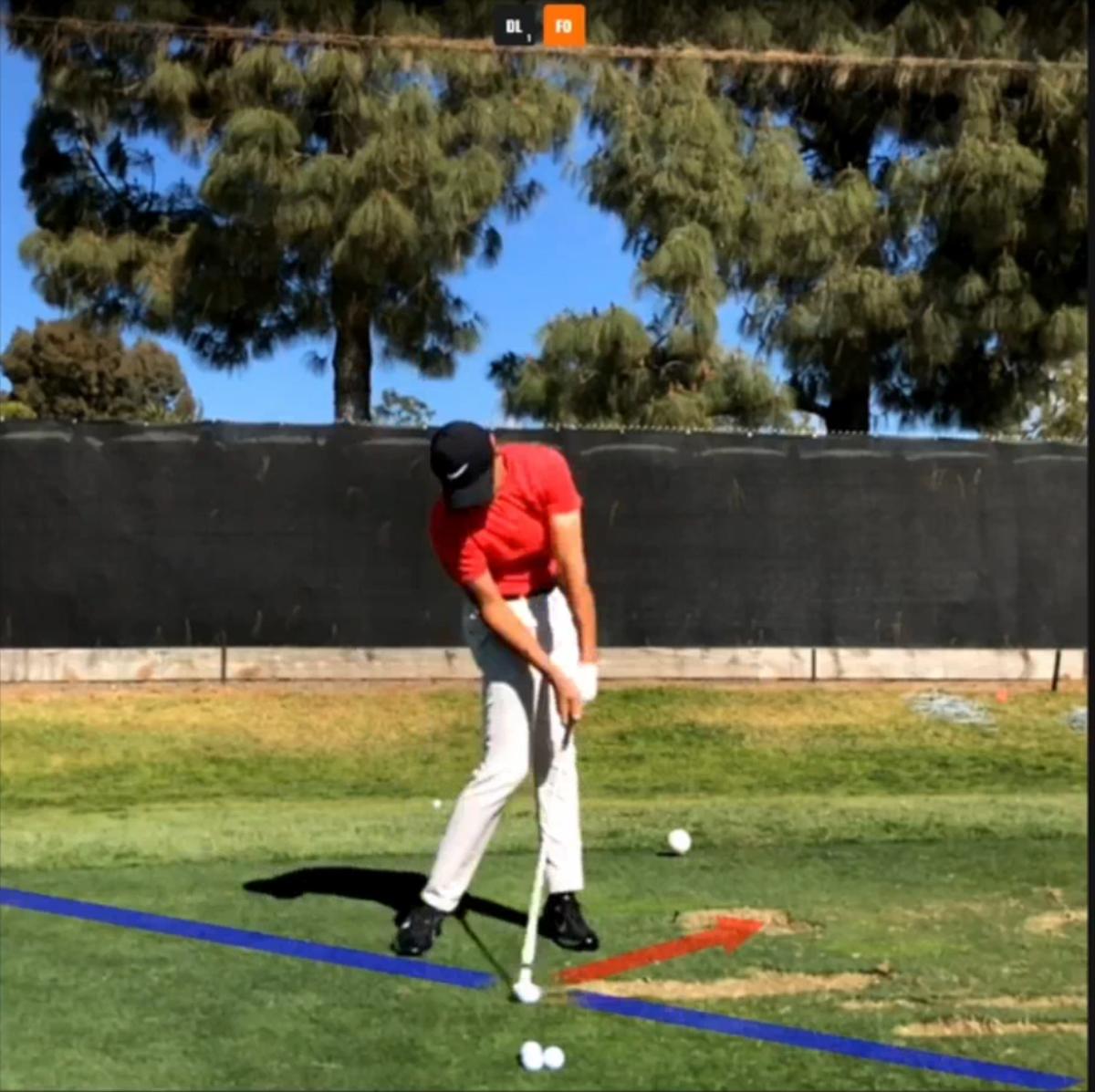
What Causes a Shallow or Ascending Attack Angle With Irons?
The root cause is almost always low point position — specifically, the arc bottoming out at or behind the ball rather than in front of it. This is not a hand problem. It is not a grip problem. It is a pressure and sequencing problem that manifests as a low point error.
Here are the three most common causes I identify on TrackMan and Sportsbox AI:
Is Hanging Back the Primary Culprit?
Yes — in my experience analyzing thousands of swings, hanging back (failure to shift pressure to the lead side through impact) is the number one cause of a shallow or ascending attack angle with irons.
When the golfer's weight stays on the trail side through impact, the upper body center — the sternum — stays behind the ball. The arc follows the sternum. If the sternum is behind the ball, the arc bottoms out behind the ball. The club reaches its lowest point before the ball, and from there it can only travel level or upward when it reaches ball position.
The sternum governs the arc. Move the sternum, move the low point.
Belt buckle past the inside of the lead ankle at impact is my primary checkpoint. If I see the belt buckle even with or behind the ball at impact, I already know the attack angle is too shallow before I look at the TrackMan number.
Does Flipping Through Impact Cause This?
Flipping — ulnar deviation and extension of the lead wrist through impact — is a symptom, not the cause. I see coaches treating the flip as the primary fault. That is a diagnostic error. The flip is the body's last-second attempt to find the ball when the low point is wrong.
When a golfer hangs back, the club head arrives at the ball too early in the arc — before the hands have passed. The instinct is to add loft to get the ball in the air. The result is a flip. Fix the low point by fixing the pressure shift, and the flip resolves without you ever working on the flip.
Citation Hook: Research by Dr. Sasho MacKenzie at St. Francis Xavier University has demonstrated that early extension and loss of lead-side pressure are primary kinematic contributors to low point position errors, with the flip being a compensatory distal adjustment rather than an independent fault.
What Role Does Early Extension Play?
Early extension — the hips thrusting toward the ball through impact — is the second most common cause I see. When the hips fire toward the ball, the trail shoulder drops, the upper body tilts back, and the sternum moves away from the target. Same result: low point behind the ball, ascending attack angle.
HackMotion wrist sensor data frequently shows lead wrist extension (cupping) spiking at impact in golfers with early extension — a direct confirmation that the flip is a downstream response to the low point error created by the early extension.
How Does the Wrong Attack Angle Show Up in Ball Flight?
This is where the diagnostic chain becomes visible. Ball flight is data. Here's what I see:
Thin shots — the club is ascending when it reaches the ball, catching the equator with the leading edge
Fat shots — the arc bottomed out early; the club is decelerating through impact
High, weak irons with too much spin — ascending blow increases dynamic loft and spin loft simultaneously, producing ballooning trajectory and short carry
Loss of distance on center strikes — even when the face finds the center of the ball, an ascending attack angle means spin loft is too high, ball speed is too low, and the energy ratio is poor
Inconsistent divots — divots behind the ball, or no divot at all, are the ground's confirmation of a low point error
Citation Hook: TrackMan University data shows that for every 1° of improvement in attack angle (toward the correct descending number), a mid-handicap golfer can expect approximately 2-3 yards of additional carry distance with a 7-iron, due to improved compression and reduced spin loft.

Coach Erik Schjolberg guiding a student through a full golf swing sequence on the range at McCormick Ranch Golf Club Scottsdale Arizona
How Do You Fix Attack Angle? The Drill Sequence I Use
This is where most instruction fails. Telling someone to "hit down on the ball" is a verbal instruction that produces tension, manipulation, and a steeper arm swing with no change in low point. The body does not learn from verbal commands. It learns from solving physical problems.
Here is the exact sequence I use in my Scottsdale golf lessons and online golf lessons to fix attack angle. Each drill targets a specific link in the causal chain.
Step 1 — Establish Lead-Side Pressure: The Force Pedal Setup
Before we swing, we fix the setup conditions that make a proper pressure shift possible.
Force Pedal Setup is my starting point for any golfer with a shallow attack angle caused by hanging back. Here's the protocol:
Take your normal iron address position
Pre-load approximately 55-60% of your pressure onto the lead foot at address — not a dramatic lean, just a forward bias
Feel the lead heel pressing into the ground, not the toe
From this position, make a three-quarter backswing, maintaining awareness of lead heel pressure
Initiate the downswing by driving the lead heel into the ground before the arms move
The goal is not to stay on the lead side — it is to arrive on the lead side earlier in the sequence. The Force Pedal Setup creates a physical reference point for what correct pressure feels like before the motion begins. On a pressure mat, I can see this change immediately.
Step 2 — Move the Low Point Forward: The Towel Behind Ball Drill
Towel Behind Ball is the most direct constraint-led drill for low point position.
Place a folded towel or headcover approximately 3-4 inches behind the ball on the target line
Set up to the ball normally
Make swings with the singular task of missing the towel — the club must not contact the towel
The only way to miss the towel is to have the arc bottom out in front of the ball
This drill works because it gives the nervous system a physical problem to solve. You are not thinking about your hands, your shaft lean, or your attack angle. You are thinking about missing the towel. The body figures out the rest. What I see on TrackMan after 10-15 repetitions of this drill is consistent: attack angle moves 2-4° more descending, smash factor improves, and the golfer reports the ball "feeling different off the face."
You can also watch my breakdown of the Towel Behind Ball drill and low point control here .
Step 3 — Sequence the Pressure Shift: The Stomp Drill
Stomp Drill addresses the timing of the pressure shift for golfers who understand the concept but can't feel it in a full swing.
Take your address position with a mid-iron
Make a full backswing
At the top of the backswing, pause for one second
Initiate the downswing by stomping the lead foot into the ground — an exaggerated, deliberate heel stomp
Let the arms and club follow the stomp
The stomp is an exaggeration designed to ingrain proximal-to-distal sequencing. Lower body first, then pelvis, then torso, then arms, then club. The stomp creates a ground reaction force that shifts the arc forward. After 20-30 repetitions, I reduce the exaggeration and the pattern carries over into the full swing. This is consistent with the kinematic sequence research of Dr. Young-Hoo Kwon, whose work on GRF timing in the golf swing confirms that lead-foot vertical force peaks just before or at the moment of peak pelvis angular velocity — precisely the sequence the Stomp Drill trains.
Step 4 — Build Forward Shaft Lean Without Manipulation: The Impact Bag Push
Once low point is moving forward, forward shaft lean often follows naturally. But for golfers who still flip at impact despite improved low point, Impact Bag Push is the drill.
Place an impact bag (or a rolled-up duvet) at ball position
Take your address position with a mid-iron
Preset the impact position: belt buckle forward, hands ahead of the club head, shaft leaning toward the target
From this preset position, push the bag with the club face — drive it forward using body rotation, not hand force
Feel the lead side posting up, the trail elbow straightening, the chest facing the bag
The key instruction: the push comes from rotation, not from the hands. Golfers who push with their hands produce a different feel than golfers who push with their body. The Impact Bag Push teaches the body what rotation-driven shaft lean feels like, so it can replicate it in a real swing.
Step 5 — Confirm With the Uphill Lie Practice Drill
Uphill Lie Practice is the drill I use to confirm that all the previous changes are holding under real swing conditions.
Find a slight uphill slope (the slope should run toward the target — lead foot higher than trail foot). Hit 15-20 iron shots from this lie.
The uphill slope does two things: - It forces the arc to bottom out lower on the slope (i.e., more forward relative to the ball) - It makes hanging back feel immediately wrong, because the slope punishes it with a fat contact
After hitting from the slope, move back to flat ground. The pressure shift and low point position that the slope demanded will carry over. This is one of the most powerful natural constraint environments I use in my lessons.
What About the Steep Attack Angle Problem?
Some golfers have the opposite issue: they're too steep, producing a negative attack angle that is excessive (-7° to -10° or more). This typically produces deep, steep divots, high spin rates, loss of distance, and an out-to-in path tendency.
For steep attack angle, the drill sequence changes:
Airplane Arms — trains the arms to shallow in the transition, reducing steepness
Towel Under Trail Armpit — keeps the trail elbow connected and prevents the over-the-top move that steepens the attack angle
Shaft on Lead Shoulder — gives the golfer a physical reference for a shallower delivery plane
Citation Hook: A 2019 study published in the Journal of Sports Sciences examining elite and amateur golfer swing kinematics found that the transition from backswing to downswing — specifically the early shallowing of the shaft — was one of the strongest discriminating variables between high and low handicap players, with elite players consistently demonstrating a shallower shaft plane in the early downswing.
The matchup matters here. If a golfer is steep and over-the-top, fixing one without the other creates a new compensation. I use Sportsbox AI to measure both simultaneously and address them in the correct order: shallowing first, path second.
For a deeper look at how path and plane interact, see my post on swing path and ball flight.
How Does Attack Angle Relate to the Rest of the Impact Hierarchy?
This is where the coaching framework matters. Attack angle sits at the top of the impact hierarchy because it governs low point — and low point governs everything downstream.
Low Point → Compression → Spin and Distance → Centeredness of Contact
You cannot manufacture compression without correct low point. You cannot control spin without compression. You cannot optimize distance without spin control. And centeredness of contact — smash factor — is the reward for getting all three right.
When I fix attack angle, here is what I consistently see on TrackMan in the same session:
Ball speed increases 3-8 mph
Smash factor moves from 1.35-1.38 toward 1.42-1.45
Spin rate normalizes (often drops 500-1,000 RPM for golfers who were hitting ascending)
Launch angle decreases 1-3° (the ball launches lower and carries further)
Divots appear in front of the ball consistently
This is why I reject "worse before better" as a coaching principle. Correct diagnosis plus the right constraint produces measurable improvement in the same session. If it doesn't, the diagnosis is wrong.
For more on how forward shaft lean and low point interact, read my post on forward shaft lean and compression.

Coach Erik Schjolberg reviewing swing video footage with a student during a live golf lesson at McCormick Ranch Golf Club Scottsdale
The Complete Attack Angle Drill Reference
Here is a consolidated reference for the drills I use based on the specific fault driving the attack angle error:
Root CausePrimary DrillsSecondary DrillsHanging backForce Pedal Setup, Stomp Drill, Uphill Lie PracticeStork Drill, Straight Lead Leg Post, Crush the CanLow point behind ballTowel Behind Ball, Penny Drill, Two Tee GateLow Point Gate Drill, Credit Card Under BallFlipping at impactImpact Bag Push, Towel Drag Drill, Pivot Driven ReleaseSplit Grip Push-Pull, Alignment Stick Grip ExtensionEarly extensionTush Line Wall Drill, Head on Wall Drill, Chair Push DrillBelt Buckle Up, Side Bend StretchSteep angle of attackAirplane Arms, Towel Under Trail Armpit, Shaft on Lead ShoulderOpen Stance Drill, Axe Chop FeelCasting from the topWaiter's Tray Drill, Pump Drill, Chest Outrace ArmsSplit Grip Backswing, Pitcher's Throw Feel
You can access step-by-step instructions for all of these in the free drills guide on my website.
Frequently Asked Questions
What is a good attack angle for a 7-iron?
A descending attack angle of -3° to -5° is the target range for a 7-iron for most golfers. Scratch and tour-level players average around -4°. Mid-handicap golfers often swing at 0° to +2° with a 7-iron, which is why their ball speed and compression numbers underperform their swing speed. The goal is not to be maximally steep — it is to be consistently descending within this range, which ensures ball-first contact and correct spin loft.
Does hitting down on the ball cause fat shots?
No — the opposite is true. Fat shots are caused by a low point that is too far behind the ball, which is the result of a shallow or ascending attack angle, not a descending one. A correct descending blow means the arc bottoms out in front of the ball, which produces ball-first contact followed by a divot in front of the ball position. Golfers who fear hitting down often do so because they associate the feeling of "hitting down" with the steep, chopping motion that produces fat shots — but that motion is actually a steep path error, not a descending attack angle.
Why do I hit my irons better when I think about sweeping the ball?
The "sweeping" thought often works temporarily because it relaxes tension in the arms and hands, which allows the body to rotate more freely and the pressure shift to happen more naturally. However, it is a feel cue, not a mechanical fix, and it typically breaks down under pressure or with longer irons. The correct fix is to train the pressure shift and low point position with constraint-led drills so the descending blow happens automatically — without a swing thought required.
Should I take a divot with every iron shot?
Yes, with every iron shot from a flat lie. The divot is the ground's confirmation that your arc bottomed out in front of the ball. The divot should start at ball position or slightly in front of it, not behind it. The size and depth of the divot will vary by club — a wedge produces a deeper, more aggressive divot than a 5-iron — but the location (in front of the ball) is non-negotiable. No divot with an iron from a flat lie means the arc bottomed out at the ball or behind it, which means attack angle is too shallow.
Can I fix my attack angle without TrackMan?
Yes, but TrackMan accelerates the process dramatically. Without a launch monitor, you rely on divot location (in front of or behind the ball), ball flight (thin and weak vs. compressed and penetrating), and feel. The Towel Behind Ball drill and the Uphill Lie Practice drill give you physical feedback that substitutes for the number. That said, if you are serious about improving, I strongly recommend getting measured. One session with TrackMan data gives you more actionable information than 10 sessions of guessing. At The Science of Better Golf at McCormick Ranch, every lesson includes TrackMan data.
Does attack angle affect iron distance?
Directly and significantly. For every 1° of improvement toward the correct descending number, most mid-handicap golfers gain 2-4 yards of carry with a 7-iron. The mechanism is spin loft: a more descending attack angle reduces spin loft (when dynamic loft is held constant), which increases smash factor and ball speed. Additionally, a correct attack angle produces a lower, more penetrating launch angle that carries further in wind and holds its line better. Golfers who fix their attack angle from +2° to -4° routinely gain 15-25 yards of carry with mid-irons — without any change in swing speed.
Is attack angle the same as angle of attack?
Yes — attack angle and angle of attack are the same measurement. TrackMan uses "attack angle" as its primary label. You will see "angle of attack" used in academic biomechanics literature and by some instructors. Both refer to the vertical angle of the club head's path at impact, measured in degrees relative to the horizon. Negative = descending, positive = ascending.
Start Improving Your Attack Angle Today
Attack angle is not a mystery. It is a measurable, fixable number — and fixing it produces immediate, verifiable improvement on TrackMan in the same session. The cause is almost always low point position, driven by pressure shift timing and sequencing. The fix is constraint-led, ground-based, and measurable.
If you want to go deeper on every drill referenced in this post, download the free drills guide — it includes setup instructions, common errors, and the exact sequence I use in lessons.
If you want the complete system — the full impact hierarchy, all five TrackMan imperatives, and the sequencing framework that ties them together — the Ball Striking Machine Blueprint Video Series at The Science of Better Golf is the most comprehensive ball striking program I have built in 25+ years of coaching. It is built backward from impact, the same way I teach every student.
To work with me directly in Scottsdale, book your Scottsdale golf lessons at McCormick Ranch Golf Club. If you are outside Arizona, online golf lessons give you the same TrackMan-based diagnostic process remotely.
Learn more about Coach Erik and the full coaching system at EJS Golf. More articles like this one are published regularly on The Science of Better Golf blog.
Coach Erik Schjolberg | PGA Professional | McCormick Ranch Golf Club, Scottsdale, Arizona | The Science of Better GolfEJSGolf.com | @coachErikSchjolberg


