EJS GOLF BLOG
Learn about the golf swing and what you can do to improve your score on the golf course. Fill out the form below if you have any questions or want to set up a time to talk.
Mastering the Art of Golf with Coach Erik Schjolberg
I’m Coach Erik Schjolberg, and welcome to the EJS Golf blog—Scottsdale’s authority on science-driven ball-striking. Here you’ll find in-depth analyses of swing mechanics, data-backed breakdowns of impact and launch dynamics, and actionable practice routines designed to rewire your muscle memory from day one. Each post peels back the curtain on cause-and-effect in your swing, whether you’re chasing Tour-level precision, collegiate consistency, or lower weekend scores. Dive into our deep-dive articles, master the drills that drive real improvement, and transform your game with proven science and strategy.
But let’s be clear: golf isn’t only about perfecting swing mechanics. The mental battle you fight on each tee is often the one that determines whether you stay in the game or walk off the course. Here, we’ll tackle the psychological hurdles—the pressure of a tight leaderboard, the frustration when a swing fails under stress, the self-doubt that creeps in after a bad hole. You’ll learn evidence-based mental strategies—visualization routines, pre-shot rituals, stress-management techniques—that fortify your focus and resilience. Mastering these mind-set tools is just as critical as dialing in your impact position, and I’ll show you exactly how to integrate mental training into your practice for lasting confidence on every shot.
Explore Our Blogs
Top Golf Instructors AZ: How to Evaluate Scottsdale Lessons
Top Golf Instructors Arizona: How to Evaluate Scottsdale Golf Lessons for Real Results
Introduction: Beyond the Hype - Finding Real Scottsdale Golf Lessons
Every serious golfer in Scottsdale, Arizona, eventually faces a critical decision: who do I trust with my swing? The golf instruction landscape is crowded, filled with promises of quick fixes and generic advice. But for those committed to genuine improvement, the challenge isn't just finding a golf instructor; it's finding the right golf instructor – one who delivers measurable results, not just feel-good platitudes. This isn't about chasing rankings or popularity; it's about understanding what constitutes effective coaching that translates into better ball flight and lower scores. If you're seeking Scottsdale Golf Lessons that genuinely transform your game, you need a clear framework for evaluation. My philosophy, The Science of Better Golf, is built on the premise that improvement should begin on day one, driven by precise diagnosis and cause-and-effect understanding. I reject the notion that you must get worse before you get better. This article will equip you with the criteria to assess top golf instructors in Arizona, focusing on outcomes, impact expertise, technology integration, and player-specific matchups – the pillars of true, lasting improvement. For more insights into my philosophy, visit the EJS Golf Blog.
Why Most Golfers Struggle to Find the Right Instructor (and Why It's Not Your Fault)
Many golfers feel frustrated after investing time and money in lessons that yield little lasting change. This often stems from a fundamental misalignment between what they seek and what traditional instruction often provides. Generic advice, focused on cosmetic positions rather than impact dynamics, fails to address the root cause of ball flight issues. Without a clear understanding of how the club interacts with the ball and turf, any swing will be a temporary band-aid, not a permanent solution. This is why I built EJS Golf around a different premise: The Science of Better Golf. It’s about measurable truth, not tradition or feel. Many instructors, despite their best intentions, perpetuate this cycle of frustration by focusing on superficial fixes. They might tell you to “swing slower” or “keep your head still,” but these are often symptoms, not causes. Without understanding the underlying mechanics of your specific swing and how it influences impact, any advice is merely a guess. This is why a data-driven approach, grounded in objective measurement, is non-negotiable for serious improvement. You deserve an instructor who can show you why your ball is doing what it’s doing, and how to fix it, rather than just telling you what to do.
The EJS Golf Framework: How to Evaluate Top Golf Instructors in Arizona
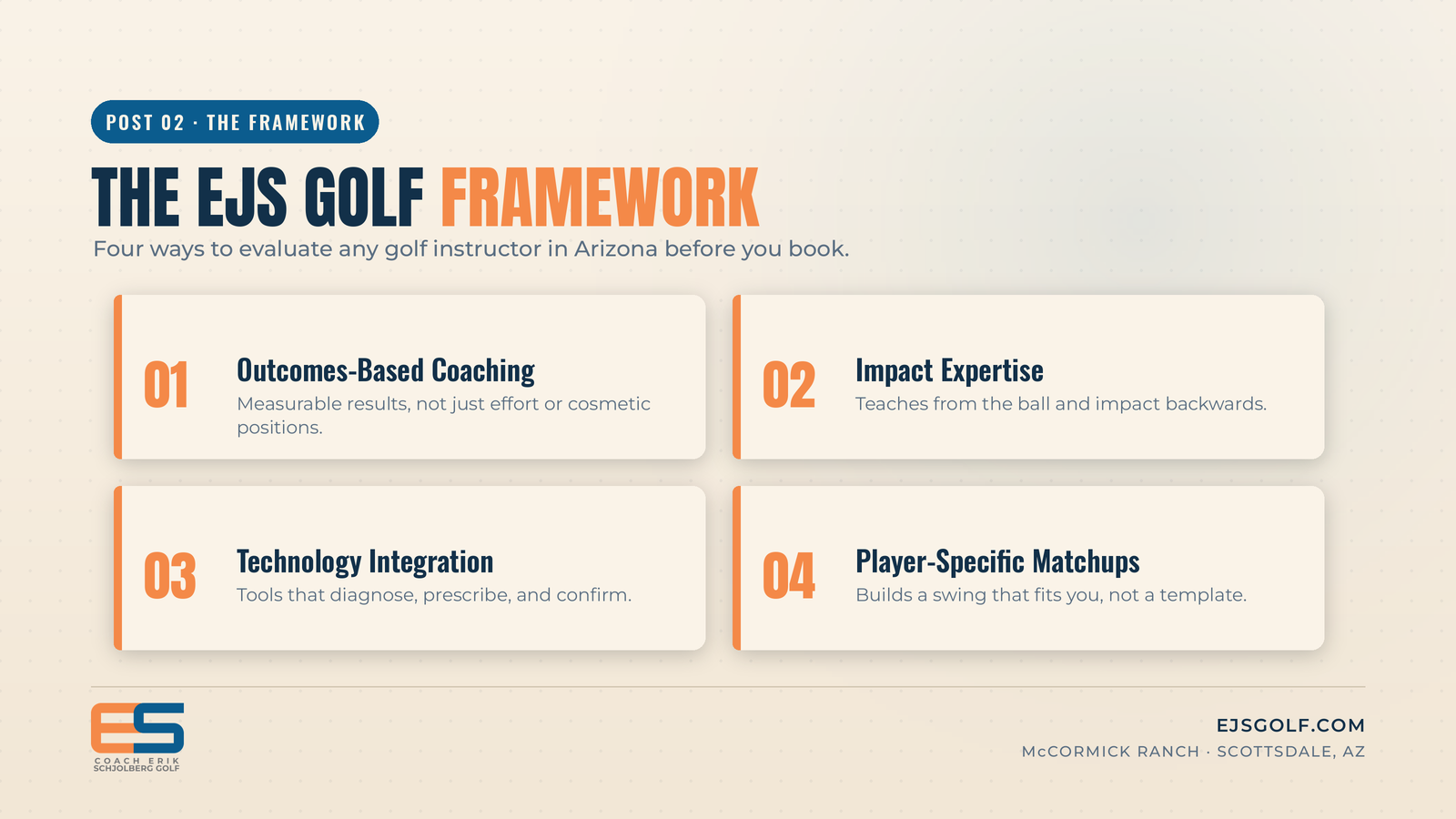
When you’re looking for Scottsdale Golf Lessons, you need a framework that cuts through the noise. My experience coaching serious golfers at McCormick Ranch Golf Club has shown me that the most effective instructors share common traits. They don't just teach a swing model; they teach you how to understand your swing and your ball flight. Here’s what to look for:
1. Outcomes-Based Coaching: Measurable Results, Not Just Effort
Many instructors focus on effort or cosmetic positions. “Keep your head down,” “left arm straight,” “don’t peek”-these are clichés that ignore the fundamental truth: the golf ball does not make mistakes. Its flight path, curvature, and contact quality are direct consequences of impact. A top golf instructor in Arizona will prioritize measurable outcomes. They will define success not by how pretty your swing looks, but by how consistently you deliver the club face to the ball, control your low point, and produce predictable ball flight. They will show you the data-TrackMan numbers, video analysis, force plate readings-that confirm improvement, not just tell you to “feel” it. If an instructor can’t show you objective data proving your improvement, you’re likely wasting your time and money. This isn't about chasing perfect numbers on a screen; it's about using those numbers to validate that the changes you're making are actually translating into better golf shots. The goal is to become a ball-striking machine, and that requires objective feedback, not just subjective feelings.
2. Impact Expertise: Teaching from the Ball Backwards
My coaching philosophy is simple: I teach from impact and ball flight backward. This is a non-negotiable for any serious golfer seeking real improvement. The best golf instructors understand that the swing is merely a means to an end-the impact. They can diagnose ball flight issues by understanding the club face and club path at impact, and then trace those back to the body motions that created them. They don't start with a generic swing model and try to force you into it. Instead, they start with your ball flight, your impact conditions, and your body, and then prescribe the most efficient path to functional impact. This requires a deep understanding of D-Plane mechanics, shaft lean, dynamic loft, and low point control. Without this expertise, an instructor is guessing, not diagnosing. For example, if your ball is consistently slicing, a generic instructor might tell you to “keep your left arm straight.” I diagnose why your club face is open relative to your path at impact, and what body motion or matchup created that condition. Then, and only then, do I prescribe a specific, constraint-based drill designed to fix that root cause.
3. Technology Integration: Tools That Serve the Golfer
Technology in golf instruction is a powerful diagnostic and feedback tool, but it must serve the golfer, not replace judgment. A top golf instructor in Arizona will leverage tools like TrackMan, high-speed video, HackMotion, and force plates not to dictate a generic swing, but to provide objective data about your swing. They use these tools to:
Diagnose: Pinpoint the exact cause of your ball flight issues (e.g., an open club face at impact, an inconsistent low point).
Prescribe: Develop targeted drills and practice plans based on your unique data.
Confirm: Show you, with objective numbers, that your swing changes are producing the desired impact conditions and ball flight.
Beware of instructors who use technology merely as a showpiece or to validate a pre-conceived swing model. The technology should illuminate your swing, not obscure it. It should help you understand cause and effect, not just tell you what you’re doing wrong. For example, HackMotion provides real-time wrist angle data that video alone cannot capture, allowing for precise adjustments to club face control and shaft lean. This is how technology accelerates learning and ensures changes are truly effective.
4. Player-Specific Matchups: The Swing Fits the Golfer
One of the biggest myths in golf instruction is that there’s one perfect swing. I reject this completely. Golf is about matchups. Your grip, club face control, pressure shift, release pattern, and body motion must work together in a cohesive system that fits your body and your athletic capabilities. A top golf instructor understands this. They don't try to make every student swing like a tour pro. Instead, they identify your unique matchups and optimize them for functional impact. This means:
Grip-Wrist Matchup: How your grip influences your wrist angles and club face control.
Pressure Shift-Rotation Matchup: How your lower body movement dictates your torso rotation and club path.
Release Pattern Matchup: How your hands and arms release the club, and how that interacts with your body rotation to control the club face and low point.
An instructor who understands matchups will help you build a swing that is efficient, repeatable, and most importantly, yours. They will not impose a generic model that leads to frustration and injury. This individualized approach is the hallmark of truly effective Scottsdale Golf Lessons.
The Drill: The One-Arm-Only Impact Drill for Low Point and Club Face Control
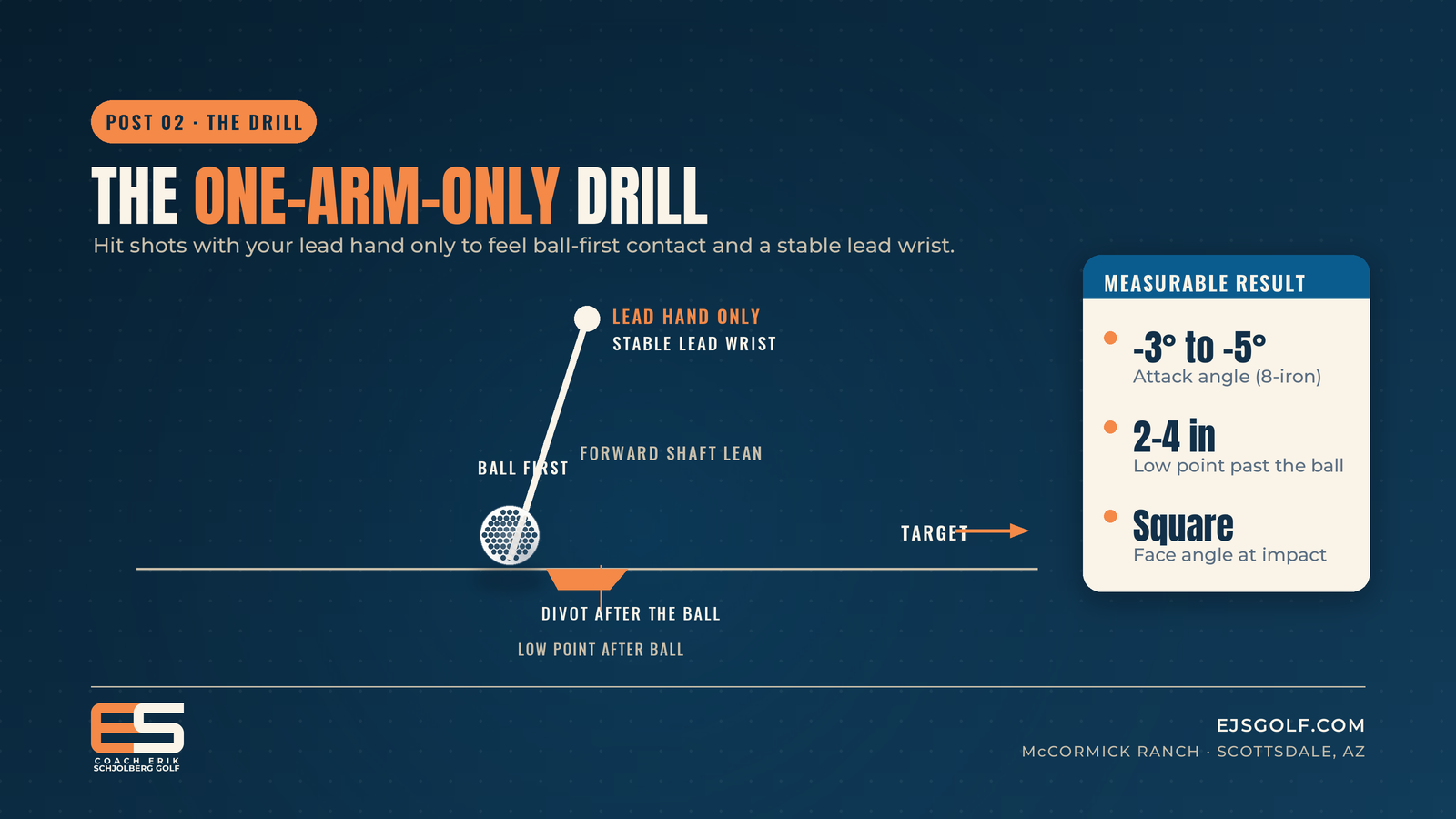
Many golfers struggle with inconsistent contact and an inability to control the club face. This often stems from a lack of awareness of how the lead arm and hand dictate the club's interaction with the ground and the ball. This drill is designed to isolate that feeling and build a more functional impact.
Setup:
Club: Start with a short iron (8-iron or 9-iron).
Stance: Take your normal address position, but only hold the club with your lead hand (left hand for right-handed golfers). Your trail arm should be folded across your chest or behind your back, completely out of the way.
Ball Position: Place the ball slightly forward of center, as you would for a normal iron shot.
Focus: Your primary focus is on maintaining a stable lead wrist and feeling the club head bottom out after the ball.
Execution:
Backswing: Make a compact backswing, focusing on keeping the club in front of your body and maintaining a relatively flat lead wrist. Avoid excessive wrist hinge or a cupping of the lead wrist.
Downswing: Initiate the downswing with your lower body, allowing the lead arm to fall naturally. The sensation should be one of the club dropping into position, not being pulled aggressively.
Impact: Focus on delivering the club face squarely to the ball, feeling the lead wrist remain relatively flat or slightly flexed. The goal is to hit the ball first, then take a divot after the ball. This confirms proper low point control and shaft lean.
Follow-Through: Allow the club to swing naturally to a short, balanced finish. The one-arm-only constraint will prevent you from over-swinging and force you to rely on proper body rotation and lead arm mechanics.
What the Golfer Should Feel:
Connection: A strong sense of connection between your lead arm and your torso throughout the swing.
Passive Release: The club head releasing naturally through impact, not being actively flipped or manipulated by the hand.
Ground Interaction: The club head brushing the turf after the ball, indicating a forward-leaning shaft and controlled low point.
Stable Lead Wrist: The lead wrist feeling firm and stable, not breaking down or extending through impact.
Feedback That Confirms Success:
Ball First, Then Turf: The most critical feedback. A clean strike where the ball is contacted before the ground.
Divot Location: A divot that starts just after the ball’s original position and points towards the target.
Ball Flight: A solid, penetrating ball flight with a predictable start line and controlled curvature. Shots that fly too high or too low, or with excessive slice/hook, indicate an issue with club face control or dynamic loft.
Sound: A crisp, solid sound at impact, indicating centeredness of contact.
Common Failures and How to Fix Them:
Hitting Behind the Ball (Fat Shots): This indicates the low point is too far behind the ball. Focus on initiating the downswing with the lower body and feeling the lead arm extend through impact, ensuring the club bottoms out forward. Ensure your weight is shifting to your lead side.
Topping the Ball: This suggests the low point is too far forward, or you’re lifting up through impact. Concentrate on maintaining your posture and allowing the club to naturally descend into the ball. The one-arm constraint will help prevent excessive lifting.
Open Club Face (Slice/Push): Often caused by an extended lead wrist or a lack of rotation through impact. Focus on keeping the lead wrist flat or slightly flexed and rotating your body fully through the shot.
Closed Club Face (Hook/Pull): Can be due to an overly flexed lead wrist or an aggressive, early release. Work on maintaining a stable lead wrist and allowing the club to release naturally with body rotation.
Measurable Result to Check:
Using a launch monitor like TrackMan, you should see:
Attack Angle: A slightly downward attack angle (e.g., -3 to -5 degrees with an 8-iron) indicating ball-first contact.
Dynamic Loft: A consistent dynamic loft that matches the club’s design loft, indicating proper shaft lean and club face control.
Low Point: The low point of the swing arc consistently positioned 2-4 inches past the ball.
Club Face Angle at Impact: A club face angle that is square to slightly open or closed relative to the target line, depending on your desired shot shape, but consistently close to zero for straight shots.
How I Would Practice This: Building Functional Impact
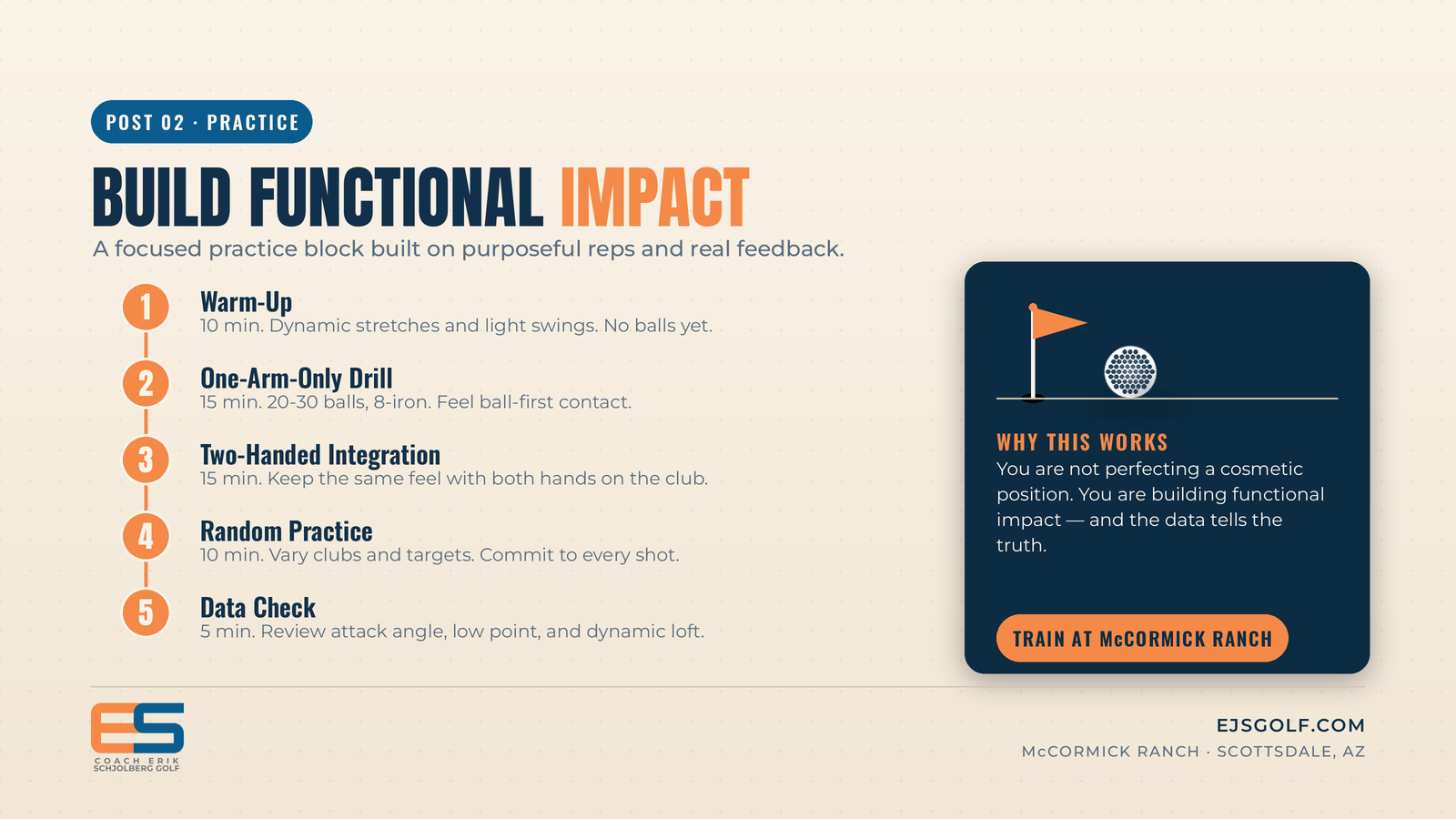
Effective practice isn't just about hitting balls; it's about purposeful repetition with clear intent and feedback. Here’s a protocol I would use to integrate the One-Arm-Only Impact Drill into your practice:
Warm-up (10 minutes): Start with dynamic stretches and light swings, focusing on body rotation and balance. No balls yet.
One-Arm-Only Impact Drill (15 minutes): Hit 20-30 balls with your 8-iron, focusing exclusively on the feel of ball-first contact and a stable lead wrist. Pay close attention to your divot pattern and initial ball flight. Don't worry about distance or direction initially; prioritize solid contact.
Two-Handed Integration (15 minutes): Transition to hitting balls with both hands, but maintain the same focus and feel from the one-arm drill. Hit 20-30 balls, gradually increasing swing speed. Monitor your ball flight and contact quality. If you lose the feel, revert to the one-arm drill for a few swings.
Random Practice (10 minutes): Hit 10-15 balls with different clubs (e.g., 7-iron, 5-iron, pitching wedge), varying targets and shot shapes. This helps transfer the skill from isolated practice to a more realistic on-course scenario. The goal is to maintain consistent low point and club face control across different clubs and situations.
Data Check (5 minutes): If you have access to a launch monitor, hit 5-10 balls and review your TrackMan data for attack angle, dynamic loft, and low point. Compare these numbers to your target values. This objective feedback is crucial for confirming progress and identifying areas for further refinement.
Remember, the goal is not to perfect a cosmetic position, but to build a functional impact. The data tells the truth. If your numbers are improving, your game will too.
The Myth of the Generic Golf Instructor: Why Specialization Matters
I often hear golfers lamenting that they’ve had many lessons but haven’t seen lasting improvement. This isn’t always a reflection of their effort; it’s often a symptom of generic instruction. The golf world is full of well-meaning instructors who teach a one-size-fits-all swing model, or who focus on superficial fixes rather than deep-seated mechanical issues. This approach fails because golf is complex, and every golfer is unique. There is no single perfect swing, only functional impact.
My approach, and what I believe distinguishes truly top golf instructors in Arizona, is a commitment to understanding the individual. I don't teach cosmetic positions; I teach cause and effect. If your ball is slicing, I don't just tell you to “keep your left arm straight.” I diagnose why your club face is open relative to your path at impact, and what body motion or matchup created that condition. Then, and only then, do I prescribe a specific, constraint-based drill designed to fix that root cause.
This specialization is crucial. Just as you wouldn't go to a general practitioner for complex heart surgery, you shouldn't expect a generic golf instructor to solve your deep-seated swing flaws. Look for instructors who:
Speak your language: They understand and can explain complex biomechanical concepts, D-Plane mechanics, and force plate data in a way that makes sense to you.
Focus on impact: Their entire coaching philosophy revolves around improving your impact conditions, not just your backswing aesthetics.
Utilize objective data: They don't rely on guesswork or subjective observation. They use technology to measure, diagnose, and confirm changes. This means they can show you, with undeniable evidence, how your swing is changing and how those changes are translating into better ball flight. Without this objective feedback, you're left to rely on feel, which often fades under pressure.
Embrace matchups: They recognize that your swing is unique and will work with your physical capabilities and tendencies, rather than forcing you into a rigid model. This means understanding how your grip, wrist angles, pressure shift, and release pattern all interact to create your unique impact conditions. They don't believe in a single “perfect” swing, but rather a functional impact that is unique to you.
When evaluating Scottsdale Golf Lessons, ask pointed questions about their diagnostic process, their use of technology, and their philosophy on individualizing instruction. A top golf instructor will welcome these questions and provide clear, data-backed answers. If they can't, or if they resort to vague platitudes, it's a red flag. Remember, your golf game is too important to entrust to guesswork. Seek out an instructor who is committed to measurable truth and who can help you understand the why behind your swing, not just the what.
The Science of Better Golf: A System, Not a Guess
The foundation of my coaching at EJS Golf is a systematic approach to improvement. It’s not about random tips or quick fixes; it’s about understanding the physics and biomechanics of the golf swing and applying that knowledge to your unique body and swing tendencies. This is what I call The Science of Better Golf. It’s a comprehensive system that encompasses:
Precise Diagnosis: Using advanced technology like TrackMan and HackMotion to measure impact conditions, club delivery, and body motion with pinpoint accuracy. This allows me to identify the exact root cause of your ball flight issues, rather than making assumptions.
Cause-and-Effect Understanding: Identifying the root cause of your swing flaws, not just treating the symptoms. We trace ball flight back to impact, impact back to club delivery, and club delivery back to body motion and matchups. This ensures that any changes we make are addressing the fundamental problem, leading to lasting improvement.
Targeted Intervention: Prescribing specific, constraint-based drills designed to address the root cause and create a new, more functional movement pattern. These drills are not generic; they are tailored to your specific needs and designed to provide immediate feedback, accelerating your learning process.
Measurable Confirmation: Using objective data to confirm that the intervention is working and that your impact conditions are improving. This feedback loop is crucial for building confidence and ensuring that you are on the right path. We don't rely on feel alone; we rely on data to validate progress.
This system is designed to produce fast, measurable change. It’s not about getting worse before you get better; it’s about improving from day one. When you understand the why behind your swing flaws, and you have a clear, data-backed plan to fix them, improvement becomes inevitable. My commitment is to help you become a ball-striking machine, capable of consistent, predictable ball flight under pressure.
Q&A: Evaluating Top Golf Instructors in Arizona
What is the most important factor to consider when choosing a golf instructor in Scottsdale?
The most critical factor is their focus on measurable outcomes and impact expertise. A top golf instructor will prioritize improving your ball flight and impact conditions over cosmetic swing changes. They should be able to clearly explain the cause-and-effect relationship between your swing mechanics and your ball flight, and they should use objective data (like TrackMan or HackMotion) to confirm improvement. Avoid instructors who rely solely on generic advice or who cannot provide measurable evidence of your progress. Look for an instructor who can articulate how they will measure your improvement and what specific metrics they will track to ensure you are progressing towards your goals
How important is technology in golf instruction?
Technology is essential, but it must be used correctly. It’s a powerful diagnostic and feedback tool, but it shouldn't replace the instructor's judgment. A top golf instructor will use technology to measure, diagnose, and confirm changes, not to dictate a generic swing model. They should be able to explain the data in a way that makes sense to you and use it to develop targeted, individualized practice plans. If an instructor uses technology merely as a showpiece, or if they can't explain how the data relates to your specific swing flaws, it's a red flag. The technology should empower you with understanding, not overwhelm you with numbers. It should be a tool that serves your improvement, not an end in itself.
What does it mean to teach from "impact backwards"?
Teaching from impact backwards means starting with the ultimate goal-functional impact-and working backward to identify the body motions and matchups that create it. It’s the opposite of starting with a generic swing model and trying to force the golfer into it. By understanding the club face and club path at impact, an instructor can diagnose the root cause of ball flight issues and prescribe specific, targeted interventions. This approach is far more effective than focusing on cosmetic positions or generic swing thoughts. It’s about understanding the physics of the golf swing and how your body interacts with the club to produce a desired ball flight. This is the only way to achieve lasting, predictable results.
Why do you say there is no single perfect swing?
Because every golfer is unique. We all have different body types, athletic capabilities, and natural tendencies. What works for one golfer may not work for another. The golf swing is a complex system of matchups-how your grip, wrist angles, pressure shift, and rotation interact. A top golf instructor understands this and will help you build a swing that optimizes your unique matchups for functional impact. Forcing a golfer into a generic model often leads to frustration, inconsistency, and even injury. My goal is to help you discover your most efficient and repeatable swing, not to mold you into someone else's ideal. The swing must fit the golfer, but impact must still be functional.
How quickly should I expect to see improvement from golf lessons?
You should expect to see measurable improvement from day one. If an instructor tells you that you have to get worse before you get better, they are likely teaching a generic swing model that doesn't fit your body or your natural tendencies. A top golf instructor will diagnose the root cause of your swing flaws and prescribe specific, constraint-based drills that produce immediate, measurable changes in your impact conditions and ball flight. While mastering a new movement pattern takes time and practice, the initial improvement should be evident immediately. My commitment is to ensure that every lesson provides you with actionable insights and tangible progress, so you leave feeling more confident and capable.
Related EJS Golf Reading
Scottsdale Golf Lessons: What to Expect from Data-Driven Coaching
Why I Don't Chase Golf Digest Rankings - And Why My Students' Handicaps Tell the Real Story
Master Low Point Control: Scottsdale Golf Lessons for Better Impact
The Science of Better Golf: Why Scottsdale's Most Serious Players Are Choosing Data Over Feel
Scottsdale Golf Lessons: Data-Driven Ball Striking Improvement
About Coach Erik Schjolberg
Coach Erik Schjolberg is a Scottsdale, Arizona-based professional golf coach and the founder of EJS Golf at McCormick Ranch Golf Club. He is a science-driven, no-nonsense instructor whose philosophy, The Science of Better Golf, focuses on teaching from impact and ball flight backward. Erik is known for producing fast, measurable change through correct diagnosis, clear cause-and-effect explanations, and drills that transfer quickly. He leverages cutting-edge technology like TrackMan, HackMotion, and force plates to provide objective data, ensuring his students achieve functional impact and become ball-striking machines. He rejects generic golf advice, prioritizing measurable truth over tradition to help golfers improve from day one.
Ready to Transform Your Game?
If you're serious about improving your golf game and are tired of generic advice, it's time to experience The Science of Better Golf. My approach is designed for golfers who demand measurable results and a deep understanding of their swing.
Whether you're struggling with inconsistent contact, unpredictable ball flight, or simply want to unlock your full potential, I can help. I offer personalized coaching that focuses on your unique matchups and provides the tools and knowledge you need to achieve lasting improvement.
If you want the full drill library I give every student, grab my free drills guide.
If you live in or visit Scottsdale, Arizona, you can book in-person Scottsdale Golf Lessons with me at McCormick Ranch.
Whether you train with me in person at my Scottsdale Golf Lessons studio or join my online golf lessons program from anywhere in the world, the system is the same - measurable, science-driven, immediate improvement.

What You Can Expect from Our Blog
1. Expert Insights on Swing Mechanics:
With over 25 years of experience as a PGA Professional Golf Instructor, I delve deep into the nuances of golf swing mechanics. My articles break down complex theories into understandable concepts, focusing on ground reaction forces (GRFs), biomechanics, and efficient energy transfer.
2. Advanced Technological Guidance:
Our academy is equipped with state-of-the-art tools like the Trackman 4 Launch Monitor, 3D Pressure Plates, and Hackmotion, among others. On the blog, I share how to leverage these technologies to gain precise feedback on your swing, helping you make informed adjustments and see measurable improvements.
3. Tailored Practice Routines:
My philosophy is built on the belief that improvement should be evident from the first lesson. I advocate a '15 minutes per day' practice model, designed to fit into your busy schedule while ensuring consistent progress. Each blog post aims to offer practice drills and routines that are easy to implement and effective in refining your skills.
4. Real Success Stories:
Read about the experiences of those who have trained at EJS Golf Academy. These testimonials not only inspire but also illustrate the practical application of our teaching methodologies and the real results achieved.
5. Interactive Learning:
We occasionally feature video tutorials and interactive content that allows you to visually grasp techniques and corrections. This blended approach helps reinforce learning and allows you to engage with the content actively.
How Our Blog Helps Golfers Get Better
Every post is crafted with the intent to educate. We cover everything from basic fundamentals to advanced techniques, ensuring there's something valuable for every skill level. By presenting data and evidence-backed strategies, our blog demystifies the 'why' and 'how' behind effective golf training. This analytical approach empowers you to make smarter decisions about your practice and play. We understand that generic advice does not suit everyone. Our blog posts are designed to help you identify your own needs and adapt our techniques accordingly. Whether it’s adjusting your grip, stance, or swing path, you’ll find personalized tips that resonate with your specific challenges. Beyond just reading, our blog serves as a community hub where you can interact with fellow golfers and share your experiences. This supportive environment encourages learning and improvement through collective wisdom.
Join Us on Your Path to Mastery
Whether you’re looking to refine your swing, understand the biomechanics of your body, or simply get more enjoyment out of the game, our blog at EJS Golf Academy is your go-to resource. Bookmark our page, subscribe to updates, and start transforming your game today.
Remember, at EJS Golf, we don’t just teach golf; we craft master golfers. Let’s begin this journey together. Visit us atEJSGolf.com to learn more about our programs and start your training online or at our Scottsdale location. Let’s make every swing count!
DO YOU HAVE QUESTIONS?
Fill out my contact form and I will respond to you within 24 hours.


phone: 480.861.9370 email: [email protected]

I've taken multiple private lessons with Erik and he's been by far the best swing coach I have ever worked with. He has the ability to dissect your swing and make small changes for big improvements. What I love most about his lessons is they go far beyond the 1 or 2 hours you're with him. He follows up with videos of how you can improve at home and on the range. The value he provides is absolutely worth the cost of his sessions. I would recommend any golfer at any level who truly wants to get better to go see Erik.”
- Reanol H.
Erik is the best! and that is not an exaggeration. There has not been a single lesson where I haven't walked out and felt like a far better golfer than before. What can't be praised enough is the effort and dedication that Eric puts into each of his students, as his approach to fixing and improving my golf swing was specific to me. While teaching, Erik takes the extra time to truly dive into what he is trying to convey rather than just telling you, allowing for a better understanding. Beyond the instruction at the course, Erik sends specific drills to you from an app that allows for slow motion replays, letting you break down everything and work on your game at any time. I genuinely mean it when I say that I would recommend Erik to anyone wanting to improve their golf game, as he is not only a top not instructor but also a top notch person who cares about his students.
- Brennan K.
Erik is flat out a great coach and mentor! I highly recommend him! Working from the ground up, my swing is healthier and smooth! I wanted a coach that shared the same main principles as the late Tony Manzoni and Erik hits the mark! Found Erik by listening to the Golf Smarter podcast by Fred Greene and connected with EJS Golf through the Perfect Motion app. Erik is motivated and incredibly gifted at his craft!
- Bryan B., Indiana, USA