Why Ball-First Contact Changes Everything About Your Iron Game | Scottsdale Golf Lessons
I am Coach Erik Schjolberg, and I run EJS Golf out of McCormick Ranch Golf Club in Scottsdale, Arizona. Every week I work with golfers who tell me their irons are "inconsistent," and when I put them on TrackMan, the story is always the same — their low point is behind the ball. They are hitting the ground before they ever reach the ball, adding loft, losing compression, and wondering why a seven iron flies the same distance as their playing partner's nine iron. The reason is not talent or athleticism, it is a fundamental misunderstanding of what the club head must do at impact. In this post, I am going to walk you through exactly what ball-first contact means, why it changes everything about your iron game, and what you need to change today to start compressing the ball the way it was designed to be compressed. This is The Science of Better Golf.
What Ball-First Contact Actually Means at Impact
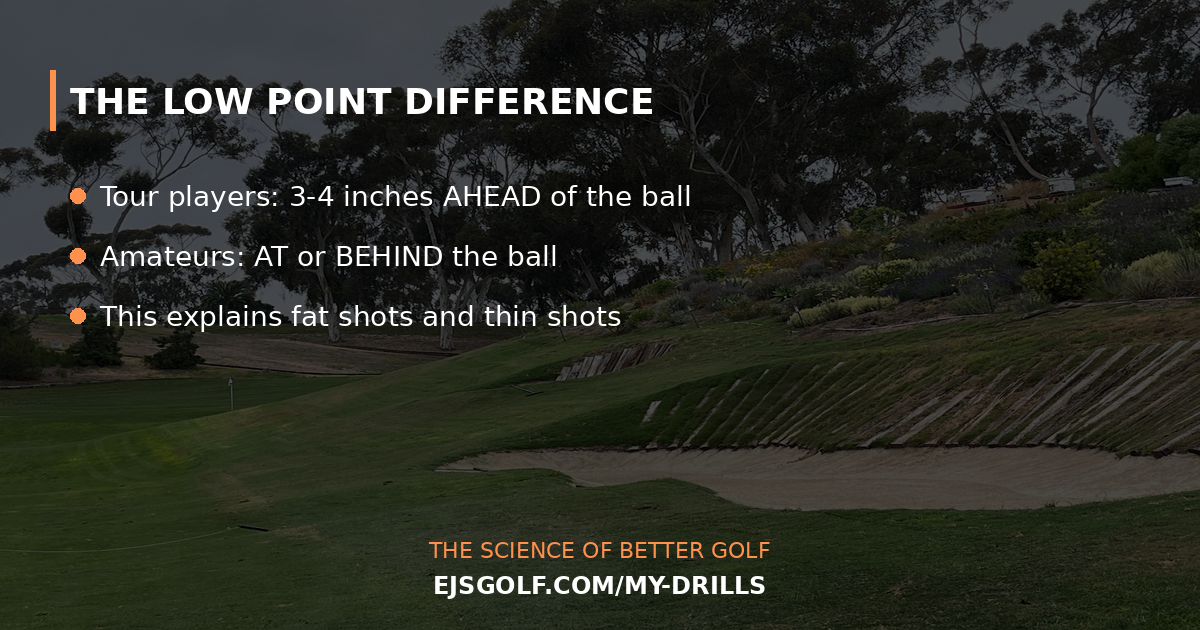
When I say ball-first contact, I am talking about a very specific event at impact that most golfers have never experienced consistently. The club head must reach the ball before it reaches the lowest point of its arc. That means the club face strikes the ball while the club head is still traveling on a slightly descending path, and the divot — if there is one — starts after the ball's position, not before it. On TrackMan, this shows up as a negative attack angle with irons, typically between negative two and negative five degrees for a mid-iron. It also shows up as a low point that is consistently two to four inches in front of the ball. When this happens, the hands are ahead of the club head at impact, the shaft is leaning forward, dynamic loft is lower than the static loft of the club, and the ball launches lower with more spin and more compression. That is where real distance control comes from — not from swinging harder, but from delivering the club correctly.
Most golfers do the opposite. Their low point is at the ball or behind it, which means the club head is either bottoming out too early or already traveling upward when it meets the ball. That is what produces fat shots, thin shots, and the kind of ballooning iron shots that lose ten yards in a headwind. The difference between a tour-caliber iron strike and an amateur iron strike is not club head speed. It is where the low point lives relative to the ball. When you understand that, you stop chasing speed and start chasing delivery — and that is where real improvement begins.
Why Your Low Point Is Behind the Ball
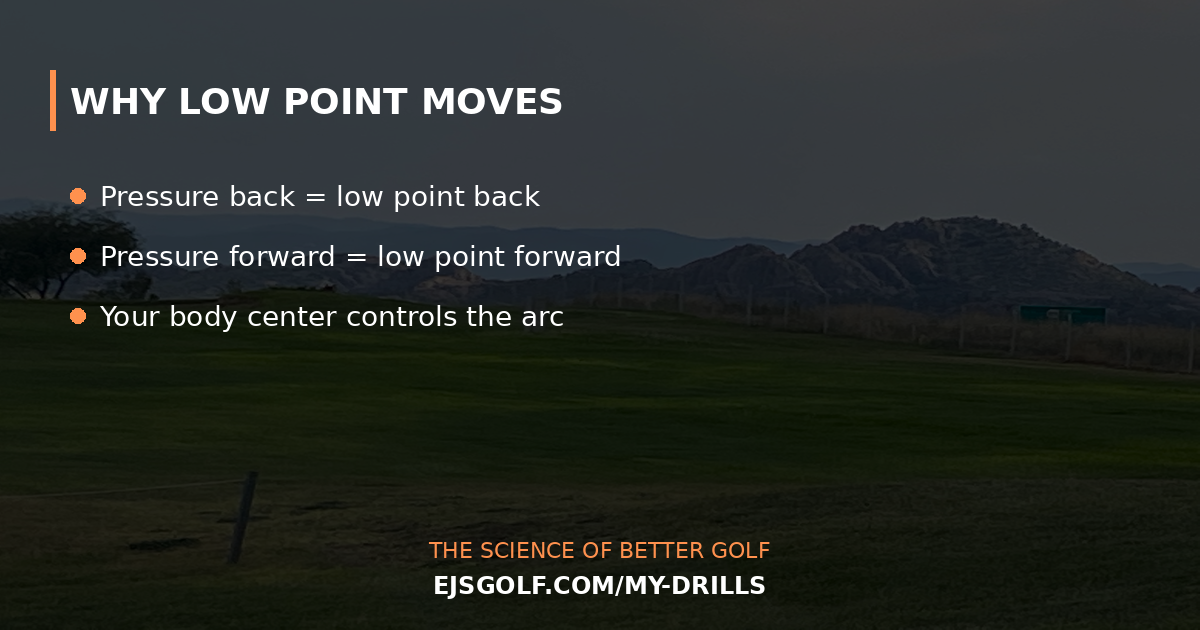
The most common cause of a low point that lives behind the ball is a pressure shift that never completes. At the start of the downswing, your pressure should be moving into the lead foot. By the time the club shaft is parallel to the ground in the downswing — what we call P6 — roughly 75 to 85 percent of your pressure should already be on the lead side. When that happens, your body is in a position to rotate through the ball with the hands leading the club head, the shaft leaning forward, and the low point displaced forward of the ball. But when your pressure stays on the trail foot at P6, your body has no choice but to stall, and the hands have to flip the club head past the hands just to make contact. That flip moves the low point backward, adds dynamic loft, removes compression, and creates the very strike pattern you are trying to eliminate.
This is not about a single "fundamental" that everyone must follow. This is about matchups. If your pressure stays on the trail side, then every other element of your downswing must compensate for that. The hands must add speed at the wrong time. The wrists must extend early to avoid burying the club into the ground behind the ball. The torso stops rotating because there is no stable lead side to rotate into. Dr. Sasho MacKenzie's research on force-driven models of the golf swing makes this clear — the swing is a chain of events where the proximal segments create the conditions for the distal segments. When the ground reaction forces are wrong, the entire chain breaks down. Your pressure shift is not just one piece of the puzzle. It is the piece that sets up every other piece.
I see this every single day in my Scottsdale golf lessons at McCormick Ranch. A golfer walks in hitting fat-thin, fat-thin, and they think the problem is their hands or their backswing. I put them on the force plates, and within two swings I can show them exactly what is happening — their vertical force peak is happening after impact instead of before it, their pressure is stuck at 60 percent trail side at P6, and their body is doing exactly what it must do to survive that position. The compensation is not the problem. The pressure pattern is the problem. Fix the cause and the compensations disappear on their own.
How a Backward Low Point Creates Your Miss Pattern
When the low point sits behind the ball, the ball flight tells you everything you need to know if you understand what you are looking at. A fat shot is the most obvious symptom — the club head reaches its lowest point before the ball, digs into the turf, and the ball goes nowhere. But the thin shot is just as connected to the same root cause. When your body senses that you are about to hit the ground too early, it makes a last-second correction by pulling the arms upward or extending the body to avoid the fat. That pulls the low point up, and now the leading edge of the club catches the ball at the equator. Fat and thin are not two different problems. They are two sides of the same coin, and that coin is a low point that lives in the wrong place.
On TrackMan, this shows up in several parameters simultaneously. Your attack angle will be neutral to positive with irons, which is the opposite of what you want. Your dynamic loft will be higher than the static loft of the club because the shaft is not leaning forward — it is vertical or leaning backward at impact. Your spin loft — the gap between your attack angle and your dynamic loft — will be too large, which means less compression, more spin of the wrong kind, and a ball that launches too high and lands too short. Your spin rate will be erratic because the strike location on the face is inconsistent. One shot catches the bottom groove and launches low with no spin. The next catches the top of the face and balloons into the air. There is no pattern because there is no consistent delivery.
This is why golfers who struggle with ball-first contact also struggle with distance gapping. If your seven iron can fly anywhere from 135 to 160 yards depending on the quality of the strike, you do not have a distance problem — you have a delivery problem. And the only way to solve it is to move the low point forward, which starts with the pressure shift I described in the section above. When the low point moves forward, the attack angle becomes consistently negative, the dynamic loft stabilizes, the spin loft narrows, compression increases, and suddenly every iron in the bag produces a predictable distance. That is what ball striking actually is — not power, but predictability built on correct impact conditions.
The Pressure Shift Drill That Fixes It on Day One
I do not believe in drills that make you worse before you get better. That is lazy coaching. If the drill is correct and the constraint is real, you should see a measurable change in your strike on the very first session. Here is the drill I use with my students every day in Scottsdale, and it works because it forces the body to shift pressure forward without requiring the golfer to think about twenty different swing positions.
Set up with a mid-iron — a seven or eight iron is ideal. Place the ball in the center of your stance as normal. Before you start your backswing, preset 60 percent of your pressure into your lead foot. You should feel the lead hip loaded and the lead thigh engaged. Now make a three-quarter backswing — do not make a full backswing on this drill. Your pressure will shift slightly to the trail side on the backswing, but because you started with more weight forward, you will not get stuck on the trail side. As you start the downswing, feel the pressure drive even harder into the lead foot. I want you to feel like you are pushing the ground away with your lead leg. By impact, I want 85 percent or more of your pressure on the lead side. Hit twenty balls this way. Do not worry about distance. Do not worry about direction at first. Pay attention only to where the club contacts the ground relative to the ball. You should start seeing divots that begin at the ball or slightly in front of it within the first five to ten swings.
What this drill does at the mechanical level is force your center of mass forward, which displaces the low point forward, which puts the hands ahead of the club head at impact naturally. You do not have to think about forward shaft lean. You do not have to think about holding lag. When the pressure is in the right place, the body organizes itself to deliver the club correctly. This is constraint-led coaching — the constraint is the preset pressure, and the body figures out the rest. On SportsBox AI, you should see your lead hip sway moving toward the target by P5, and your pelvis rotation increasing through impact because the lead side is stable. On HackMotion, you should see wrist extension decreasing at impact because the hands are leading rather than flipping. The data should confirm what the divot pattern already tells you — the low point has moved forward.
Using Technology to Verify Your Progress
If you have access to a launch monitor like TrackMan or Foresight, track three parameters after every range session where you practice this drill. First, watch your attack angle with irons. It should move from neutral or positive to negative — somewhere between negative two and negative four degrees is the target for a mid-iron. Second, watch your dynamic loft. It should decrease by two to four degrees compared to your old pattern because the shaft is leaning forward at impact instead of leaning backward. Third, watch your spin loft. As attack angle improves and dynamic loft decreases, spin loft narrows, and that means more compression and more consistent distance control. If you have pressure plates or force plates in your facility, look at the timing of your vertical force peak — it should occur just before impact, not after it. That is the signature of a golfer who is using ground reaction forces correctly.
For golfers without technology, use a simple visual check at the range. Place a tee in the ground one inch in front of your ball. Your goal is to hit the ball and then clip the tee with the bottom of your swing arc. If you are clipping the tee consistently, your low point is in front of the ball and you are making ball-first contact. If you are missing the tee, your low point is still behind the ball and you need more reps with the pressure preset drill. This is a free, immediate feedback loop that any golfer can use on any range in the world.
Common Mistakes That Keep Your Low Point Behind the Ball
The first mistake golfers make when trying to achieve ball-first contact is trying to hit down on the ball with their arms. They have heard the phrase "hit down to make the ball go up," and they interpret that as a steep, chopping motion driven by the hands and arms pulling the club into the ground. This is wrong and it creates a new set of problems. When you drive the club downward with your arms without shifting your pressure forward, you steepen the shaft, increase the angle of attack beyond what is productive, and dig deep divots that point left of the target. The low point might technically be at the ball, but the delivery is so steep that you lose all the benefits of ball-first contact — low spin loft, controlled trajectory, and predictable distance. The downward strike must come from the body being in the right position, not from the arms forcing a downward blow.
The second mistake is sliding the hips laterally instead of rotating. When I tell a golfer to get their pressure into the lead foot, some of them interpret that as a lateral slide toward the target. The hips move laterally five or six inches past the ball, and now the body is ahead of the club, the face is wide open, and every shot pushes right or, if they flip the hands to save it, hooks left. The pressure shift is a rotational movement, not a lateral one. The lead hip shifts slightly toward the target in transition and then rotates open. On SportsBox AI, I am looking for pelvis sway of about two to three inches toward the target, combined with 35 to 45 degrees of pelvis rotation at impact. If the sway is excessive and the rotation is minimal, you have a slide, not a shift.
The third mistake is trying to keep the head perfectly still. This old piece of advice has done more damage to amateur golfers than almost anything else in the game. When you try to keep your head perfectly still, you prevent your body from shifting pressure forward naturally. The head should move slightly toward the target in the downswing — one to two inches — as the body rotates and the pressure shifts. Locking the head in place forces the low point to stay where it started, which is behind the ball. Let the head move with the body. Your eyes will track the ball just fine. The ball is not moving. It will be there when the club arrives.
Frequently Asked Questions About Ball-First Contact
Does ball-first contact apply to all skill levels, or is this only for advanced golfers?
Ball-first contact applies to every golfer who uses irons, regardless of handicap or experience level. The physics of how a golf club is designed to interact with the ball and the turf do not change based on your skill level. A lofted iron is designed to be delivered with the shaft leaning forward and the hands ahead of the club head. When any golfer achieves this, they compress the ball better, control their distances more precisely, and eliminate the fat-thin cycle that plagues the majority of recreational players. I have students who come to me as complete beginners and I teach them ball-first contact from day one because it is not an advanced skill — it is the correct way to use the tool.
How quickly should I see results with the pressure shift drill?
You should see a measurable change in your divot pattern within the first twenty swings. I am not being optimistic or exaggerating. When you preset 60 percent of your pressure into the lead foot and then drive it forward in the downswing, the low point physically cannot stay behind the ball the way it does when you are stuck on the trail foot. The body follows the pressure. If you are not seeing any change after twenty swings, you are likely not committing to the preset — you are reverting to your old pattern on the downswing. Record yourself on video from face-on and check whether your pressure is actually moving forward or whether you are pulling back to the trail side in transition.
I have always been told to "keep my head down" and "stay behind the ball." Is that wrong?
"Keep your head down" is one of the most harmful pieces of advice in golf instruction. It encourages you to lock your upper body in place, which prevents the pressure from shifting to the lead side and keeps the low point behind the ball. You should absolutely keep your eyes on the ball through impact, but your head can and should move slightly toward the target — about one to two inches — as your body rotates through. "Stay behind the ball" has some merit with the driver, where you want an ascending attack angle, but with irons it is counterproductive because you need the body ahead of the ball to move the low point forward.
Will ball-first contact help me hit the ball farther with my irons?
Yes, and the reason is spin loft. When your low point is behind the ball, your dynamic loft is too high and your spin loft is too wide. That means you are using more of the club's loft than intended, launching the ball too high, and losing compression. When you achieve ball-first contact, the shaft leans forward, dynamic loft decreases, spin loft narrows, and you get a more penetrating ball flight that carries farther and rolls out with better control. Most of my students in Scottsdale golf lessons gain 10 to 15 yards per iron within the first month simply by improving their low point. They are not swinging any faster. They are just delivering the club the way it was designed to be delivered.
Can I practice ball-first contact at home without a range?
Absolutely. You can practice the pressure preset in your living room with no club at all. Stand in your setup position, preset 60 percent of your weight into your lead foot, then rehearse a slow-motion downswing while driving that pressure even further into the lead foot. Feel the lead hip rotate open while the pressure stays loaded. Do this fifty times a day. When you get to the range, the pattern will already feel familiar because your body has rehearsed the movement. You can also use a doorframe for resistance — push your lead hand against the frame at hip height and feel the ground pressure increase in your lead foot. That is the sensation of ground reaction forces loading into the lead side.
What is the difference between ball-first contact and just taking a divot?
Taking a divot does not guarantee ball-first contact. A golfer can take a massive divot that starts three inches behind the ball — that is a fat shot with a divot. Ball-first contact specifically means the club face meets the ball before the club reaches the bottom of its arc. The divot, if there is one, starts at the ball position or slightly in front of it. On TrackMan, this correlates directly with a negative attack angle and a low point that is forward of the ball. So the quality of the divot matters more than the existence of the divot. A thin, shallow divot that starts at the ball is infinitely better than a deep, chunky divot that starts behind it.
How does ball-first contact change with different irons — short irons versus long irons?
The principle is the same across all irons, but the magnitude changes slightly. With a pitching wedge or short iron, the ball is positioned in the center of your stance, and the attack angle will naturally be steeper — perhaps negative four to negative six degrees. With a five iron, the ball is slightly forward of center, and the attack angle is shallower — perhaps negative one to negative three degrees. The low point is still in front of the ball in both cases, but the degree of shaft lean and the depth of the descending blow vary. The pressure shift works the same way regardless of the iron. What changes is ball position, which naturally adjusts the attack angle without requiring you to think about it.
The Real Key to Becoming a Ball Striking Machine
Ball-first contact is not a secret and it is not complicated, but it does require you to stop doing the things that prevent it from happening. Stop trying to scoop the ball into the air. Stop keeping your head locked in place. Stop sliding your hips without rotating. Start shifting your pressure into the lead foot before impact, and let the body organize itself around that correct pressure pattern. The low point moves forward. The shaft leans forward. Compression happens naturally. Distance control becomes predictable. And suddenly you are not a golfer who "sometimes hits it well" — you are a ball striking machine who delivers the club the same way every time.
If you are in the Scottsdale area, I invite you to come work with me at McCormick Ranch Golf Club. I use TrackMan, force plates, SportsBox AI, and HackMotion to show you exactly what is happening in your swing and exactly what needs to change. We do not guess. We measure, we fix the root cause, and you see improvement on day one. If you are not local, I offer online golf lessons worldwide where we analyze your swing on video and build a custom plan to get your low point forward and your ball striking consistent. Either way, stop accepting inconsistency as normal. It is not normal. It is a solvable problem, and the solution starts with ball-first contact.
Get my full drills guide by clicking on the link. Read more on my blog here. And learn more about my coaching approach at EJS Golf.
About Coach Erik Schjolberg
Coach Erik Schjolberg is a PGA Professional and founder of EJS Golf, offering Scottsdale golf lessons at McCormick Ranch Golf Club and online golf coaching worldwide. His data-driven approach focuses on biomechanics and "The Science of Better Golf."
Ready to Improve Your Golf Game?
Get my free drills guide: EJSGolf.com/my-drills
Follow me on: Instagram


