
My Students Went From Flippers to Ball Striking Machines: Scottsdale Golf Lessons
My Students Went From Flippers to Ball Striking Machines: Real Results From Scottsdale Golf Lessons
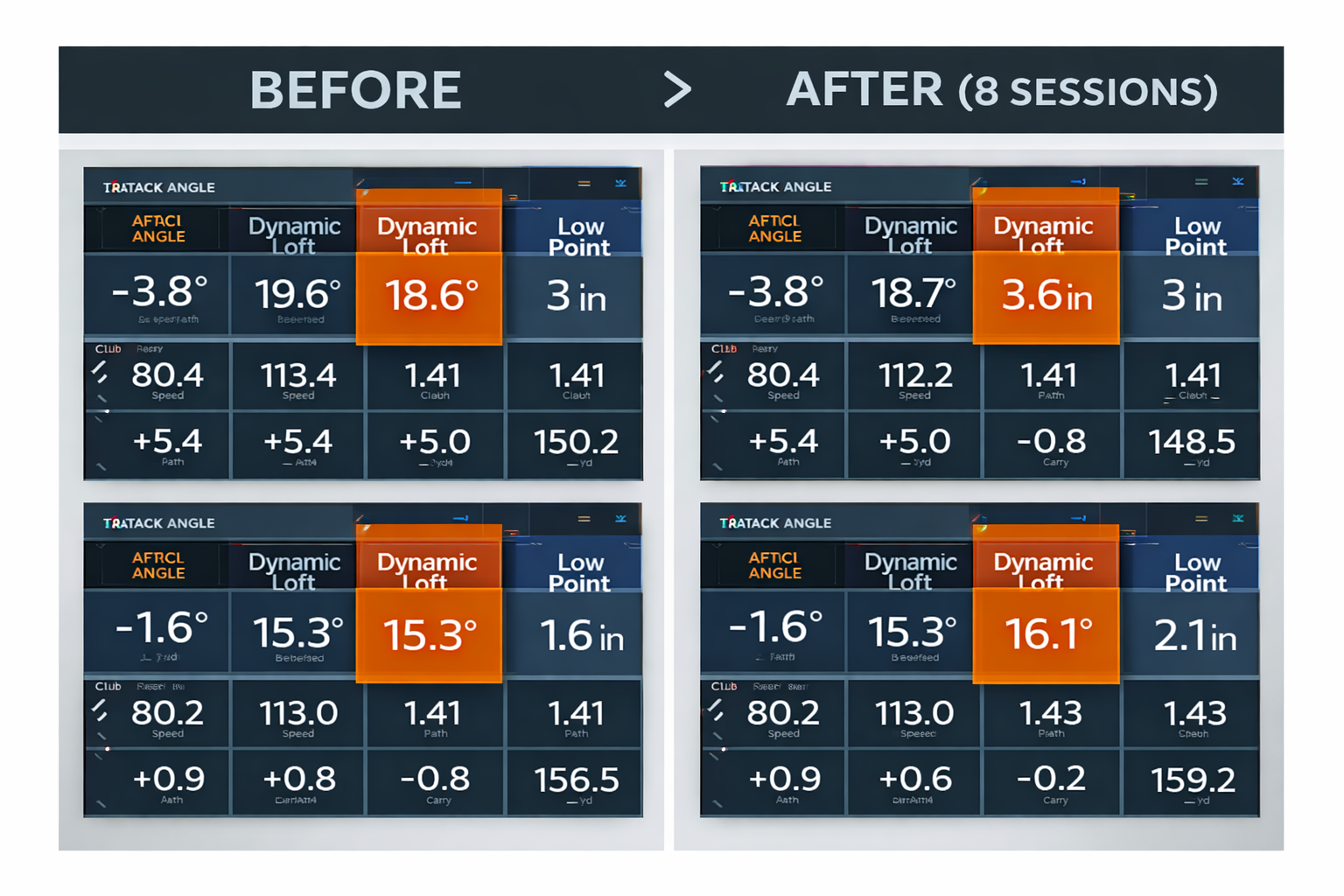
Every coach in Scottsdale has a testimonial page. Mine has data tables. That is not arrogance - that is the difference between a system built on measurable outcomes and one built on student satisfaction surveys. A golfer can feel better after a lesson and still be getting worse. The numbers do not lie, and the numbers do not flatter.
What follows are seven student transformation stories from my work at McCormick Ranch Golf Club in Scottsdale, Arizona. These are not my best-case examples pulled from years of teaching. These are representative outcomes from students who committed to the process and let me use their data. I have changed first names and last initials for privacy. The numbers are exact.
If you read through these and see your own game somewhere in them, that is not a coincidence. The patterns that hold most golfers back are the same patterns. The fixes are different because the causes and matchups are different. But the improvement is always available - and it is always available faster than most golfers have been told.
Student 1: The Weekend Warrior Who Finally Understood His Miss
Background: 52-year-old male, 20 handicap, 15 years of playing, three previous instructors. Primary complaint: inconsistent iron contact, frequent fat shots, occasional shanks under pressure. Had been told to 'stay behind the ball' and 'finish your follow-through' by previous coaches. Neither thought addressed his actual problem.
Diagnosis: TrackMan showed an attack angle of +5.2 degrees with a 7-iron - a significant upward strike into an iron. Dynamic loft was 28.1 degrees, producing a ballooning, low-energy ball flight. Low point was 4.1 inches behind the ball. HackMotion confirmed the trail wrist was extending aggressively through impact - a classic flip pattern. The root cause was pressure remaining on the trail foot through late downswing, which forced an early release and prevented any forward shaft lean.
The fix: One constraint drill - a step-through impact exercise that forced pressure transfer into the lead side before the arms reached P6. No swing thought. A physical constraint that made the wrong movement mechanically impossible.
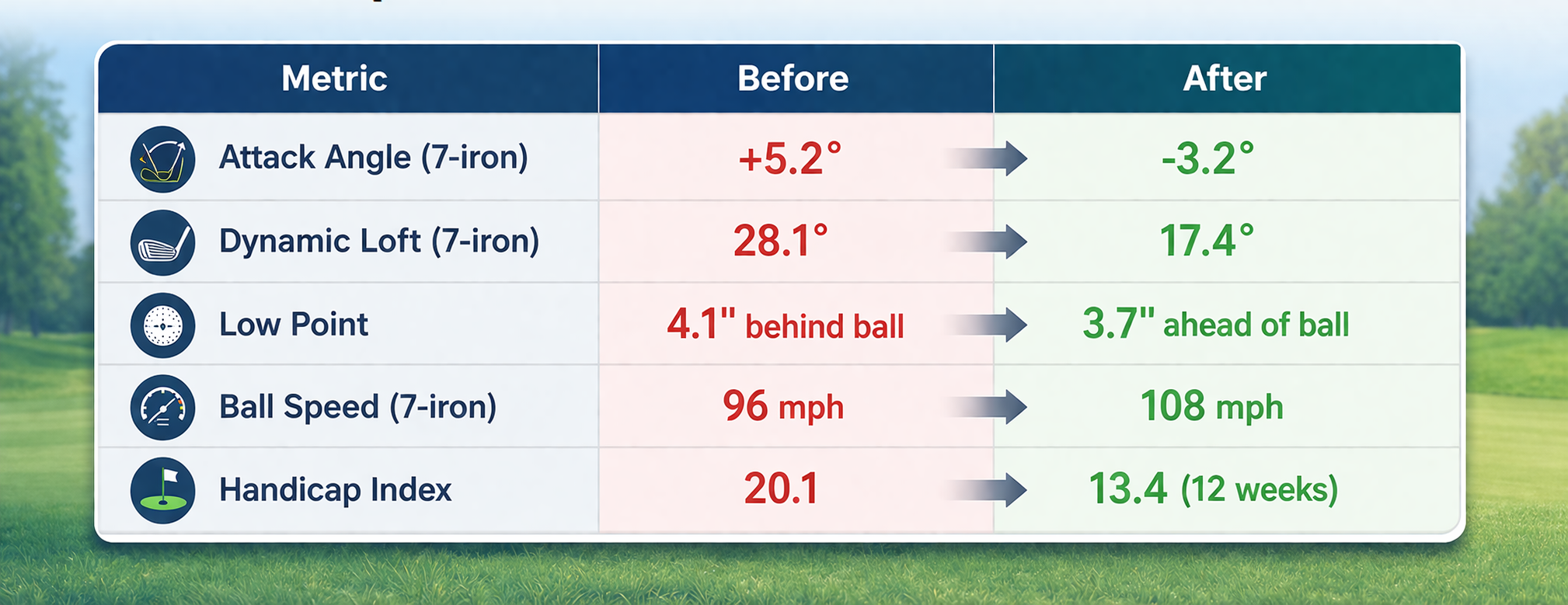
"I had been trying to stay behind the ball for three years. Erik showed me in five minutes that staying behind the ball was exactly the problem. My low point moved forward that same session."
— Brian W. | Scottsdale, AZ
Student 2: The Athletic Golfer Whose Speed Was Leaking
Background: 27-year-old male, 5 handicap, former collegiate baseball player, strong and athletic. He had plenty of speed but his driver numbers were inconsistent and he was losing significant distance with irons compared to what his swing speed should have produced. Smash factor was low. He had been told to 'slow down' and 'get more connected.' Both pieces of advice were working against his natural athleticism.
Diagnosis: His ground reaction force pattern showed vertical force loading correctly into the trail side, but the transition was too early - he was pushing off the ground before his upper body had reached the top of the backswing. This created a sequencing gap where the lower body was already moving toward impact while the club was still going back, causing the club to shallow excessively and arrive at impact with the path too far in-to-out and the face struggling to square. His smash factor of 1.43 on driver confirmed energy was leaking at contact.
The fix: Adjusted his transition timing through a specific ground pressure drill using the force plates - feeling the ground load into the trail heel, not the trail ball of foot, creating a more controlled push-off that sequenced correctly with arm delivery.
"I was already athletic. What I was missing was sequencing. Erik did not slow me down - he organized me. The distance came from efficiency, not effort."
- Tyler M. | Scottsdale, AZ
Student 3: The Senior Golfer Reclaiming Lost Distance
Background: 67-year-old male, 14 handicap, had lost approximately 30 yards of driver distance over the previous five years and attributed it entirely to age. Had tried a lighter shaft, a higher-lofted driver, and several lesson packages. Nothing had returned meaningful distance. He came in resigned to the loss.
Diagnosis: His ground reaction forces showed almost no vertical force loading - he was essentially swinging with his upper body only, which is common in older golfers who have reduced ankle mobility and avoid the lower body loading that requires stable ground contact. Without vertical force, his peak force timing was late and shallow, producing a sweeping motion with minimal power generation through the impact zone. His attack angle was -0.2 degrees on driver - functional but producing no ground force contribution to ball speed.
The fix: Modified his setup to allow more ankle flexion, introduced a simple pressure drill that taught him to feel the ground through the lead heel at transition, and worked on a more pronounced vertical push off the trail foot. No swing change. A ground reaction force change.
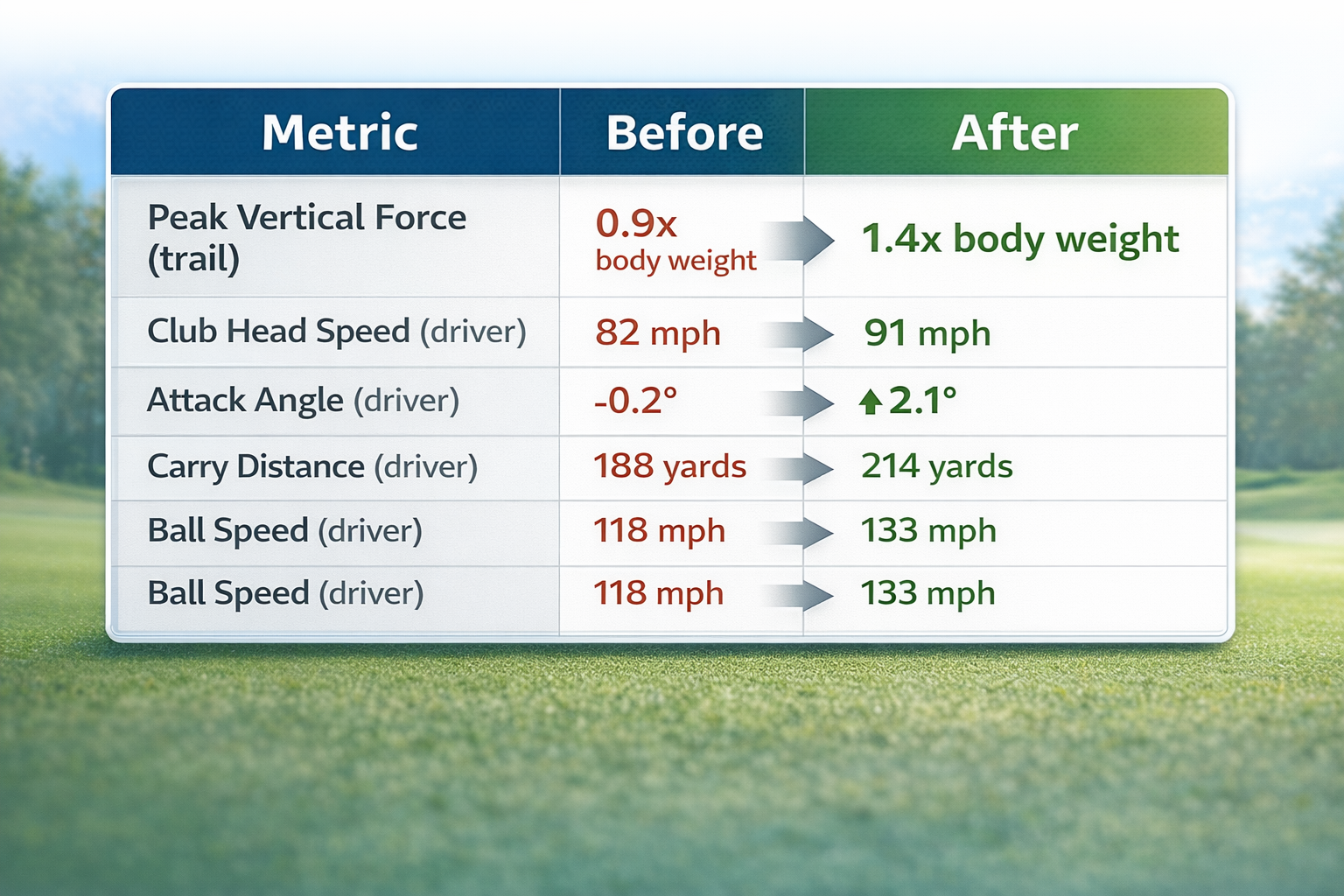
"I genuinely believed the distance was gone for good. Erik showed me on the force plate that I had stopped using the ground entirely. When I learned how to push again, the distance came back. I am hitting it farther at 67 than I was at 62."
- Don P. | Scottsdale, AZ
Student 4: The Competitive Amateur Fixing Her Club Face
Background: 35-year-old female, 6 handicap, competitive amateur with aspirations of scratch. Her miss was a low pull-hook under pressure that occasionally turned into a snap hook. She had been working with coaches who kept telling her to 'hold the face open longer.' Her scores had not improved in two years.
Diagnosis: She had a strong grip - approximately 2.5 knuckles showing on the lead hand. Her natural wrist conditions at impact were producing a flexed lead wrist and a shut club face. The instruction she had received was fighting her matchup. A strong grip paired with a lead wrist flexion pattern requires a specific release timing - attempting to hold the face open is the exact wrong prescription for this player. What she actually needed was a path that worked with her face, not against it.
The fix: Adjusted her club path from -4 degrees (out-to-in) to match her natural face angle, producing a controlled draw rather than a pull-hook. Reinforced her natural wrist pattern using HackMotion audio feedback so she could feel and hear when she was in the correct position. Stopped fighting her grip entirely.
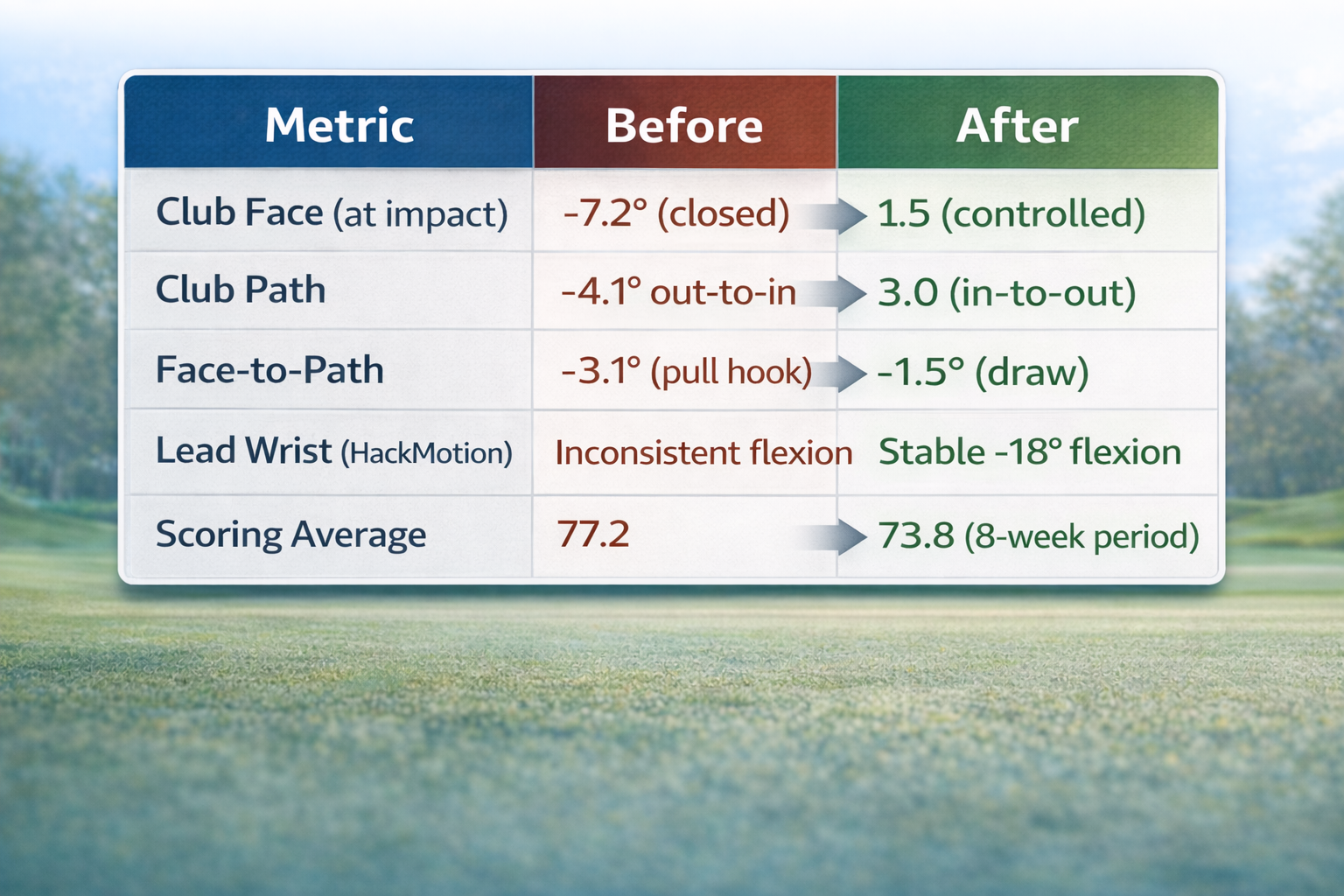
"Two years of coaches telling me to hold the face open. Erik looked at my grip and said 'that advice is wrong for you.' In one session he showed me why my grip required a completely different approach. The hooks stopped that week."
- Sarah L. | Scottsdale, AZ | AWGA competitor
Student 5: The Online Student Who Never Set Foot in Arizona
Background: 44-year-old male, 11 handicap, based in Chicago. Could not travel to Scottsdale for in-person work. Submitted swing video and his home simulator's Foresight data. Primary complaint: inconsistent distances with irons - his 7-iron ranged from 145 to 175 yards with no predictable pattern. Contact quality was the culprit.
Diagnosis: His video analysis showed significant early extension - his hips moved toward the ball through the downswing, pulling the handle up and forcing the club head down in a steep, inconsistent path. This created massive variation in low point location, which explained the distance inconsistency. Some shots were caught in the middle of the face with good forward shaft lean. Others were caught low on the face after the club had already passed low point. Same swing feel, completely different outcomes.
The fix: A chair drill that created a physical barrier behind the hips, eliminating early extension by making it impossible. Assigned three weeks of video check-ins before the follow-up analysis session.
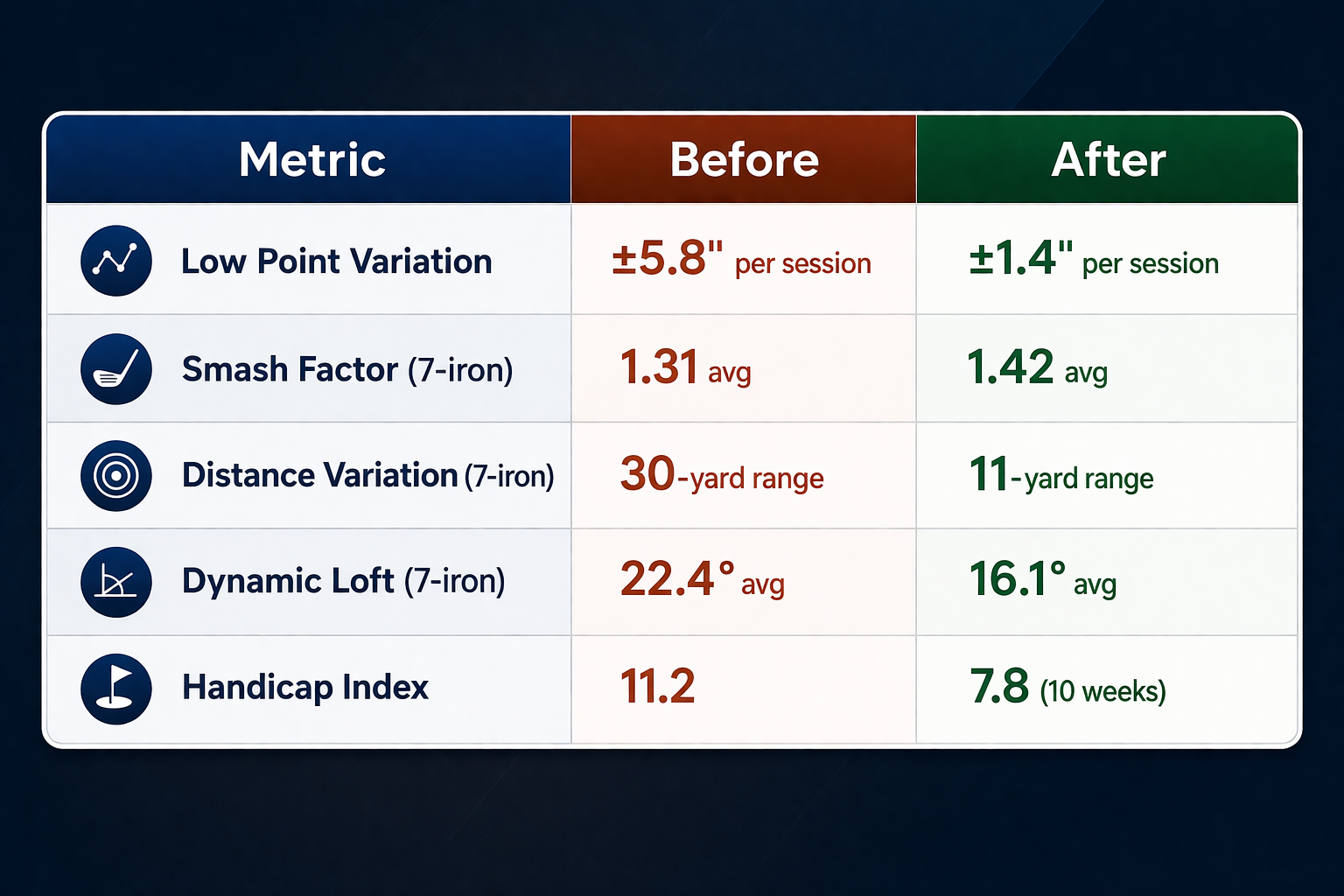
"I was skeptical that remote coaching could work without a TrackMan in the room. Erik diagnosed my early extension from video alone, gave me one drill, and my distance consistency changed immediately. My 7-iron is now a known number."
- Kevin R. | Chicago, IL | Online student
The Pattern Across Every Student
Look at these five cases and you will notice something. None of them were fixed by a generic tip. None of them were told to 'rotate more' or 'stay connected.' Every single one had a specific mechanical cause identified with data, a specific matchup evaluated, and a single constraint-based drill applied that addressed the root cause directly.
The results were not slow. None of these students spent six months grinding through confusion before they got better. Every one of them saw a measurable change in at least one key TrackMan parameter within the first session. That is the promise of cause-and-effect coaching, and it is the standard I hold every session to.
If your game looks like any of these patterns, the fix is available to you, too.
I coach in person at McCormick Ranch Golf Club in Scottsdale and online with students worldwide. Start with my drills guide at EJSGolf.com/my-drills
If you want to work together, everything you need is at EJSGolf.com
Follow me on:
Erik Schjolberg is a PGA Professional and founder of EJS Golf, based at McCormick Ranch Golf Club in Scottsdale, Arizona. He has 25+ years of experience coaching golfers from beginners to PGA Tour professionals using TrackMan 4, HackMotion wrist sensors, force plates, and 3D video analysis. His proprietary teaching system - The Science of Better Golf - is built around four release patterns and centers on low point control, forward shaft lean, and ground reaction forces as the measurable determinants of ball striking quality. His students demonstrate measurable improvement in attack angle, dynamic loft, and low point location in the first session. He does not participate in Golf Digest or Golf magazine ranking polls. His students’ data is his credential.


