HackMotion and Wrist Angles in the Golf Swing: What Sensor Data Reveals That Video Misses
HackMotion and Wrist Angles in the Golf Swing: What Sensor Data Reveals That Video Misses
High-speed video has transformed golf instruction over the past two decades. Being able to see what is happening at 500 or 1,000 frames per second has revealed movement patterns that were completely invisible to the naked eye and confirmed things that great instructors had suspected but could never prove visually. Video is essential. Video is also incomplete.
The specific thing video struggles to capture is wrist angle. The wrists are small joints that move in three planes simultaneously - flexion and extension, radial and ulnar deviation, and rotation. At impact, the club head is traveling at 80 to 120 miles per hour, and the wrist conditions at that exact moment determine the club face angle, the dynamic loft, and whether the shaft is leaning forward or backward. A high-speed camera can give you a general impression of wrist position. It cannot give you a precise angle. It especially cannot give you precise angles during practice in real time.
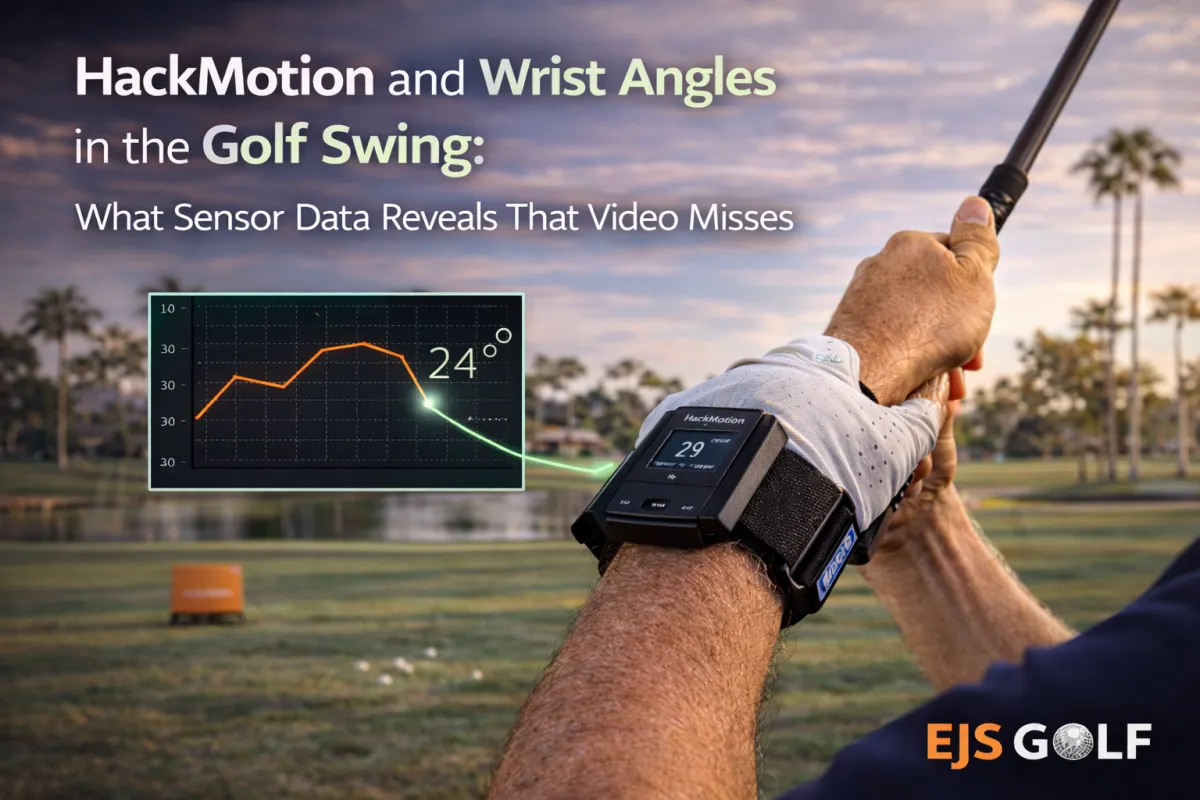
HackMotion does. It is a small sensor that clips to the lead glove and wirelessly transmits lead wrist flexion, extension, and ulnar/radial deviation data in real time to a connected device. I use it at EJS Golf in Scottsdale for every student who has an impact condition that traces to wrist behavior - which is the majority of students.
What the Wrists Do at Impact and Why It Matters
The lead wrist at impact is the primary gatekeeper of the club face. In the simplest terms: a lead wrist that is flexed (bowed) at impact closes the club face relative to the swing plane. A lead wrist that is extended (cupped) at impact opens the club face. The relationship is direct and measurable.
This is not a new observation - instructors have talked about the flat or bowed lead wrist for years. What HackMotion adds is precision. 'Flat wrist at impact' is a visual category. Minus 18 degrees of flexion at P7 is a number. The difference between minus 18 degrees and minus 8 degrees can be visually indistinguishable in video but produces a measurable difference in club face angle and dynamic loft at impact.
The trail wrist tells a related but different story. A trail wrist that maintains flexion (maintains the angle formed between the forearm and the back of the hand) through impact keeps the club head behind the hands - preserving shaft lean and forward low point. A trail wrist that extends through impact is the flip pattern: the club head passes the hands before impact, dynamic loft inflates, and low point moves behind the ball. The trail wrist extension pattern is one of the most common impact issues I diagnose in Scottsdale students, and HackMotion identifies it in seconds.
What Video Misses That HackMotion Catches
Here is a specific example that illustrates the difference. I had a student in Scottsdale - a 7 handicap, good athlete, consistent ball striker with one persistent problem: under pressure, his ball flight would suddenly go low and left with a hook. He had been told by previous coaches that he was 'over-rotating' or 'releasing too early.' Video could not pinpoint the exact cause because the swing looked functionally correct at normal speed and even at 240 fps.
HackMotion showed that his lead wrist was at minus 22 degrees of flexion in his normal swings - a strong, flexed position that matched his strong grip and produced a controlled draw. Under pressure, his lead wrist flexion increased to minus 31 degrees. Nine degrees of additional flexion that video could not see - but that was enough to close his club face an additional 4 to 5 degrees at impact, turning his controlled draw into a hook.
The fix was not a swing change. It was a HackMotion audio training session where he practiced keeping his lead wrist at a consistent minus 20 to minus 22 degree range through impact, with the audio feedback beeping when he entered the correct zone and going silent when he went beyond it. Within three sessions, the pressure hook had disappeared - because the cause had been identified with precision and addressed with precision.
Video would never have found that. Video showed a player making a visually similar swing in both situations. The number told the truth.
The Grip-Wrist Matchup: Why There Is No Universal Target
One of the most important things HackMotion has confirmed in my teaching is that there is no universal correct wrist angle at impact. The correct lead wrist angle is the one that, combined with your grip strength, produces a neutral club face for your intended shot shape.
Here is the relationship. A strong grip (more knuckles showing on the lead hand) pre-closes the club face at setup. To deliver that pre-closed face to a neutral position at impact requires the lead wrist to be in less flexion than it was at setup - meaning the grip has already done some of the closing work. If a strong grip player also adds significant wrist flexion through impact, the face is over-closed and the result is a hook.
A weak grip (fewer knuckles showing) pre-opens the club face at setup. To close that face to neutral at impact requires more lead wrist flexion than a strong grip player would need. If a weak grip player is told to 'maintain a flat lead wrist' - a common instruction - they will arrive at impact with an open face and produce a fade or push.
HackMotion data lets me measure each player's exact grip-wrist relationship and determine the target wrist angle for their specific matchup. That number becomes their personal training target - the one number they are trying to reproduce consistently. When they hit that number, the ball goes where they intend. When they deviate from it, HackMotion tells them immediately.
HackMotion in Practice: How I Use It in Scottsdale Sessions
In a typical lesson session at McCormick Ranch Golf Club in Scottsdale, I use HackMotion in three phases. First, in the diagnostic phase, I use it to measure the student's wrist angles at P6, P7, and P8 during their baseline swings. I am looking for the specific deviation from target - too much extension, too much flexion, or inconsistency between swings.
Second, in the intervention phase, I use HackMotion's real-time audio feedback mode. I set a target range for the lead wrist angle at P7 and the device beeps when the student enters that range. This gives immediate, swing-by-swing feedback without requiring the student to look at a screen between shots. The audio is processed by the brain faster than visual feedback, which accelerates the learning curve significantly.
Third, in the confirmation phase, I cross-reference the HackMotion improvements with TrackMan. When the wrist angle reaches target, the TrackMan numbers confirm it: dynamic loft drops, attack angle normalizes, ball speed goes up. The two data systems tell the same story from different angles, and that cross-confirmation is what makes the student confident that the change is real.
Get the full wrist angle drill guide - including target angles for different grip positions and the HackMotion training protocol I use in Scottsdale - at EJSGolf.com/my-drills
"I always thought my flip was a timing issue. HackMotion showed me it was a wrist angle issue — my trail wrist was extending 8 degrees earlier than it should have been. Once I saw the exact number, the fix was obvious. My dynamic loft dropped 6 degrees in two sessions."
— Chris V. | Scottsdale, AZ
More Resources:
Follow me on:
Erik Schjolberg is a PGA Professional and founder of EJS Golf, based at McCormick Ranch Golf Club in Scottsdale, Arizona. He has 25+ years of experience coaching golfers from beginners to PGA Tour professionals using TrackMan 4, HackMotion wrist sensors, force plates, and 3D video analysis. His proprietary teaching system - The Science of Better Golf - is built around four release patterns and centers on low point control, forward shaft lean, and ground reaction forces as the measurable determinants of ball striking quality. His students demonstrate measurable improvement in attack angle, dynamic loft, and low point location in the first session. He does not participate in Golf Digest or Golf magazine ranking polls. His students’ data is his credential.


