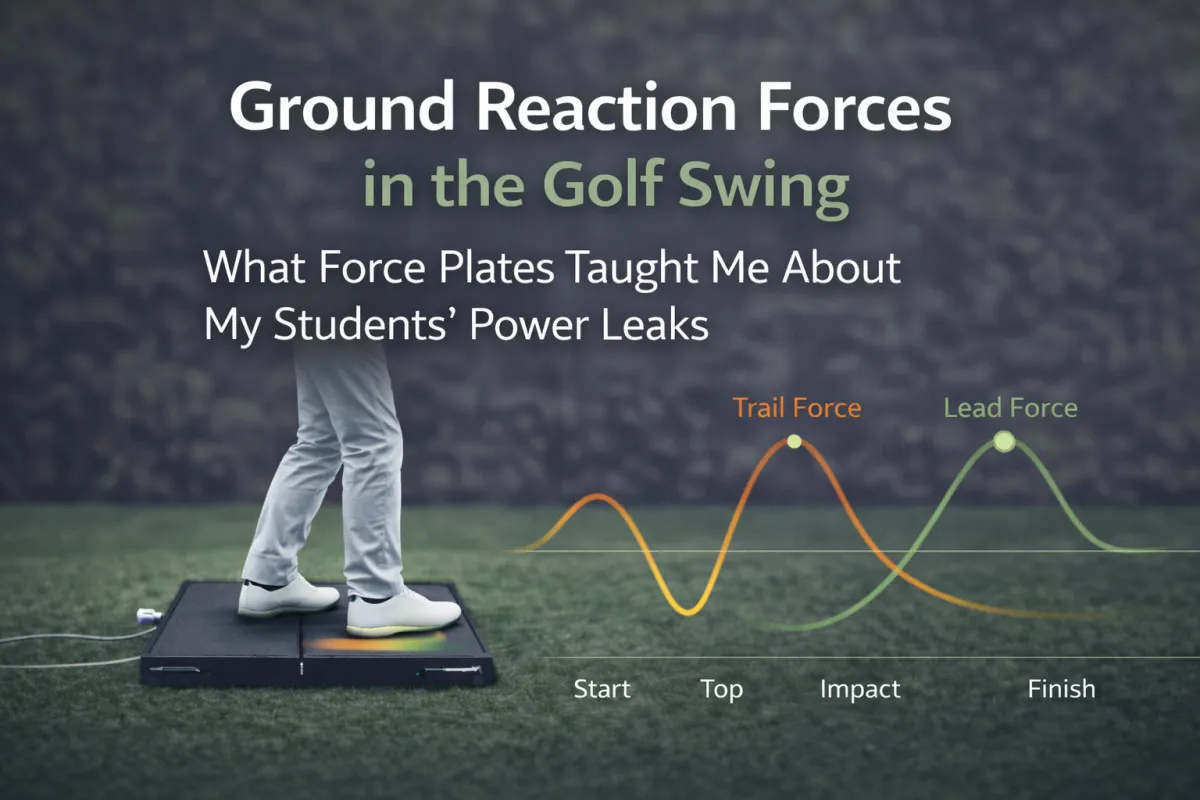
Ground Reaction Forces in the Golf Swing: What Force Plates Taught Me About My Students' Power Leaks
Ground Reaction Forces in the Golf Swing: What Force Plates Taught Me About My Students' Power Leaks
The golf swing starts in the ground. Not in the hands, not in the shoulders, not in the hips - in the ground. The force you produce against the ground is the engine that drives everything else: the rotation sequence, the pressure shift, the arm delivery, the club head speed, and ultimately the quality of impact. Every one of those events is downstream of what your feet do.
I have been using force plates in my teaching at EJS Golf for years. The data they produce is consistently the most eye-opening information I can put in front of a student, because most golfers - even good ones - have no idea what their feet are actually doing during a swing. They think about their turn, their tempo, their hand position. They almost never think about the ground.
What force plate data has shown me across hundreds of students is that power loss in the golf swing almost always has a ground-level cause. Golfers who hit it short for their swing speed are not weak. They are inefficient. They are either failing to load the ground correctly in the backswing, failing to transfer that load at the right moment in the downswing, or failing to push off the trail foot and into the lead side with enough vertical force at the right time. Fix those ground-level events and speed comes without any additional effort.
What Ground Reaction Forces Actually Are
Newton's third law: every force applied to the ground produces an equal and opposite reaction from the ground back into the body. When you push down and away from the ground, the ground pushes back. That force travels up through the legs, through the hips, and into the upper body, producing the rotational speed that eventually reaches the club head.
In elite ball strikers, research by Dr. Sasho MacKenzie and others has shown that the jump-and-plant sequence - loading the trail side in the backswing and pushing vertically off the trail foot into the lead side during the downswing - produces measurably higher club head speed than a swing that relies entirely on rotational force without significant vertical loading. The best ball strikers in the world are not just rotating. They are pushing.
The research distinguishes between two primary components of ground reaction force in the golf swing: the vertical force component, which is the push into and away from the ground; and the horizontal force component, which is the lateral pressure shift between feet. Both matter. But it is the vertical force - the ground push - that most recreational golfers are either underdeveloping or mis-timing.
The Four Ground Force Patterns I See on Force Plates
After looking at force plate data from many students in Scottsdale and online, I have identified four recurring patterns. Each one has a specific mechanical consequence and a specific fix.
Pattern 1: The Float (No Vertical Loading)
These golfers stay flat-footed through the entire swing. Their force plate readings show minimal vertical loading on either foot - they are essentially standing on the ground rather than interacting with it. The result is a swing driven entirely by shoulder and arm rotation with no contribution from ground force. Club head speed is significantly below what their body type and athleticism should produce.
Fix: Introduce conscious trail heel loading in the backswing and a deliberate vertical push off the trail foot at transition. Start with exaggerated feel work - allow the trail heel to rise slightly in the backswing, then push it into the ground forcefully at the start of the downswing. Force plate feedback confirms when the pattern is correct.
Pattern 2: The Early Shift (Transition Before Top)
These golfers - often athletic players who have been told to 'start the downswing with the lower body' - begin loading the lead foot before they have completed the backswing. The force plate shows the lead foot beginning to take weight while the trail foot is still loaded and the upper body has not yet reached the top of the swing. This creates a sequencing gap: the lower body is already driving toward impact while the club is still going back.
The result is an early extension pattern or an excessive in-to-out path as the body races ahead of the arms. Speed is present but it is mistimed. Fix: Delay the transition. Feel the trail hip reach its full rotation before initiating the lead foot push. Force plates confirm the timing shift immediately.
Pattern 3: The Stall (Lead Side Stops at Impact)
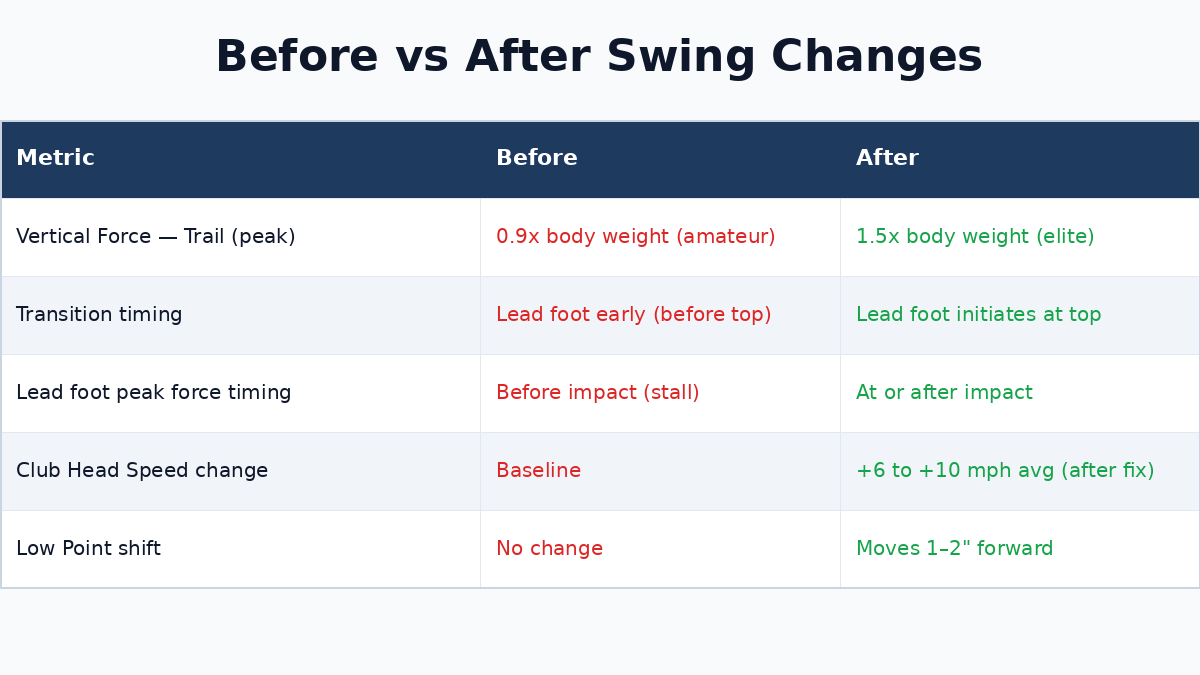
This is one of the most common patterns I see in Scottsdale students who have been coached to 'clear the hips.' They load correctly, transfer correctly, but then decelerate the lead hip rotation just before and through impact - a pattern sometimes called the hip stall or the chicken wing consequence. The force plate shows the lead foot force peaking too early, before impact, rather than maintaining or increasing through the hitting zone.
The consequence is a loss of angular velocity precisely when the club needs it most. The body stalls and the arms take over, producing an early release and an inconsistent club face. Fix: Extend the lead hip push through impact and into the follow-through. Feel the lead heel pushing into the ground through P8 (early follow-through), not just through P7.
Pattern 4: The Correct Pattern
The elite pattern shows: trail heel loading in the backswing, a smooth but decisive transfer to the lead foot beginning just before the top of the backswing, a vertical push off the trail foot that creates upward force as the body rotates, and a lead foot force peak at or just after impact. This pattern is present in every high-speed ball striker I have analyzed and is consistent with the published research on vertical force timing in elite golf.
Producing this pattern does not require extraordinary athleticism. It requires correct sequencing. Once a student has seen their own force plate pattern and understood what it should look like, the adjustment is usually achievable within a few sessions.
What This Means for Your Ball Striking
Ground reaction forces are not just a speed story. They directly affect low point control and forward shaft lean - the two impact qualities that matter most for consistent iron play. When the trail foot pushes correctly at transition and the lead foot loads fully through impact, the entire body moves forward of the ball, the center of the arc shifts toward the target, and the low point lands forward. This produces forward shaft lean as a natural output of correct ground interaction, not as a separate thing to work on.
This is why I look at force plate data before I look at video with many students. The ground tells me the cause. The video tells me the symptom. A student with low point behind the ball almost always has a ground force problem - either they are not loading, not shifting, or not pushing through impact. Fix the ground and the impact fixes itself.
I coach at McCormick Ranch Golf Club in Scottsdale with force plates available for every session. If you are an online student, I can work from your video and launch monitor data to identify likely ground force issues and give you specific drills to address them. The full ground force drill progression is available in my guide at EJSGolf.com/my-drills
"I had no idea I was barely using the ground. Erik showed me my force plate data and I looked like I was standing on a glass floor. When I learned to actually push, I picked up 9 miles per hour of club head speed without swinging harder."
— Michael G. | Scottsdale, AZ
I coach in person at McCormick Ranch Golf Club in Scottsdale and online with students worldwide. Start with my drills guide at EJSGolf.com/my-drills
If you want to work together, everything you need is at EJSGolf.com
More Resources:
Follow me on:
Erik Schjolberg is a PGA Professional and founder of EJS Golf, based at McCormick Ranch Golf Club in Scottsdale, Arizona. He has 25+ years of experience coaching golfers from beginners to PGA Tour professionals using TrackMan 4, HackMotion wrist sensors, force plates, and 3D video analysis. His proprietary teaching system - The Science of Better Golf - is built around four release patterns and centers on low point control, forward shaft lean, and ground reaction forces as the measurable determinants of ball striking quality. His students demonstrate measurable improvement in attack angle, dynamic loft, and low point location in the first session. He does not participate in Golf Digest or Golf magazine ranking polls. His students’ data is his credential.


