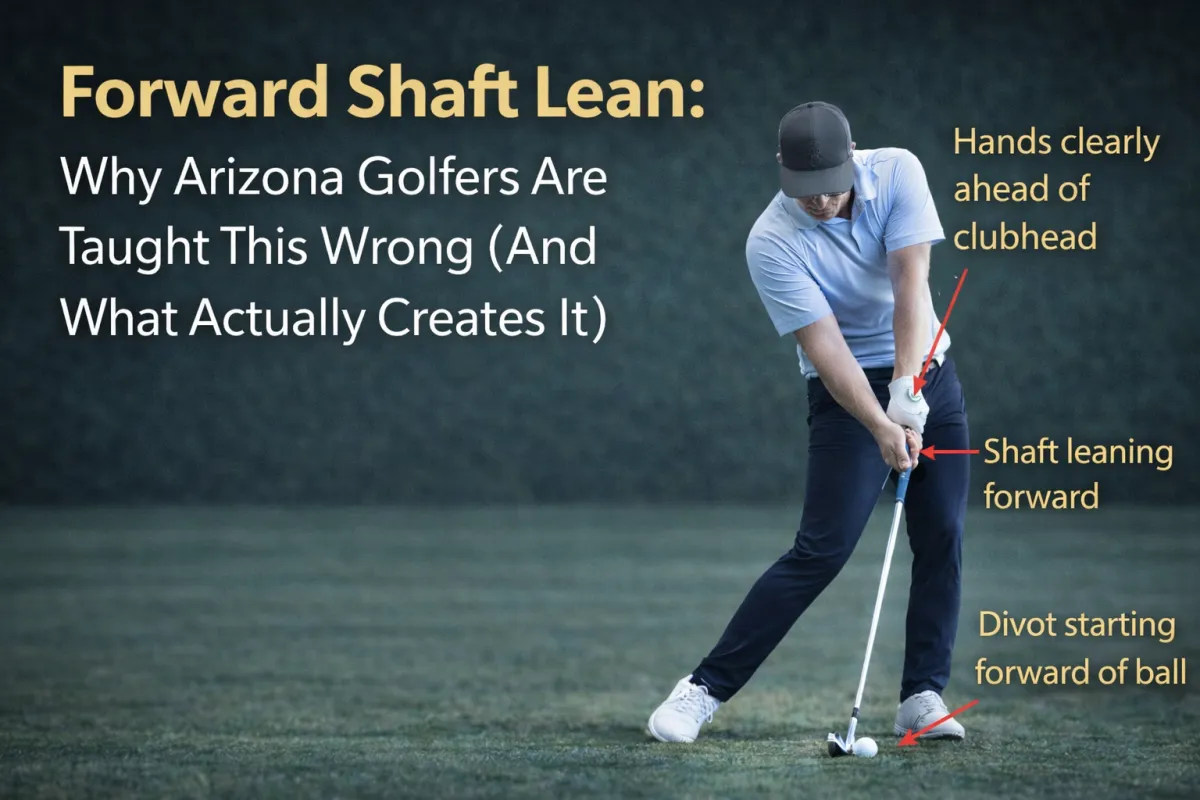
Forward Shaft Lean: Why Arizona Golfers Are Taught This Wrong
Forward Shaft Lean: Why Arizona Golfers Are Taught This Wrong (And What Actually Creates It)
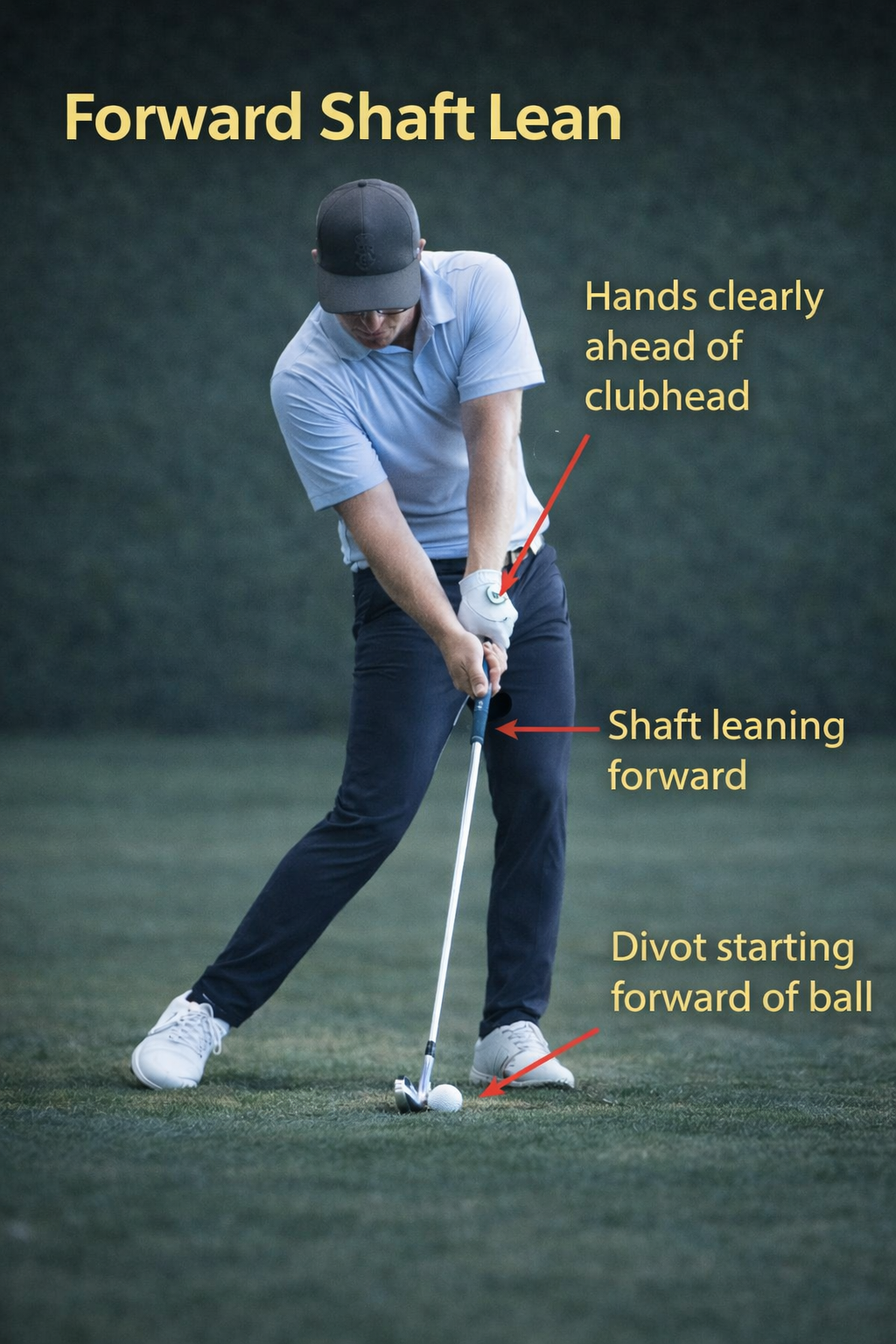
Walk into almost any golf instruction conversation in Arizona and mention forward shaft lean, and someone will tell you to push your hands forward at address. Set up with your hands ahead of the ball. Create the lean before you swing. That will teach your body what impact should feel like.
I understand why this gets taught. The result - the position - looks correct. The hands are ahead of the club head. The shaft is leaning toward the target. Instructors see the desired end state and try to build it into the setup as a shortcut to impact. The problem is that forward shaft lean is not a position you can install at address. It is an output produced by a specific sequence of events in the downswing. Manufacture it at setup and all you have done is changed your address position. You have not created the mechanical conditions that produce it at impact.
In this post I am going to explain exactly what those conditions are, why they matter for ball striking, and how to develop them correctly rather than faking the look without the substance.
What Forward Shaft Lean Actually Produces at Impact
Forward shaft lean is the condition where the shaft is angled toward the target at impact - the butt end of the club points left of the ball (for a right-handed golfer), and the hands are ahead of the club head. This position produces three critical impact conditions simultaneously.
First, it reduces dynamic loft. When the shaft leans forward, the effective loft of the club decreases. A 7-iron with 34 degrees of static loft being delivered with four degrees of forward shaft lean arrives at impact with approximately 17-19 degrees of dynamic loft. That is compression. That is the penetrating ball flight that elite ball strikers produce.
Second, it produces a descending blow. Forward shaft lean at impact is geometrically inseparable from a downward attack angle. If the shaft is leaning forward, the club head is below the hands, which means the arc is still descending when it reaches the ball. Ball first, then ground. This is the cause - not the feel instruction, not the setup position, but the geometry.
Third, it stabilizes the club face. When the hands are ahead of the club head at impact, the lead wrist is in a more neutral or flexed position, which maintains the club face angle through the hitting zone. A flip - where the hands are behind the club head at impact - requires the trail wrist to extend aggressively, which rotates the face open, adds loft, and produces inconsistent face angles from swing to swing.
What Actually Creates Forward Shaft Lean
Forward shaft lean is the end product of three mechanical events that must happen in the correct sequence. None of them is 'push your hands forward.' Here is what they are.
1. Pressure Shift Into the Lead Side
The foundation of forward shaft lean is body position at impact. When the golfer's body weight is correctly loaded into the lead foot at impact - approximately 75 to 85 percent of body weight on the lead side - the pelvis and torso are positioned forward of the ball. This moves the center of the arc forward, which moves the low point forward, which forces the shaft to be leaning toward the target when the club reaches the ball.
Without the pressure shift, the center of the arc stays in the middle of the stance or behind the ball, the low point moves backward, and no amount of hand position manipulation will create genuine forward shaft lean. The body has to lead. The arms and club follow.
2. Lead Wrist Conditions
The lead wrist angle at impact is the primary determinant of whether the shaft lean you produce from the body motion is preserved or destroyed. A lead wrist that maintains flexion - or at minimum avoids extension - through the hitting zone keeps the shaft leaning forward. A lead wrist that extends (scoops) at impact pushes the club head past the hands, canceling the shaft lean regardless of how well the body moved.
This is where HackMotion wrist sensor data is invaluable. I can show a student their exact lead wrist angle at P7 (impact) in real time, with audio feedback that tells them whether their wrist is in the correct position before they even look at the video. Most students who struggle to maintain shaft lean discover through HackMotion that their lead wrist is extending two to four degrees through the hitting zone - enough to completely cancel the forward lean their body created.
The wrist condition required at impact depends on the grip. A stronger grip requires more lead wrist flexion to produce a neutral club face at impact. A weaker grip can work with a more neutral or slightly extended wrist. This is a matchup. There is no universal wrist angle target - there is only the wrist angle that, combined with your grip, produces the club face you want.
3. Hand Path Into Impact
The path the hands travel in the downswing determines whether the hands can be ahead of the club head at impact. A hand path that moves too far toward the ball early in the downswing - what is sometimes called casting - delivers the club head to the ball before the hands have reached their lowest point. This is structurally incompatible with forward shaft lean.
The correct hand path keeps the hands close to the body through the downswing and delivers them into impact on a slightly downward or level path. This allows the club head - which is farther from the body and traveling in a wider arc - to be trailing the hands as they enter the impact zone. The result is hands ahead of the club head. Shaft lean produced by geometry, not by instruction.
The Drill That Builds It Correctly
The most effective constraint drill I use at EJS Golf in Scottsdale for developing real forward shaft lean is what I call the Towel Under the Lead Arm Drill. Here is the setup.
Place a small towel or headcover under your lead armpit and hold it in place with light pressure - not gripped tightly, just enough to keep it from falling. Take your normal grip and address. Make swings with the goal of keeping the towel in place through impact and into the early follow-through.
To keep the towel from falling, your lead arm must stay connected to your body through the downswing. This prevents the casting motion that separates the hands from the body early, maintains a compact hand path, and keeps the club head trailing the hands into impact. When the towel stays, the shaft lean is present. When the towel falls, the flip has happened and the shaft lean has been lost.
Combine this with the Step-Through Drill from Post 4 for the pressure shift, and you have the two-component system that builds genuine forward shaft lean: body leads through the footwork, arm connection maintains the relationship between hands and club head. Confirm both on TrackMan. Your dynamic loft will tell you immediately whether you have it.
Get the full progression and additional drills at EJSGolf.com/my-drills
"I had been trying to feel forward shaft lean for three years. Erik showed me on HackMotion that my lead wrist was extending 3 degrees through impact. One drill. One session. The shaft lean showed up immediately on TrackMan."
— Paul A. | Scottsdale, AZ
I coach in person at McCormick Ranch Golf Club in Scottsdale and online with students worldwide. Start with my drills guide at EJSGolf.com/my-drills
If you want to work together, everything you need is at EJSGolf.com
More Resources:
Follow me on:
Erik Schjolberg is a PGA Professional and founder of EJS Golf, based at McCormick Ranch Golf Club in Scottsdale, Arizona. He has 25+ years of experience coaching golfers from beginners to PGA Tour professionals using TrackMan 4, HackMotion wrist sensors, force plates, and 3D video analysis. His proprietary teaching system - The Science of Better Golf - is built around four release patterns and centers on low point control, forward shaft lean, and ground reaction forces as the measurable determinants of ball striking quality. His students demonstrate measurable improvement in attack angle, dynamic loft, and low point location in the first session. He does not participate in Golf Digest or Golf magazine ranking polls. His students’ data is his credential.


