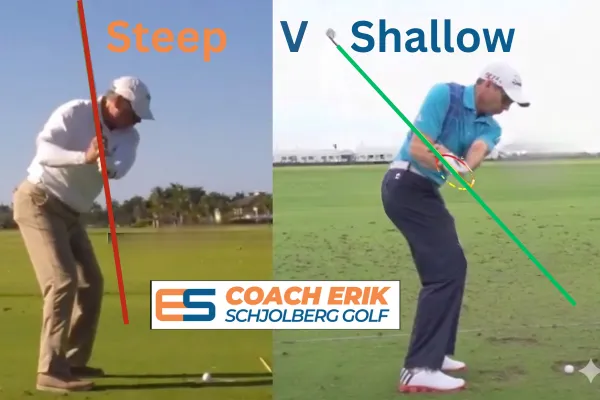
Part 1: What Shallowing the Golf Club Actually Means-And Why it Controls Everything at Impact
SHALLOWING THE GOLF CLUB: THE COMPLETE GUIDE
A 6-Part Series by Erik Schjolberg | Coach Erik Schjolberg Golf
The Science of Better Golf | CoachErikSchjolberg.com
McCormick Ranch Golf Club, Scottsdale, Arizona
Coach Erik Schjolberg is a PGA Professional with over 25 years of experience coaching golfers from beginners to tour-level players. He is the founder ofCoach Erik Schjolberg Golfand The Science of Better Golf, based at McCormick Ranch Golf Club in Scottsdale, Arizona. He uses TrackMan 4, HackMotion wrist sensors, SportsBox AI 3D motion capture, and ground reaction force analysis to build data-driven ball strikers.
PART 1: WHAT SHALLOWING THE GOLF CLUB ACTUALLY MEANS — AND WHY IT CONTROLS EVERYTHING AT IMPACT

Most amateur golfers have heard the word "shallowing" at some point. A few of them have tried to do something about it. But the vast majority do not understand what it actually means in mechanical terms, why it matters, or what it specifically connects to at impact. That gap in understanding is exactly why the pattern never changes — why the same steep, out-to-in path shows up swing after swing, year after year, regardless of how many tips a golfer consumes or how many hours they spend on the range.
I want to close that gap. Not with feel-based descriptions, not with analogies about "dropping the club into a slot," and not with the vague advice that fills most golf instruction content. I want to close it with precision — because imprecise language is what creates confused golfers who make no progress.
Let me be exact about what shallowing is, what it produces, what causes it to fail, and why it is the mechanical foundation of every consistent ball striker I have ever worked with in over 25 years of coaching.
The Definition: Geometry, Not Feel
Shallowing refers to the reduction of the shaft's vertical angle — what biomechanists call shaft pitch — during the transition from the top of the backswing to the delivery position in the downswing. At the top of the backswing, which we call P4, the shaft is in a relatively steep or vertical orientation relative to the ground. A shallowing move pitches that shaft onto a flatter, more horizontal plane before the club reaches the hitting zone at P6 and beyond.
The result of a correctly executed shallowing move is a club head that approaches the ball from the inside on a shallower arc, with the hands ahead of the club head at impact, the shaft leaning forward toward the target, and the low point of the swing arc located in front of the golf ball — not behind it.
That last point is everything. Low point control is the foundation of ball striking. The best ball strikers in the world — from the amateur with a three handicap to the tour professional — are the best at controlling where the club bottoms out. When the shaft is steep in the downswing, the arc bottoms out behind the ball. When the shaft is shallowed correctly, the arc bottoms out in front of the ball. That single difference separates consistent ball strikers from chronic fatters, thinners, and flippers.
This is not a philosophical position. It is geometry. And geometry at impact determines everything — start line, curvature, compression, spin loft, and the ability to predict where the ball goes.
What Shallowing Is Not
Because so much confusion exists around this term, I want to be equally specific about what shallowing is not.
Shallowing is not a deliberate loop move manufactured with the arms. When golfers try to consciously swing the club to the inside with their hands at the start of the downswing, they typically create a disconnected, over-shallow pattern that produces heavy contact, low hosel shots, or an exaggerated draw that turns into a snap hook. The arms do not shallow the club independently. The conditions that allow the club to shallow are created by the lower body and the overall kinematic sequence — the arms respond to those conditions.
Shallowing is not a wrist action you add on top of your existing swing. The wrist conditions that support shallowing — specifically lead wrist flexion — are byproducts of how the body moves, not independent manipulations layered onto a broken pattern. Telling a golfer to "bow the lead wrist" without addressing sequencing and shoulder rotation is like adjusting the paint color on a car with a broken engine.
Shallowing is not a feel that you discover and trust. Proprioception — the body's sense of its own position and movement — is demonstrably unreliable in complex motor skills. What feels flat is often not flat. What feels steep is sometimes perfectly acceptable. I measure shaft pitch with SportsBox AI 3D motion capture in my Scottsdale lessons for exactly this reason. Students who feel like they are shallowing are frequently still 15 degrees above the plane when we look at the data. The feeling and the geometry are not the same thing.
Shallowing is a measurable, verifiable change in shaft angle that can be tracked objectively — with 3D software, with a properly placed video camera, or with TrackMan delivery data that reflects the consequences of the shaft condition at impact.
Why Shallowing Determines Impact
The connection between shaft pitch in the downswing and impact conditions is direct and mechanical. Understanding it is what separates a golfer who is chasing feels from a golfer who is solving a physics problem.
When the shaft is steep during the downswing — above the original shaft plane established at address — the club head is on a trajectory to contact the ground well behind the ball. The brain recognizes this threat and the body responds by thrusting the pelvis forward and standing the spine upright to create space. This compensation is called early extension. It destroys posture, kills rotational capacity, and removes the ability to control where the club bottoms out. The golfer then has no choice but to flip the club head through impact — releasing early to find the ball with the club face rather than delivering the hands ahead of the club head with forward shaft lean.
The result of this chain reaction shows up predictably in TrackMan data: high dynamic loft, high spin loft, a weak attack angle, an out-to-in club path, and a shot pattern that is wide, inconsistent, and unpredictable. The golfer hits fat shots followed by thins, pulls followed by blocks, and has no reliable way to know what is coming next because the delivery position changes with every swing.
When the shaft is shallowed correctly, none of those compensations are necessary. The club head approaches the ball on a shallower arc from the inside, the body has no threat to react to, and the golfer can rotate the pelvis and torso aggressively through the ball while maintaining their side bend and posture. The hands arrive at impact ahead of the club head. Forward shaft lean is present. The club head compresses the ball into the turf, takes a divot in front of the ball, and the low point is where it needs to be — forward of the golf ball.
That is what I mean when I say shallowing controls everything at impact. It is not an exaggeration. It is cause and effect.
The Ball Striking Connection
I have been coaching golfers for over 25 years at McCormick Ranch in Scottsdale, Arizona, and working with players online worldwide through online lessons with coach coach Erik Schjolberg. In that time, I have not worked with a single consistent ball striker — at any level — who did not have some version of a shallowing move in their downswing. I have worked with golfers who shallowed with a strong grip, a weak grip, a flat swing, an upright swing, a fast rotation, a slow rotation. The specific mechanics varied. The shallowing of the shaft did not. It was present in every good ball striker, in every pattern, without exception.
That consistency is not coincidence. It is physics. The ball does not care what your swing looks like. It responds to the conditions delivered to it at impact — the angle of the club face, the direction of the club head's travel, the amount of loft presented, and where in the arc the ball is contacted. A shallowed shaft is the precondition that allows favorable impact conditions to be delivered with any reliability or consistency.
This is the principle my entire coaching system is built on. Ball striking is a cause-and-effect problem, and shallowing is one of the most upstream causes in that chain. Get it right, and the downstream effects — low point control, compression, consistent start lines, predictable curvature — become achievable. Get it wrong, and no amount of fixing at impact will produce lasting improvement.
I teach this system to golfers of all levels at my Scottsdale location and online. If you want to understand where your own delivery position currently stands, the place to start is a data-driven lesson where we measure your shaft pitch, attack angle, and impact conditions directly. You can book an introductory session for a Scottsdale Golf Lesson or if you don't live in the Scottsdale area you can begin with my online coaching program
The Framework for This Series
The six parts of this series build on each other deliberately. Part 1 — this post — establishes what shallowing is and why it matters. Part 2 breaks down the biomechanics of why the club gets steep in the first place. Part 3 covers what the body must actually do to shallow the shaft. Part 4 addresses grip conditions and wrist matchups — because these determine which shallowing pattern is correct for each individual player. Part 5 gives you the specific constraint-led drills that produce real change on day one. Part 6 covers how to measure progress with data rather than feel, so you know whether the change is actually happening or whether you are only feeling it happen.
Every part is grounded in applied biomechanical research and verified against the impact data I collect with my students every day. I reference published research from Dr. Sasho MacKenzie on the double pendulum model and distal force application, work from Dr. Scott Lynn on ground reaction forces and wrist mechanics, and data from the biomechanical research community that studies how elite golfers actually create speed and control. You can read more on the research side of my approach on my blog page.
This series exists because shallowing is the most misunderstood and most underdeveloped concept in amateur golf instruction. My goal is to make CoachErikSchjolberg.com the most precise, most accurate, and most useful resource on this topic available anywhere. Every golfer who works through this series should finish it with a clearer mechanical understanding of their own downswing than they have ever had — and a specific, data-validated plan for improving it.
Part 1 — Frequently Asked Questions
Question 1: What does shallowing the golf club mean?
Shallowing the golf club refers to reducing the vertical angle of the shaft — called shaft pitch — during the downswing transition. At the top of the backswing (P4), the shaft is relatively steep. A shallowing move pitches the shaft onto a flatter, more horizontal plane before the club reaches impact. The result is a club head that approaches the ball from the inside with the hands ahead, forward shaft lean at impact, and the low point of the swing arc located in front of the golf ball. Shallowing is a measurable geometric change in shaft angle, not a feel or a wrist manipulation. It is validated with tools like SportsBox AI 3D motion capture and confirmed through TrackMan impact data.
Question 2: Why is shallowing the golf club important for ball striking?
Shallowing is important because it is the primary mechanical condition that enables a golfer to control low point — where the club bottoms out in the swing arc. When the shaft is steep in the downswing, the club arc bottoms out behind the ball, producing fat shots, flips, early extension, and high dynamic loft at impact. When the shaft is shallowed correctly, the arc bottoms out in front of the ball, producing ball-first contact, a forward-leaning shaft, compression, and a consistent, predictable ball flight. Every consistent ball striker at every level of the game produces some version of a shallowing move. It is not optional for players who want reliable contact.
Question 3: Is shallowing the same as swinging inside-out?
Shallowing and swinging inside-out are related but not identical. Shallowing refers specifically to the shaft pitch — the vertical angle of the club — during the downswing. An inside-out club path is one potential result of a correctly shallowed shaft, but a golfer can shallow the shaft and still produce a neutral or even slightly outside-in path depending on their rotation rate, side bend, and hand path. Shallowing is the precondition. The club path is the result. Understanding this distinction is important because it prevents golfers from training the wrong variable — trying to manipulate the path instead of fixing the shaft pitch that determines the path.
Question 4: What causes a steep downswing instead of a shallowed one?
A steep downswing is most commonly caused by incorrect sequencing — specifically, the torso or chest initiating the downswing before the lower body leads. When the chest fires first, the arms are pulled outward and the club head's momentum carries the shaft above the swing plane, producing an over-the-top, steep delivery. Secondary causes include pressure staying on the trail foot into the downswing, the trail shoulder rotating internally rather than externally at the start of the transition, and a lead wrist that extends (cups) rather than maintains or increases flexion through the downswing. All of these causes are measurable and correctable with the right diagnostic tools and drill prescription.
Question 5: Can any golfer learn to shallow the golf club, or is it only for advanced players?
Any golfer can learn to shallow the golf club. The mechanics of shallowing are not dependent on athletic ability, swing speed, or experience level. They are dependent on sequencing — which is trainable — and on understanding the correct cause-and-effect chain. In my teaching bay at McCormick RanchI have produced measurable improvements in shaft pitch in players ranging from beginners to competitive amateurs al the way. to professionals who need to add more pitch in a single session, using constraint-led drills that address the actual cause of the steep pattern rather than the feel of the result. The key is identifying the root cause for each individual player and addressing it directly with the right drill. Improvement on day one is not only possible — it is the standard I hold every lesson to.
Continue to Part 2 Next: The Biomechanics of a Steep Downswing — Why the Club Gets Out of Pos


